

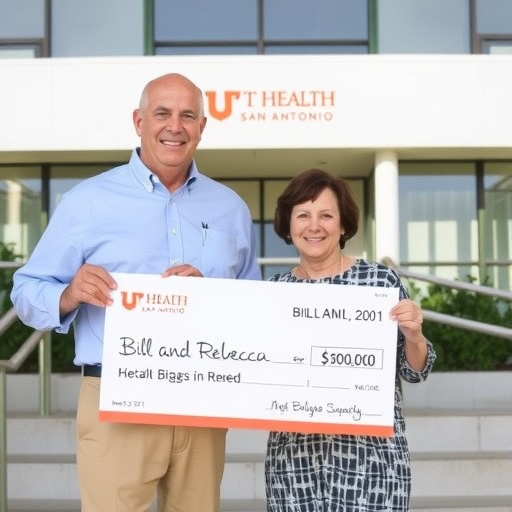
In a significant development in the fight against Alzheimer’s disease and related neurodegenerative disorders, UT Health San Antonio has received a generous $5 million donation from Bill and Rebecca Reed, longtime supporters and advocates for innovative medical research. This substantial contribution is aimed at accelerating the work of the Glenn Biggs Institute for Alzheimer’s and Neurodegenerative Diseases, a cornerstone of the institution’s commitment to combating dementia—a condition that poses a growing public health challenge, especially in South Texas.
The donation will establish the Bill and Rebecca Reed Fund for Precision Therapies and Supportive Care, designed to enhance research and patient care initiatives that reflect the latest advancements in precision medicine. The fund underscores personalized therapeutic approaches, recognizing that Alzheimer’s disease manifests heterogeneously across individuals due to complex interactions of genetics, lifestyle, and environmental factors. By targeting these nuances, the fund aims to foster treatments tailored to specific patient subtypes, which may improve efficacy and quality of life.
Historically, the Reeds have been influential contributors to UT Health San Antonio, serving as volunteer leaders since 2013 and championing efforts that propel advancements in the understanding of neurodegenerative diseases. Their philanthropic vision is rooted in the urgent need to mitigate the impact of dementia, a progressive syndrome characterized by cognitive decline and loss of functional independence that affects millions worldwide. Bill Reed eloquently emphasized the importance of focusing resources on precise, innovative interventions that hold promise for affected families.
This latest endowment coincides with the renaming of the Biggs Institute’s precision therapy center to the Bill and Rebecca Reed Center for Precision Therapies and Supportive Care. The center itself acts as a nexus where clinical care, research, and community support converge, embodying a multidisciplinary approach essential for addressing the multifaceted challenges presented by Alzheimer’s disease. The foundational gift by the Reeds in 2019 had catalyzed the establishment of this facility, which subsequently contributed to securing designation as a National Institute on Aging Alzheimer’s Disease Research Center.
Precision therapy in the context of neurodegenerative diseases emphasizes the heterogeneity of disease mechanisms and progression pathways. According to Dr. Sudha Seshadri, professor and behavioral neurologist and founding director of the Biggs Institute, individualized treatment strategies consider distinct genetic profiles and life histories that influence disease onset and symptomatology. This precision-based framework facilitates the design of personalized intervention regimens that could delay progression or ameliorate symptoms more effectively than generalized treatment models.
The timing of the Reeds’ contribution is particularly strategic, aligning with the inauguration of the Center for Brain Health at UT Health San Antonio—a state-of-the-art facility spanning over 100,000 square feet. This center not only houses the Biggs Institute but also consolidates comprehensive clinical programs with cutting-edge research laboratories and support systems for caregivers, promoting an integrated care model that addresses the needs of patients, families, and healthcare providers.
Beyond financial support, the Reeds’ gift is a strong endorsement of the institute’s groundbreaking work, which includes a robust research portfolio of more than 55 active clinical trials and over 265 observational studies. These trials explore novel pharmacological treatments, aging-related mechanisms, and interventions for conditions currently lacking approved therapies. Observational studies leverage emerging technologies such as wearable sensors and in-home monitoring devices for early fall detection and ongoing symptom tracking, representing a leap forward in patient-centric research methodologies.
The Biggs Institute also plays a pivotal role in education and workforce development, training future clinicians and researchers through 40 neurology residency positions and eight fellowship programs. This educational commitment ensures the continuous evolution of comprehensive neurological expertise necessary to address the complexity and scale of neurodegenerative diseases. Furthermore, its Brain Bank, which includes over 1,000 donated brains from diverse populations, remains an invaluable resource for post-mortem research, enabling scientists to study pathological changes that underpin dementia.
Addressing dementia in South Texas is particularly crucial given the region’s demographic and socioeconomic characteristics which disproportionately affect vulnerable populations. UT Health San Antonio’s position as the academic health center for The University of Texas at San Antonio empowers it to integrate clinical innovation with community outreach and public health initiatives. This multifaceted strategy can significantly transform outcomes for patients while fostering academic excellence.
Bill and Rebecca Reed’s philanthropy is also inspired by the legacy of Glenn Biggs, a San Antonio businessman and philanthropist who suffered from Alzheimer’s disease, and his wife Ann. Their namesake institute carries forth this personal connection by not only advancing biomedical research but also emphasizing compassionate care—a holistic perspective that reflects the institute’s vision and mission.
UT Health San Antonio’s broad network of healthcare professionals and support programs, including partnerships with the School of Nursing to deliver caregiver support, complements the institute’s research and clinical endeavors. Together, these programs embody a continuum of care and discovery aimed at “making lives better” and setting a standard for other institutions confronting the daunting challenges posed by neurodegenerative diseases.
As dementia continues to impose a heavy societal and economic toll worldwide, initiatives such as the Bill and Rebecca Reed Fund for Precision Therapies and Supportive Care represent beacon projects that fuse philanthropy, science, and patient-centric care. This gift exemplifies how targeted investments in specialized research centers can expedite the translation of scientific discoveries into tangible benefits, improving prognosis and support for those afflicted and their families.
Subject of Research: Alzheimer’s disease and neurodegenerative disorders prevention and treatment through precision medicine and supportive care.
Article Title: Bill and Rebecca Reed’s $5 Million Gift Propels Precision Medicine at Glenn Biggs Institute for Alzheimer’s and Neurodegenerative Diseases
News Publication Date: February 12, 2026
Web References:
– UT Health San Antonio: https://uthscsa.edu/
– Glenn Biggs Institute for Alzheimer’s and Neurodegenerative Diseases: https://biggsinstitute.org/
– UT Health San Antonio Center for Brain Health: https://news.uthscsa.edu/ut-health-san-antonio-center-for-brain-health-celebrates-a-new-era-of-hope-healing-and-discovery-with-ribbon-cutting-2/
– Caring for the Caregiver Program: https://utcaregivers.org/
Keywords: Alzheimer’s disease, Dementia, Neurodegenerative diseases, Precision therapies, Clinical trials, Neurology education, Brain health, Philanthropy, Caregiver support, South Texas healthcare, Neurodegeneration research, Personalized medicine


