

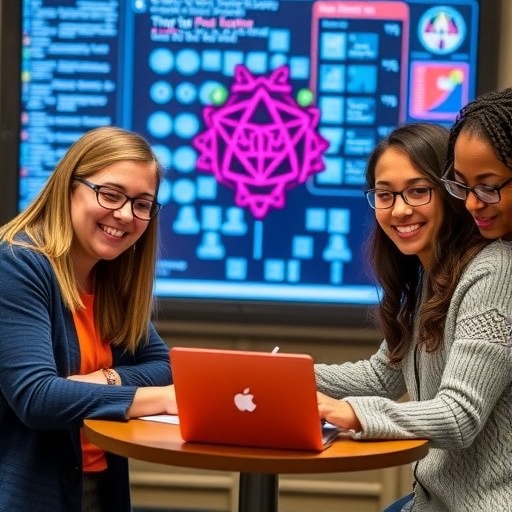
The National Science Foundation (NSF) has bestowed a prestigious six-year grant approaching $2 million to The University of Texas at Arlington (UTA), aimed at bolstering the next generation of mathematics professionals by providing scholarships to meritorious undergraduate students in the mathematical sciences. This initiative underscores the national imperative to nurture a robust Science, Technology, Engineering, and Mathematics (STEM) workforce, which is crucial for sustaining economic competitiveness and innovation leadership across vital industrial sectors.
Since its inception in 2008, UTA’s Math S-STEM program has been purpose-built to bridge the gap between academic potential and professional achievement. It offers scholarships that significantly alleviate financial barriers for students pursuing degrees in mathematics. To date, this program has seen remarkable success, with 155 former scholarship recipients having completed their bachelor’s degrees in mathematics, demonstrating the efficacy of targeted financial support combined with academic mentorship.
The new NSF grant will enable UTA to sustain these scholarships, providing up to $15,000 annually per student for those who meet stringent qualifications. This financial aid is complemented by a comprehensive mentorship framework, where faculty members engage in regular one-on-one sessions with scholars. This mentorship not only fosters academic excellence but also provides critical career guidance, helping students navigate pathways toward graduate education or immediate entry into the workforce.
UTA’s Department of Mathematics has garnered national acclaim for its ability to consistently produce graduates equipped for high-impact careers. Faculty members such as Professors Jianzhong Su, Barbara Shipman, Tuncay Aktosun, Ruth Gornet, and Hristo Kojouharov have been instrumental in crafting an educational environment that emphasizes both theoretical rigor and real-world applicability. Their dedication ensures that students are well-prepared to meet the complex challenges of the modern scientific landscape.
Highlighting the tangible impact of such support, Professor Tuncay Aktosun shared the success story of a recent scholarship recipient who secured a six-figure position at a leading global technology firm immediately after graduation. Such outcomes exemplify the program’s role in propelling math graduates into lucrative and influential careers, reflecting the high demand within the technology sector for professionals with a strong mathematical foundation.
From an economic perspective, the U.S. Bureau of Labor Statistics reported that mathematicians and statisticians commanded a median salary of $104,350 in 2024. Job growth projections for these fields are robust, anticipated at an 8% increase through 2034, a rate significantly above the average across all occupations. Graduates holding mathematics degrees typically earn a median annual income of $86,000, which surpasses the median wage of $70,000 for holders of degrees in other disciplines, underscoring the financial value of mathematical expertise.
Mathematics as a discipline is exceptionally versatile, underpinning a broad spectrum of industries ranging from defense and engineering to actuarial science, banking, and cutting-edge technology. According to Dr. Aktosun, the discipline cultivates essential skills beyond numerical proficiency, such as critical thinking, precise problem-solving, and leadership. Employers across these sectors consistently report a strong preference for candidates possessing a rigorous mathematical background due to the adaptability and analytical capabilities they confer.
The Math S-STEM program’s holistic approach involves more than financial aid; it integrates academic development and professional preparation. Faculty mentors closely engage with scholarship recipients, guiding them in identifying career opportunities, refining graduate school applications, and navigating complex job markets. This approach ensures that students do not merely graduate but transition successfully into rewarding careers or advanced studies that expand their professional horizons.
UTA’s sustained NSF support attests to the university’s commitment to innovation in STEM education and workforce development. By channeling resources into the cultivation of mathematical talent, the program directly addresses national challenges related to STEM shortages, fostering a pipeline of skilled professionals equipped to meet growing demands across sectors. The multipronged strategy reinforces the university’s role as a pivotal contributor to fostering national economic growth and technological advancement.
In an era where data-driven decision-making and complex quantitative modeling have become central to innovation, the mathematical sciences are more critical than ever. UTA’s initiative exemplifies best practices in STEM education by blending financial support with mentorship, ensuring aspiring mathematicians possess the capabilities to excel in both academic and industry environments.
This scholarship program also highlights the broader societal value of investing in STEM disciplines. Mathematics graduates contribute not only to economic output but also enrich scientific inquiry and technological innovation, driving progress in fields as diverse as cybersecurity, artificial intelligence, and financial systems. By supporting these students, UTA and the NSF are shaping a future workforce that underpins these transformative areas.
Lastly, the collaboration between dedicated faculty and motivated students at UTA provides a model for other institutions aiming to amplify the impact of STEM education. By aligning educational opportunities with talent cultivation and career development, the Math S-STEM program embodies a synthesis of scholarship, mentorship, and professional readiness, paving the way for mathematics graduates to become leaders in their fields.
Subject of Research: Undergraduate STEM scholarship programs in mathematical sciences
Article Title: National Science Foundation Awards Nearly $2 Million to University of Texas at Arlington to Empower Mathematics Undergraduates
News Publication Date: 2024
Web References:
https://mediasvc.eurekalert.org/Api/v1/Multimedia/3cb8c87f-e7dc-4a2c-aeb7-d0fbe9520836/Rendition/low-res/Content/Public
Image Credits: UT Arlington
Keywords: Applied mathematics, Pure mathematics, History of mathematics, Mathematical principles, Scientific community, Science careers, Career advice, Science job market, Industry jobs, Government jobs


