

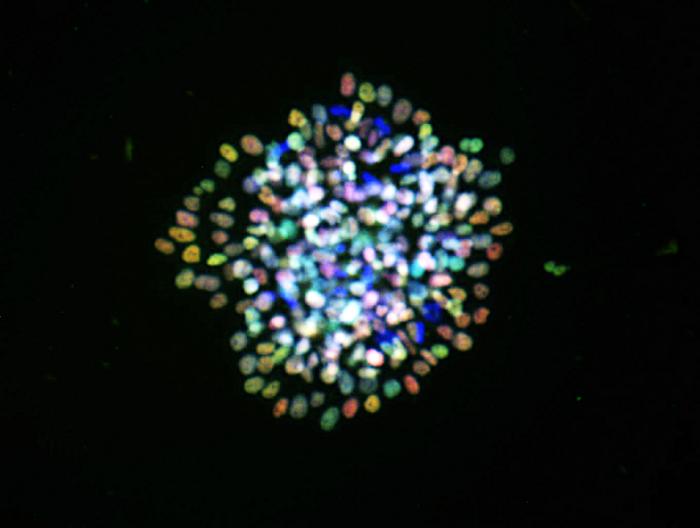
In a new study published in Cell Stem Cell, USC scientists report significant progress in cultivating nephron progenitor cells (NPCs), the cells destined to form the kidney’s filtration system, the nephrons. NPCs hold immense promise for understanding kidney development, modeling diseases, and discovering new treatments.

Credit: Image by Biao Huang/Li Lab
In a new study published in Cell Stem Cell, USC scientists report significant progress in cultivating nephron progenitor cells (NPCs), the cells destined to form the kidney’s filtration system, the nephrons. NPCs hold immense promise for understanding kidney development, modeling diseases, and discovering new treatments.
“By enhancing our capability to grow NPCs from human stem cells, we create a new avenue for understanding and combating congenital kidney diseases and cancer,” said corresponding and lead author Zhongwei Li, an assistant professor of medicine, and stem cell biology and regenerative medicine at the Keck School of Medicine of USC.
In the study, funded in part by the National Institutes of Health, Li Lab postdocs Biao Huang and Zipeng Zeng and their collaborators improved the chemical cocktail for generating and growing NPCs in the laboratory.
This improved cocktail enables the sustained growth of both mouse and human NPCs in a simple 2-dimensional format. This marks a major improvement over the previous 3-dimensional system, which was not only more cumbersome, but also limited the ability to perform genome editing on the cells.
The cocktail also enables the expansion of induced NPCs (iNPCs) from human pluripotent stem cells. These iNPCs closely resemble native human NPCs. With this approach, iNPCs can be generated from any individual starting with a simple blood or skin biopsy. This approach will facilitate the creation of patient-specific kidney disease models and enhance efforts to identify nephron targeted drugs.
Moreover, the cocktail is powerful enough to reprogram a differentiated type of kidney cell known as a podocyte into an NPC-like state.
Demonstrating the practical applications of their breakthrough, the scientists performed genome editing on the NPCs to screen for genes related to kidney development and disease. This screening identified previously implicated genes, as well as novel candidates.
In a further demonstration, the scientists introduced the genetic mutations responsible for polycystic kidney disease (PKD) into the NPCs. These NPCs developed into mini-kidney structures, known as organoids, exhibiting cysts—the hallmark symptom of PKD. The team then used the organoids to screen for drug-like compounds that inhibited cyst formation.
“This breakthrough has potential for advancing kidney research in many critical ways—from accelerating drug discovery to unraveling the genetic underpinnings of kidney development, disease, and cancer,” said Li. “Importantly, it also provides supplies of NPCs as critical building blocks to build synthetic kidneys for kidney replacement therapy.”
Additional co-authors include: Sunghyun Kim, Connor C. Fausto, Kari Koppitch, Hui Li, Xi Chen, Jinjin Guo, Chennan C. Zhang, Tianyi Ma, Pedro Medina, Megan E. Schreiber, Mateo W. Xia, Ariel C. Vonk, Tianyuan Xiang, Tadrushi Patel, Yidan Li, Riana K. Parvez, Jyun Hao Chen, Matthew E. Thornton, Brendan H. Grubbs, Yali Dou, Ksenia Gnedeva, Qi-Long Ying, Nuria M. Pastor-Soler, Kenneth R. Hallows, Nils O. Lindström, and Andy McMahon from USC; Zexu Li and Teng Fei from Northeastern University in Shenyang, China; Balint Der from USC and Semmelweis University in Budapest, Hungary; Zhenqing Liu from City of Hope; and Yarui Diao from the Duke University School of Medicine.
Eighty percent of this work was supported by federal funding from the National Institutes of Health (NIH) (grant numbers DK054364, and T32HD060549) and the NIH Common Fund’s High-Risk High-Reward Research program (grant number DP2DK135739). Additional support came from University Kidney Research Organization (UKRO) foundation funding, a Keck School of Medicine of USC Dean’s Pilot Award, a USC Stem Cell Challenge Grant, a USC Provost’s Undergrad Research Fellowship, a Chan Zuckerberg Initiative seed network grant (CZIF2019-002430), and a CIRM Bridges Award.
McMahon is a scientific advisor or consultant for Novartis, eGENESIS, Trestle Biotherapeutics, GentiBio, and IVIVA Medical. Li, Huang, Zeng, McMahon, Hallows, and Pastor-Soler have applied for intellectual property protection for technologies described in this study.
Journal
Cell Stem Cell
Method of Research
Experimental study
Subject of Research
Cells
Article Publication Date
30-Apr-2024
COI Statement
McMahon is a scientific advisor or consultant for Novartis, eGENESIS, Trestle Biotherapeutics, GentiBio, and IVIVA Medical. Li, Huang, Zeng, McMahon, Hallows, and Pastor-Soler have applied for intellectual property protection for technologies described in this study.

