

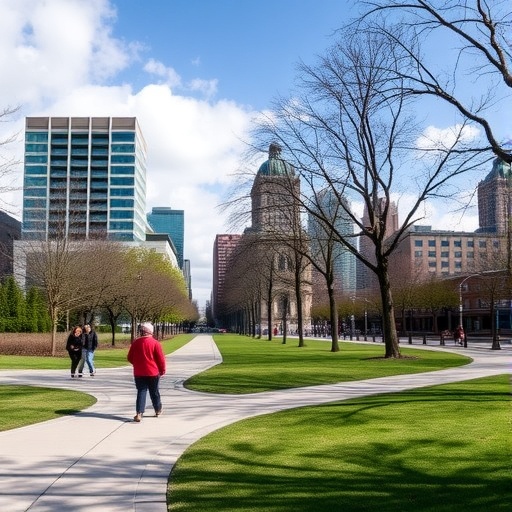
As urbanization accelerates across the globe, cities are becoming the epicenters of human habitation, economic activity, and cultural exchange. Yet beneath this urban dynamism lies a haunting disparity—one that profoundly impacts the health, happiness, and well-being of city residents worldwide. A groundbreaking new study published in npj Urban Sustainability in 2026 reveals that access to urban parks, often touted as a remedy for city stress and a booster of quality of life, is strikingly uneven across different cities and countries. This disparity not only reflects but also amplifies existing inequalities, deepening the divide in well-being experienced by residents.
The research, led by Kuang, W., Hou, Y., Dou, Y., and colleagues, comprehensively maps the availability and distribution of urban green spaces—specifically parks—in cities of varying sizes and economic profiles. Leveraging satellite imagery, municipal data, and surveys from millions of city dwellers, the team developed an unprecedentedly detailed picture of global urban park accessibility. Their findings paint an unsettling picture: residents in lower-income cities and marginalized neighborhoods consistently face significant deficits in park access compared to their wealthier counterparts.
Urban parks offer a medley of ecosystem services—shade, cleaner air, noise reduction, and spaces for physical activity and social interaction. These benefits are critically linked to mental and physical health outcomes, reducing stress and encouraging active lifestyles. However, the researchers found that in many cities, particularly those in the Global South, urban green spaces are sparse and often poorly maintained. This scarcity exacerbates health disparities and limits the potential for social cohesion and community-building activities.
The study introduces a new quantitative index—termed the Urban Park Equity Index (UPEI)—which evaluates not only park area per capita but also factors in the quality, safety, accessibility, and distribution equity of green spaces. Application of UPEI across 300 cities reveals that while some metropolises enjoy lush, evenly distributed parks, many others suffer from “park deserts,” where vast swaths of urban populations have little to no nearby green space. This disparity correlates with socioeconomic variables, indicating systemic governance and planning failures in delivering equitable urban amenities.
One remarkable insight from the study is the role of historical city planning decisions in shaping contemporary park availability. Cities founded or expanded during periods of colonial or industrial prioritization of economic exploitation often exhibit entrenched green space inequities. In these contexts, marginalized communities remain confined to less desirable, denser urban neighborhoods with limited public recreational resources. This historical inertia reveals why park disparity is not simply a modern issue but a legacy problem requiring deliberate restructuring.
The researchers further examined the impact of urban parks on social well-being through resident surveys. Respondents with limited park access reported higher levels of perceived stress, poorer overall health status, and lower satisfaction with their urban environment. Conversely, those with nearby, accessible parks expressed increased community belonging, reduced loneliness, and enhanced physical activity. These psychosocial benefits underline parks’ crucial role as social equalizers—public goods that can foster inclusion if distributed fairly.
Climate considerations also surfaced as a potent dimension in park distribution inequities. Many cities facing the harshest impacts of urban heat islands due to climate change are the very places lacking adequate green infrastructure. Urban parks serve as critical cooling zones, mitigating temperature spikes and enhancing climate resilience. The conspicuous absence of green spaces in vulnerable neighborhoods thus compounds environmental injustice, exposing residents to disproportionate climate-related health risks.
Technology proved indispensable in the study’s methodologies. High-resolution earth observation data combined with machine learning algorithms enabled precise mapping of vegetation cover, park boundaries, and pedestrian accessibility pathways. This integrated approach allowed the team to transcend traditional administrative boundaries, assessing not just the amount of green space but its real-world functional accessibility—a critical advance over previous studies that relied solely on acreage metrics.
Crucially, the paper advocates for policy frameworks that prioritize green equity in urban planning. It emphasizes that equitable park distribution should be baked into urban development norms, not treated as an afterthought. Helping cities integrate green infrastructure with affordable housing, public transit, and community services can deliver holistic improvements to quality of life. Moreover, community involvement in park design and maintenance emerged as a key factor in ensuring spaces meet diverse resident needs and foster a sense of ownership.
Kuang and colleagues also issued a clarion call for increased funding at local, national, and international levels to support green infrastructure projects that address disparities. The economic benefits from improved public health and social cohesion far outweigh investment costs, a fact underscored by detailed cost-benefit analyses included in the supplementary materials. These highlight how green equity initiatives can spur sustainable urban development and reduce long-term social healthcare burdens.
Importantly, the paper sheds light on innovative urban park solutions being trialed around the world, from multifunctional pocket parks in dense neighborhoods to green corridors reestablishing habitat connectivity. These experimental models demonstrate that even modest interventions can dramatically improve equitable access. The study’s extensive global dataset provides a roadmap for cities to benchmark their green equity and tailor context-specific responses.
Despite the urgency of the findings, the researchers are cautiously optimistic. There is mounting recognition among city planners, policymakers, and civil society actors of the profound importance of urban green spaces. Global climate pledges and urban sustainability goals increasingly incorporate green infrastructure as a pillar of resilience and inclusivity. Yet, bridging the gap from aspiration to implementation remains challenging, requiring sustained multidisciplinary effort and political will.
In conclusion, this study is a clarion call to rethink urban sustainability through the lens of equity. As cities continue to grow and climate challenges intensify, the distribution of urban parks emerges as a critical determinant of whose health and well-being are prioritized. Ensuring equitable access to green spaces is not merely an environmental or aesthetic issue—it is a fundamental social justice imperative that shapes the lived realities of billions of urban residents around the world.
Policymakers must thus urgently adopt data-driven frameworks like the Urban Park Equity Index to identify critical gaps and guide strategic investments. Equally, empowering local communities with resources and decision-making authority can democratize urban space planning, making green cities truly for all. This research lays the groundwork for a future where urban parks serve not just as escapes from city bustle but as pervasive, equitable lifelines nurturing human and planetary health alike.
Subject of Research: Urban park distribution inequities and their impact on resident well-being globally
Article Title: Global disparities in urban parks deepen inequality in resident well-being
Article References:
Kuang, W., Hou, Y., Dou, Y. et al. Global disparities in urban parks deepen inequality in resident well-being. npj Urban Sustain (2026). https://doi.org/10.1038/s42949-026-00371-8
Image Credits: AI Generated


