

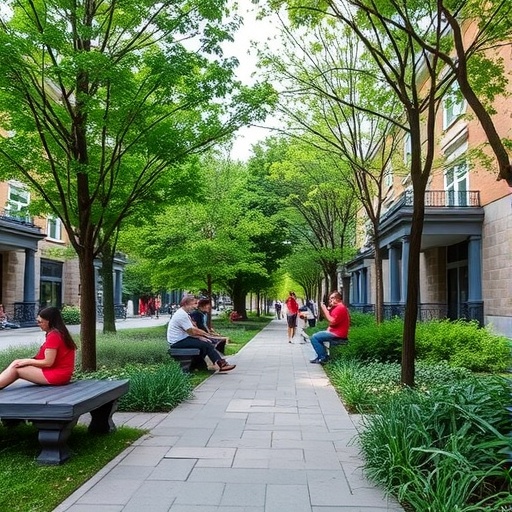
As urban landscapes continue to evolve and expand, the significance of green spaces in fostering healthier communities has never been more evident. Recent research conducted by Chen, Yin, and Ye unveils a compelling correlation between urban greenery and the mental well-being of older adults—a demographic often susceptible to social isolation and loneliness. This study, published in npj Urban Sustainability (2026), provides empirical evidence demonstrating how accessible green spaces within cities can act as catalysts for social engagement, ultimately alleviating feelings of loneliness among the elderly.
Loneliness among older adults has emerged as a pressing public health concern worldwide. Studies consistently show that social isolation can exacerbate mental health disorders, including depression and anxiety, and can even increase mortality rates. Against this backdrop, the role of environmental factors, particularly urban green infrastructure, has garnered increasing attention. Chen and colleagues’ work systematically explores this dimension by analyzing the multifaceted benefits of urban green spaces, going beyond aesthetics to reveal their profound psychosocial impact.
The researchers employed a multidisciplinary approach, integrating urban planning, environmental psychology, and public health perspectives. Through extensive data collection involving surveys, spatial analysis, and observational studies across multiple metropolitan areas, the team assessed how the presence and quality of urban parks, community gardens, and green corridors influence older adults’ social participation patterns. Their findings emphasize that green spaces are not merely passive backdrops but active social hubs encouraging interaction.
Key to this dynamic is the design and accessibility of these green spaces. The study distinguishes between various types of green environments, from large public parks to pocket gardens integrated into residential neighborhoods. For older adults, proximity and ease of access to these areas significantly determine their usage frequency. Well-maintained, safe, and inviting green spaces promote organic encounters and communal activities, which become vital channels for socializing in later life.
One particularly significant outcome highlighted in the study is the reduction of subjective loneliness reported by older adults who regularly engage in activities within urban green spaces. Social participation fostered in these environments ranges from casual conversations and group exercises to organized community events and volunteer initiatives. This diverse range of interactions addresses different social needs and preferences, making green spaces inclusive venues that accommodate varied lifestyles.
From a technical standpoint, the researchers utilized geospatial analytics to map correlations between green space availability and reported levels of loneliness. These analyses controlled for confounding variables such as socioeconomic status, physical health, and urban density. Furthermore, the incorporation of wearable technology data and real-time social interaction logs enriched the methodological rigour, providing a nuanced understanding of how environmental exposure shapes social behavior.
One of the study’s novel contributions lies in its exploration of the biophilic principles underlying urban design. The authors argue that connection to nature through urban green spaces sparks intrinsic motivation for social engagement. This resonates with theories of restorative environments and attention restoration, where nature exposure replenishes cognitive resources, reduces stress, and improves mood—factors conducive to forging and maintaining social bonds.
The implications of this research extend into urban policy and public health strategy. By quantifying how green spaces contribute to social cohesion and mental well-being among older residents, the findings advocate for integrating green infrastructure into age-friendly city frameworks. Such integration requires cross-sector collaboration between urban planners, public health officials, and community organizations to ensure that green spaces are not only abundant but are also equitably distributed and culturally sensitive.
Moreover, the study addresses potential challenges, such as the risk of “green gentrification,” wherein the enhancement of urban environments may inadvertently marginalize vulnerable populations through rising property values and displacement. Chen and colleagues call for proactive measures to preserve affordable housing and maintain inclusive community access to green amenities.
Technological innovations also feature prominently in the study’s recommendations. The authors suggest leveraging smart city technologies—such as sensor networks and mobile applications—to monitor green space usage and facilitate social programming tailored to older adults’ needs. These tools can dynamically adapt offerings and infrastructure maintenance, ensuring green spaces remain vibrant and responsive social arenas.
The psychological dimension of the findings is underscored by in-depth interviews and qualitative data. Participants frequently expressed that urban nature provided a sense of continuity, belonging, and purpose. For many, tending community gardens or participating in outdoor group activities rekindled a sense of agency and community connectedness, critical determinants of healthy aging.
From an epidemiological perspective, the protective effects of green space engagement may extend to cognitive health. Emerging evidence suggests that social participation, combined with physical activity in natural settings, may delay the onset of dementia-related symptoms. While this study primarily focuses on social outcomes, it lays the groundwork for future interdisciplinary investigations into the cognitive benefits of green-space exposure.
Importantly, the authors emphasize that green space interventions should be tailored to local contexts, considering climatic conditions, cultural practices, and urban morphology. A one-size-fits-all approach is insufficient; instead, adaptive design strategies that co-create spaces with community input ensure relevance and sustained engagement.
The study contributes to shifting public narratives from viewing urban green spaces solely as recreational or environmental necessities to recognizing them as essential social infrastructure. By fostering social participation and mitigating loneliness, green spaces emerge as vital components of holistic urban health strategies, especially relevant in the post-pandemic era where social isolation has intensified globally.
In conclusion, Chen, Yin, and Ye’s pioneering research illuminates the interdependence of environmental design and social well-being in aging populations. As cities juggle the challenges of demographic shifts and urban expansion, prioritizing green infrastructure can nurture not only ecological but also psychosocial resilience. Policymakers, planners, and public health practitioners alike must heed these insights to create inclusive urban environments where aging populations can grow together, surrounded by thriving green spaces that promote connection, vitality, and belonging.
Subject of Research: The impact of urban green spaces on social participation and loneliness alleviation in older adults.
Article Title: Growing together: how urban green spaces enhance social participation and alleviate loneliness in older adults.
Article References:
Chen, Y., Yin, C. & Ye, Y. Growing together: how urban green spaces enhance social participation and alleviate loneliness in older adults.
npj Urban Sustain (2026). https://doi.org/10.1038/s42949-026-00343-y
Image Credits: AI Generated


