

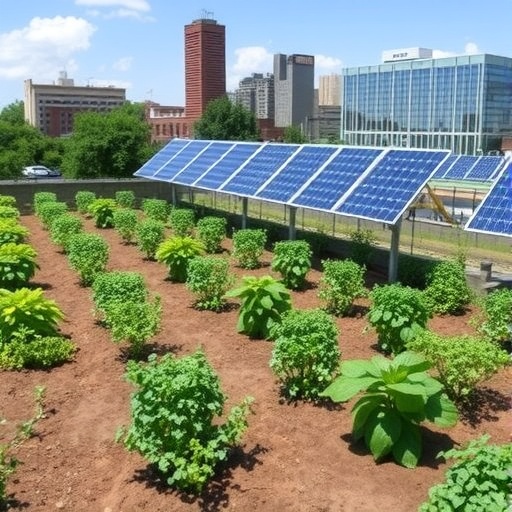
In the face of escalating climate change challenges, urban environments are increasingly turning to innovative solutions that merge sustainability, energy production, and food security. A groundbreaking study published in npj Urban Sustainability in 2026 unveils the promising potential of urban agrivoltaics — a synergy of urban agriculture and photovoltaic technology — to enhance crop resilience and optimize food-energy systems within cityscapes. This transformative approach addresses multifaceted urban sustainability issues, marrying the demands for renewable energy and local food production under the increasing pressures of unpredictable weather patterns and rising temperatures.
Urban agrivoltaics involves the strategic placement of solar panels above crops cultivated in urban settings, creating a microclimate that benefits plant growth while simultaneously capturing solar energy. This configuration permits dual land use, especially valuable in densely populated metropolitan areas where space is severely limited. The study’s authors, Merheb, Caplan, Phuyal, and their colleagues, conducted comprehensive field experiments coupled with sophisticated climate modeling to evaluate the impacts of urban agrivoltaics on both agricultural yield and photovoltaic efficiency under future climate scenarios.
One of the central findings of the research is that shading provided by solar panels can mitigate the harmful effects of extreme heat waves on sensitive crops. Excessive solar radiation and high ambient temperatures typically induce stress responses in plants, diminishing photosynthetic activity and accelerating dehydration. The partial shade created by agrivoltaic installations reduces thermal stress and evapotranspiration rates, thereby preserving soil moisture and enabling plants to sustain productivity during heat events. This buffering effect is crucial as cities are experiencing more frequent and intense heat waves due to urban heat island effects combined with global warming.
Beyond mitigating heat stress, the study revealed that urban agrivoltaic systems improve water use efficiency. The shading reduces direct sunlight exposure on the soil surface, which decreases the evaporation rate substantially. Lower evaporation means retained soil moisture, enabling crops to require less irrigation to maintain growth. This water-saving effect is particularly vital in urban areas facing water scarcity or stringent water-use regulations, enhancing food security by stabilizing yields with less resource input.
Moreover, the research highlights how agrivoltaic systems can enhance food-energy synergies by simultaneously generating clean electricity and producing crops within the same urban footprint. This integrated model maximizes land productivity, an increasingly scarce commodity in cities worldwide. The electricity produced can power local infrastructures or urban services, reducing dependency on fossil fuels and shrinking carbon footprints, while the crops grown below provide fresh, locally sourced food, reducing food miles and associated emissions.
Another significant aspect of the study is its exploration of plant species diversity under agrivoltaic conditions. Different crops exhibit varying tolerances to shading and altered microclimatic conditions, influencing their growth performance. The researchers tested a variety of vegetables and herbs, identifying species that not only tolerate but thrive in partial shade environments created by solar panels. These insights provide crucial guidance for urban planners and farmers seeking to optimize crop selection in agrivoltaic systems, tailoring production to both environmental conditions and market demands.
The technological dimensions of integrating photovoltaic panels with rooftop and urban farm structures were also scrutinized. The study underscores the necessity for adaptive solar panel designs—such as adjustable tilt angles and elevated mounting systems—to maximize light distribution to crops while harvesting solar energy efficiently. Additionally, sensor networks integrated into agrivoltaic farms can monitor ambient temperature, humidity, and soil moisture in real-time, enabling precision agriculture techniques to further optimize resource allocation and crop management.
Crucially, the study uses robust climate projection models to assess how urban agrivoltaics will perform under future climate extremes, including scenarios of increased temperatures, variable precipitation, and intensified solar irradiance. Results indicate that urban agrivoltaics retains resilience under these projections, providing a consistent food-energy output despite climatic uncertainties. This adaptability places the approach as a key component of urban adaptation strategies, enabling cities to buffer themselves against the volatile impacts of climate change.
The environmental co-benefits of urban agrivoltaics extend beyond energy and food production. By increasing vegetative cover in cities, agrivoltaic farms contribute to improved air quality through enhanced carbon sequestration and pollutant absorption. Additionally, the shaded microclimates help mitigate urban heat island effects by reducing surface and air temperatures, thus improving urban livability and reducing cooling energy demand. These synergistic effects create positive feedback loops that advance multiple sustainability goals simultaneously.
Socioeconomic impacts form another critical focus of the research. Urban agrivoltaic installations can create green jobs, foster community engagement in sustainable practices, and enhance urban food sovereignty by empowering local producers. By decentralizing food and energy systems, cities can reduce vulnerabilities to global supply chain disruptions, which have been prominently exposed during recent crises. Moreover, these systems encourage circular economy principles by linking urban wastes, such as organic compost, to productive urban agriculture.
The scalability and replicability of urban agrivoltaic systems were also analyzed. While rooftop installations show immediate promise, the study advocates for integration within diverse urban typologies, including vertical farming structures, parking lots, open parks, and even brownfields. Such diversity allows customization according to urban density, land value, and infrastructural contexts, broadening the application conditions and benefits achievable across different cities and regions with varying environmental and socio-economic characteristics.
Challenges and limitations are candidly discussed in the paper. Initial costs for installation and the complexity of managing dual-use systems require technical expertise and capital investment that may hinder adoption, especially in low-income neighborhoods. Structural constraints on older buildings may limit retrofit potential. Furthermore, optimizing the angle and placement of panels to find the best balance between light for crops and solar harvesting requires nuanced engineering solutions and ongoing adaptive management.
Despite these hurdles, the study presents a compelling case for urban agrivoltaics as a scalable, multifunctional strategy that addresses critical sustainability challenges in an integrated manner. The interweaving of energy production and food resilience fosters a path towards a circular, low-carbon urban future, where cities evolve from mere consumers to active producers of resources embedded in their own built environments.
In summary, this pioneering research from Merheb, Caplan, Phuyal, and colleagues charts a visionary course for urban sustainability. By marrying advanced photovoltaic technology with innovative urban agriculture practices, agrivoltaics offers a resilient and dynamic solution to the intertwined crises of climate change, food security, and energy sustainability faced by modern cities. As urban planners, policymakers, and researchers seek impactful adaptations, urban agrivoltaics stand out as a beacon of integrative, forward-thinking design that delivers tangible environmental, economic, and social benefits.
The findings not only deepen understanding of how built environments can be transformed into productive landscapes but also inspire a reimagining of the urban form itself—hybrid spaces where nature and technology synergistically thrive amidst the concrete. Urban agrivoltaics underscore the potential held within cityscapes to become hubs of innovation-led sustainability, promising to reshape urban existence in harmony with the planet’s evolving climate challenges.
Subject of Research: Urban agrivoltaics, crop resilience, food-energy synergies, climate adaptation in urban environments
Article Title: Urban agrivoltaics enhance crop resilience and food-energy synergies in a changing climate
Article References: Merheb, C., Caplan, J.S., Phuyal, P. et al. Urban agrivoltaics enhance crop resilience and food-energy synergies in a changing climate. npj Urban Sustain (2026). https://doi.org/10.1038/s42949-026-00381-6
Image Credits: AI Generated


