

For millennia, the Jomon people inhabited the Japanese archipelago, their legacy etched into time through pottery and archaeological remnants. Recent advances in genetic analysis have uncovered new dimensions to their enigmatic history, revealing that their origins may stem from a single migratory lineage rather than multiple, as traditionally thought. This revelation pivots the narrative of Jomon history towards the influences of environmental and cultural evolution, challenging the long-standing assumptions about the dispersal and diversification of ancient Japan’s earliest inhabitants.
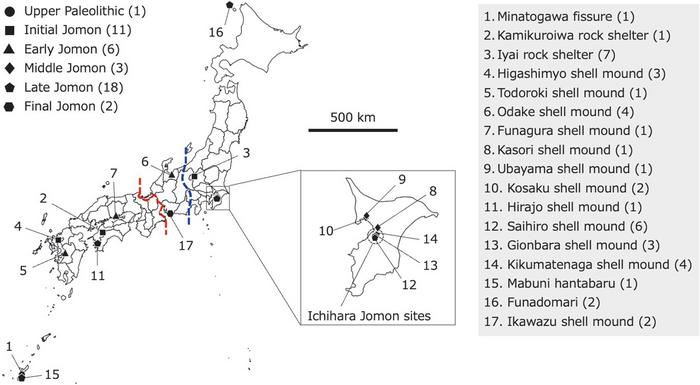
The Jomon period, spanning approximately 16,000 years ago, is renowned for its distinct pottery culture and significant archaeological footprint across Japan. However, until now, the finer details about the Jomon population’s demographic history have remained out of reach. Previous genetic investigations primarily focused on present-day Japanese populations, often blurred by complex admixture events over millennia. To overcome this, researchers led by Professor Hiroki Oota at the University of Tokyo embarked on an ambitious genetic study using mitochondrial DNA extracted directly from ancient Jomon skeletons, including 13 newly sequenced individuals from Ichihara Jomon sites in Chiba Prefecture.
These genetic data unlocked a powerful tool: whole mitogenome analysis coupled with Bayesian skyline plots, a sophisticated statistical approach that models changes in population size over time based on mutation rates within mitochondrial DNA. This methodology allows researchers to reconstruct demographic trends from ancient DNA sequences. The findings were striking, showing a pronounced population expansion of the Jomon between roughly 13,000 and 8,000 years ago, with the most significant growth localized in eastern Japan. This period aligns with post-glacial environmental shifts that may have enhanced resource availability, setting the stage for a demographic surge.
A cornerstone of this study challenges the classical subdivision of the Jomon into distinct eastern and western lineages based on mitochondrial DNA haplogroups. Rather than multiple ancestral migrations shaping these genetic divisions, the researchers propose a model where a single founding population dispersed and subsequently experienced genetic drift, leading to the observed regional differences. This paradigm shift suggests that the eastern and western Jomon differences are less about separate origins and more about localized evolutionary and cultural trajectories that unfolded after their initial settlement.
The environmental context of these demographic changes provides additional clarity. Eastern Japan, characterized during the Jomon by extensive forest ecosystems teeming with diverse plant and animal life, likely offered a more stable and abundant food supply. Marine resources, including salmon and trout, were exploited early by eastern coastal communities, fostering resilient populations capable of sustained growth. In contrast, western Japan’s harsher climate and lower resource productivity may have restricted population expansions, emphasizing how ecological variations profoundly impacted human social dynamics.
This intricate interplay between environment and population movement underscores the importance of integrating multidisciplinary perspectives. Genetic findings now complement archaeological records, yet discrepancies remain. For instance, some archaeological evidence does not perfectly mirror the timing or scale of demographic shifts inferred from genetic data, posing critical questions for ongoing research. To bridge these gaps, future studies intend to weave together paleoclimatology, archaeology, and ecological data to develop a holistic understanding of Jomon prehistoric life.
Moreover, the discoveries bear significant implications on how prehistoric human populations adapted to climate fluctuations and resource distributions. The Jomon’s ability to thrive for thousands of years in diverse environments reflects a sophisticated interplay of cultural innovations and ecological knowledge, embodied in their subsistence strategies and settlement patterns. This complexity had previously been masked by more simplistic migration hypotheses, now supplanted by a nuanced view highlighting evolutionary stasis interspersed with regional adaptations.
Professor Hiroki Oota’s team applied Bayesian skyline plots extensively, refining demographic reconstructions with unprecedented resolution. These plots translate genetic mutation patterns into probabilistic models that estimate effective population size changes over time, crucially impacting our understanding of prehistoric population bottlenecks, expansions, and separations. This statistical approach represents a leap forward in paleogenomics, enabling researchers not only to chart population sizes but also to infer migratory and isolation events that shaped ancient genetic landscapes.
The study also emphasizes the potential influence of cultural differences between eastern and western Jomon groups beyond mere genetic divergence. Variations in subsistence strategies, such as marine resource utilization and forest management, likely played significant roles in shaping population dynamics. These socio-ecological factors may have encouraged differential population growth rates, community resilience, and settlement patterns, indicating that culture and environment acted as potent evolutionary drivers during the Jomon period.
Importantly, this research highlights the limitations of assuming population history strictly from modern DNA samples. Paleo-genomic data extracted directly from ancient remains provide clearer, less confounded insights into ancestral demographics and evolutionary processes. The Jomon case exemplifies how ancient DNA can revolutionize our comprehension of prehistoric societies, revealing intricate details lost in the temporal churn of migrations, admixture, and cultural transformations.
The implications extend beyond Japanese prehistory, providing a blueprint for studying ancient populations worldwide. By combining high-resolution mitogenomic sequencing with advanced computational models and interdisciplinary analyses, researchers can unlock the deep genetic and cultural histories of early human groups. These methods allow for reconstructions that honor the complexities and diversities of ancient peoples rather than reducing them to simplistic migratory waves.
As Professor Oota and colleagues continue their integrative approach, future work promises to clarify unresolved issues, including reconciling genetic data with archaeological and ecological records. Their commitment to multidisciplinary collaboration exemplifies modern approaches in evolutionary anthropology and population genetics, harnessing technology and scholarship to breathe life into ancient stories embedded in our genomes.
This groundbreaking research fundamentally reshapes our understanding of the Jomon people, illuminating how a single ancestral lineage diversified through regional adaptation, environmental niches, and cultural evolution over thousands of years. It invites us to reconsider population history as an intricate tapestry woven from genes, climate, culture, and chance.
Subject of Research: Human tissue samples
Article Title: Demographic history of the Jomon people: insights from whole-mitogenome analysis
News Publication Date: 30-Jan-2026
Web References:
https://www.jstage.jst.go.jp/article/ase/advpub/0/advpub_251024/_article
References:
Koki Yoshida, Yoshiki Wakiyama, Yuka Nakamura, Guido Valverde, Akio Tanino, Daisuke Waku, Takafumi Katsumura, Motoyuki Ogawa, Tomohito Nagaoka, Kazuaki Hirata, Kae Koganebuchi, Yusuke Watanabe, Jun Ohashi, Minoru Yoneda, Ryuzaburo Takahashi, Hiroki Oota, “Demographic history of the Jomon people: insights from whole-mitogenome analysis”, Anthropological Science, DOI: 10.1537/ase.251024
Image Credits: ©2026 Oota et al. CC-BY-ND
Keywords: Jomon people, mitochondrial DNA, demographic history, Bayesian skyline plots, ancient Japan, population genetics, prehistoric migration, paleoenvironmental adaptation, cultural evolution, mitogenome analysis


