

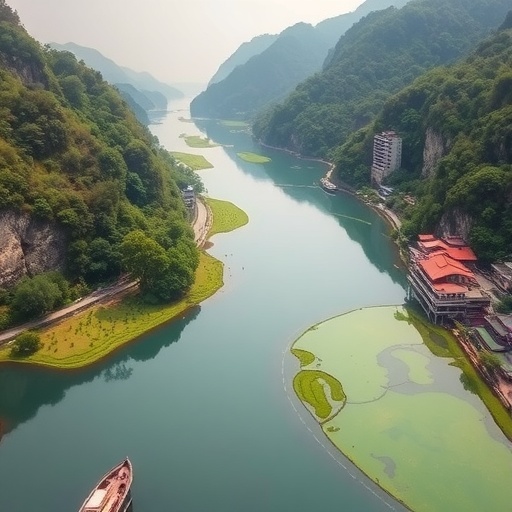
The Yangtze River Economic Belt stands as one of China’s most critical regions, not only for its economic contributions but also for its ecological diversity. Recent research led by Wang, J., Fang, W., and An, H. in their study titled “Estimation of regional heterogeneity and synergistic drivers of ecological boundary transgression in the Yangtze River Economic Belt” brings to the forefront the intricate interplay between ecological dynamics and human activities across this vital landscape. As the Yangtze River continues to face unprecedented pressure from urbanization, industrial growth, and climate change, understanding these complex relationships is more crucial than ever.
The research provides a deep dive into the regional heterogeneity of the ecological boundaries within this area, highlighting the different environmental and socio-economic pressures affecting various locales. By employing a combination of modeling techniques and empirical data collection, the study delineates how these heterogeneities manifest in terms of biodiversity loss, shifts in ecosystems, and the encroachment of urban areas into natural habitats. The need for such nuanced analyses is underscored by the continued degradation of ecosystems, which threatens both the environment and local livelihoods.
Furthermore, this groundbreaking study identifies synergistic drivers that contribute to ecological boundary transgression. This term, while technical, refers to the overlapping impacts of multiple factors, including economic activities, population growth, and climatic variations. The research emphasizes how these intertwined influences can exacerbate ecological degradation, making it increasingly challenging to implement effective conservation strategies. The authors call for an integrated approach that considers these synergistic effects when planning for regional development and environmental management.
One of the predominantly highlighted findings of the research is the significance of local governance in mediating the effects of these drivers. The role of governmental policies, community engagement, and sustainable development practices are crucial in fostering a balance between economic growth and ecological sustainability. The authors argue that inclusive policy frameworks, which involve multiple stakeholders, can create synergies that benefit both the economy and the environment.
The study also sheds light on how climate change acts as a significant catalyst for ecological boundary transgressions. Rising temperatures, altered precipitation patterns, and increased incidences of extreme weather contribute to shifts in regional ecosystems. Such climatic changes not only impact biodiversity but also threaten food security and water supply for millions of residents dependent on these environments. Timely intervention and adaptive management practices are paramount to alleviate these risks and to safeguard the ecological integrity of the Yangtze River Economic Belt.
In assessing regional heterogeneity, the researchers employed advanced geographical information system (GIS) technology to visualize and interpret the spatial distribution of ecological boundaries. This facilitates a better understanding of how ecological boundaries vary across different landscapes and allows for targeted conservation efforts. The integration of technology into ecological research has proven indispensable, offering insights that traditional methods may overlook.
Moving forward, the potential for stakeholder collaboration emerges as a recurring theme in the study. Local communities, government bodies, and non-governmental organizations must engage in dialogue and shared decision-making. In this way, stakeholders can effectively address the multi-dimensional challenges presented by ecological degradation and work collectively towards sustainable goals. The implications of such collaborative efforts may extend well beyond the confines of the Yangtze River, serving as a model for other regions confronting similar environmental dilemmas.
Another dimension of this research concerns the implications for biodiversity conservation strategies. The findings suggest that biodiversity loss in the Yangtze River Economic Belt is not uniform; certain areas suffer more significantly than others due to accumulated pressures. Thus, conservation efforts need to be context-specific and sensitive to local environmental conditions. This tailored approach may lead to more effective outcomes, ensuring that diverse ecological features are preserved for future generations.
Educational initiatives also play a role in addressing ecological challenges. By informing residents and stakeholders about the importance of ecological boundaries and the consequences of overexploitation, communities can foster a sense of stewardship toward their environment. The research highlights the necessity for educational programs that emphasize ecological awareness and the sustainable use of natural resources.
Moreover, the interconnections between economic activities and ecosystems underscore the importance of sustainable development practices. The study calls for re-evaluating existing economic models in light of environmental sustainability, advocating for green economies that prioritize resource conservation and ecological health alongside economic growth. This shift could redefine the relationship between development and conservation in the Yangtze River Economic Belt.
Additionally, the research points to the need for effective monitoring and assessment frameworks that can capture the dynamic nature of ecological changes. Establishing criteria for assessing ecological health will empower policymakers to make informed decisions based on solid data. Transparent and systematic monitoring processes can also encourage public participation and trust in environmental governance.
In closing, the study by Wang, J., Fang, W., and An, H. illuminates the urgent need for integrated research and collaborative action to address the pressing challenges facing the Yangtze River Economic Belt. As this region grapples with the forces of modernization and climate change, insights from this research can guide sustainable practices that protect ecological boundaries while fostering economic resilience. The synergy between ecological health and human development will ultimately dictate the future of this vibrant region, underscoring the interconnectedness of our social, economic, and environmental landscapes.
Subject of Research: Regional heterogeneity and drivers of ecological boundary transgression in the Yangtze River Economic Belt.
Article Title: Estimation of regional heterogeneity and synergistic drivers of ecological boundary transgression in the Yangtze River Economic Belt.
Article References:
Wang, J., Fang, W., An, H. et al. Estimation of regional heterogeneity and synergistic drivers of ecological boundary transgression in the Yangtze River Economic Belt.
Environ Monit Assess 198, 192 (2026). https://doi.org/10.1007/s10661-026-15036-3
Image Credits: AI Generated
DOI: https://doi.org/10.1007/s10661-026-15036-3
Keywords: Yangtze River, ecological boundaries, regional heterogeneity, climate change, biodiversity conservation, sustainable development.


