

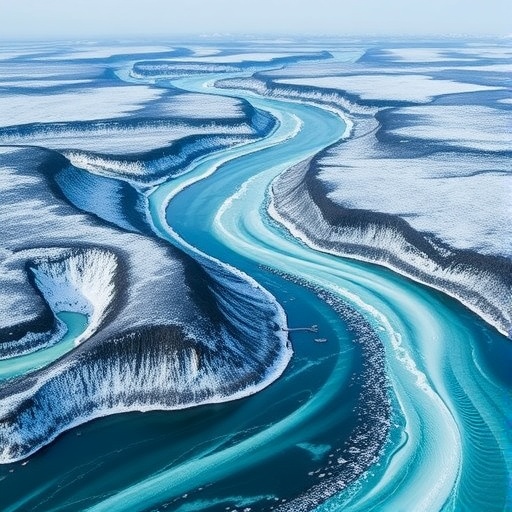
In the ever-evolving Arctic landscape, the flow and behavior of its rivers are critical indicators of environmental change, particularly in the context of climate warming. Recent research delves into the dynamic responses of Arctic rivers to rising temperatures, revealing a complex and bifurcated migration pattern that challenges previous assumptions about these essential waterways. Spanning nearly five decades of data from 1972 through 2020, this study meticulously reconstructs the migration rates of rivers across a vast 1,500 km stretch of the Arctic and sub-Arctic regions, enveloping diverse channel sizes and varying floodplain characteristics.
This comprehensive investigation uncovers a distinct split in river behavior contingent upon the thermal regimes of their surrounding permafrost. Rivers flowing through the warmer zones characterized by discontinuous permafrost show a pronounced acceleration in their migration rates. Conversely, rivers residing in colder, continuous permafrost landscapes exhibit a marked slowdown. This bifurcation underscores the sensitivity of river systems to nuanced climatic factors, particularly how freeze-thaw dynamics directly influence channel movement.
Two primary mechanisms emerge as drivers behind this divergent pattern. First, the thawing of permafrost within floodplains appears to enhance river migration by destabilizing banks and enabling more rapid geomorphological changes. Permafrost degradation compromises bank stability and increases sediment availability, which in turn facilitates faster lateral channel shifting. Second, the phenomenon of river-ice breakup, which traditionally exerts considerable erosive force and prompts channel migration, is experiencing diminished intensity. This reduction in ice breakup vigor translates into decreased mechanical disturbance of riverbanks, thereby slowing migration in the coldest regions.
Delving deeper, researchers developed a mechanistic model that captures the interplay between these competing processes and air temperature. The model effectively encapsulates how the relative influence of permafrost thaw and ice breakup strength coalesce to dictate migration velocity. Warmer temperatures intensify permafrost degradation, tipping the balance toward faster lateral shifts, while simultaneously lessening ice breakup intensity, which has a counteracting effect in colder zones.
These findings illuminate the intricate feedback loops between hydrology, cryology, and geomorphology in Arctic river systems. The thaw-accelerated migration in discontinuous permafrost environments portends significant implications for sediment transport and carbon mobilization. Arctic rivers, rich in organic carbon sequestered in permafrost soils for millennia, are gateways for this ancient carbon to enter aquatic and atmospheric systems. Accelerated river migration enhances the vulnerability of stored permafrost carbon by exposing and mobilizing it into the hydrosphere, potentially amplifying greenhouse gas emissions.
On the other hand, the deceleration observed in continuous permafrost regions raises intriguing questions about the long-term stability of these river corridors. Reduced river-ice breakup intensity may signify broader shifts in ice phenology driven by warming, altering erosion regimes and sediment flux. This phenomenon might stabilize certain river pathways temporarily, but could also result in more abrupt future geomorphological responses as warming continues.
Understanding how Arctic rivers react to warming is vital not only for predicting future landscape evolution but also for refining global climate models. The study highlights the necessity of integrating permafrost conditions and ice dynamics into river response models, offering a refined framework that can enhance predictive accuracy. This framework serves as a critical tool for researchers and policymakers aiming to quantify carbon fluxes and landscape change in polar regions under accelerating climate change.
Furthermore, the nuanced relationship between air temperature and river response patterns identified in this study bridges gaps in previous research that produced seemingly contradictory conclusions about Arctic river behavior. By including both temperature-dependent permafrost degradation and changes in ice breakup intensity, the research reconciles disparate findings and establishes a coherent paradigm that reflects region-specific responses to warming.
Importantly, the 50-year dataset underpinning this work is unprecedented in scale and scope. It integrates multi-decadal observations and diverse geophysical conditions, allowing researchers to move beyond snapshot assessments toward robust temporal analyses. This temporal depth strengthens the confidence in observed trends and the underlying mechanistic interpretations. It also underscores the accelerated pace of geomorphic response compared to past centuries, reinforcing the Arctic’s role as a sentinel of global environmental change.
The investigative team employed advanced remote sensing and geomorphological mapping techniques to trace river migration. This approach enabled high-resolution tracking of lateral channel movement, even in remote and challenging Arctic environments. Such innovative methodologies pave the way for expanded monitoring networks, vital for capturing ongoing landscape transformations as climate warming intensifies.
These results carry profound implications not only for climate science but also for indigenous communities and ecosystems dependent on stable river systems. Accelerating river migration could disrupt habitats, alter nutrient cycles, and impact subsistence lifestyle practices tied to riverine resources. Conversely, slowing migration might preserve certain traditional landscapes but also signal underlying environmental stressors that warrant attention.
Given the centrality of rivers in Arctic ecological and economic networks, understanding how their pace changes sets the stage for future interdisciplinary research. It invites collaboration between climatologists, hydrologists, ecologists, and indigenous knowledge holders to address the multifaceted challenges of a warming Arctic. The study’s mechanistic insights into temperature-driven controls offer a critical foundation for such integrative efforts.
Looking ahead, continued monitoring and modeling efforts are essential to capture the evolving interplay between warming, permafrost dynamics, and river migration. As the Arctic experiences unprecedented temperature anomalies, the relative balance of thaw-driven acceleration versus ice breakup-related deceleration may shift, potentially producing new and unforeseen geomorphic regimes. Adaptive management strategies will hinge on this evolving understanding.
In sum, the revelation of bifurcating migration rates among Arctic rivers in response to temperature offers a compelling narrative about the complexity and variability of climate impacts. It challenges simplistic conceptions of Arctic change and highlights the mosaic nature of responses shaped by localized thermal and hydrological conditions. This enhanced conceptual framework equips the scientific community with sharper tools to forecast riverine and carbon cycle feedbacks in a rapidly warming Arctic, underscoring the riverine pulse as a key barometer of planetary change.
Subject of Research: Arctic river migration dynamics and permafrost thaw in response to climate warming
Article Title: Resolving the changing pace of Arctic rivers
Article References:
Geyman, E.C., Lamb, M.P. Resolving the changing pace of Arctic rivers. Nat. Clim. Chang. (2025). https://doi.org/10.1038/s41558-025-02512-w
Image Credits: AI Generated


