

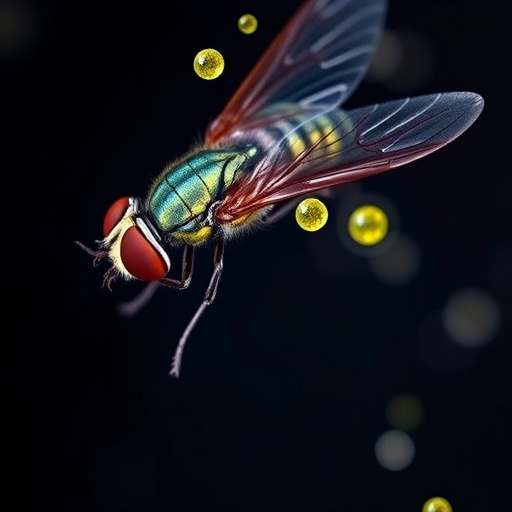
In a groundbreaking study that significantly enhances our understanding of the evolutionary journey of blow flies, researchers have delved deep into the world of mitogenomics. Published in the esteemed journal BMC Genomics, researchers Huang, Sang, and Yan, alongside their esteemed colleagues, present an intricate exploration of the phylogeny and evolution of the Calliphoridae family, which encompasses blow flies—a group that has long intrigued entomologists and geneticists alike. These flies are not merely a nuisance; they play critical roles in various ecosystems, from decomposition to forensic science.
The study leverages advanced genomic techniques to unravel the complex evolutionary relationships among various blow fly species. By sequencing and analyzing mitochondrial genomes, the researchers have opened a new frontier in understanding how these species have adapted and evolved over millions of years. The meticulous approach taken in this research provides valuable insights not only into the genetics of blow flies but also into the broader implications for biodiversity and species conservation.
Mitochondrial DNA (mtDNA) has emerged as a vital tool for phylogenetic studies due to its relatively rapid mutation rate compared to nuclear DNA. This characteristic makes mtDNA a reliable marker for tracing lineage and evolutionary relationships over shorter timescales, which is essential when studying taxa that display rapid evolutionary changes. The researchers utilized this advantage to construct phylogenetic trees that depict the evolutionary pathways of different blow fly species, illuminating their divergence and adaptation strategies over time.
The methodology employed in this research is indicative of a significant shift in how evolutionary biology can be studied. Traditional phylogenetic methods often relied on morphological characteristics, which can be misleading. The integration of genomic data allows for more precise and robust tree construction, providing a clearer picture of evolutionary history. In addressing the limitations of morphological taxonomy, this research exemplifies the power of modern genomics in resolving taxonomic ambiguities that have persisted for decades.
Furthermore, the findings of this study are poised to impact not only evolutionary biology but also practical applications in fields such as medicine and agriculture. Blow flies are known vectors for various diseases; thus, understanding their evolutionary dynamics can inform strategies for pest control and disease management. The research underscores the interconnectedness of ecological health and the evolutionary stories behind organisms that inhabit our world, emphasizing the importance of maintaining biodiversity.
The study also sheds light on the historical biogeography of blow flies, exploring how geographic and climatic changes over millennia have influenced their diversification. By correlating genetic data with environmental variables, the researchers were able to establish links between ecological shifts and evolutionary responses in blow fly populations. This aspect of the research provides crucial insights into how current climate change may impact these species, and by extension, the ecosystems they inhabit.
Despite the detailed genomic insights provided by the study, the authors acknowledge the limitations of current databases and the need for more comprehensive sampling across the globe. They emphasize the necessity for continuous research, warranted by the ever-evolving nature of biodiversity itself. The call for further exploration resonates with an urgent reminder of the rapidity with which species can bloom or become extinct in response to environmental pressures.
In an era where genomic research is becoming increasingly accessible, the study advocates for the application of these techniques to lesser-known taxa within the Diptera order. The evolutionary patterns unveiled in blow flies could very well be mirrored in other insect families, suggesting a rich terrain for future studies that can expand our genetic knowledge base.
The significance of this research reaches far beyond the academic arena; it contributes to the global discourse on conservation efforts. By understanding the evolutionary roots of species like blow flies, conservationists can develop more effective strategies for protecting these organisms and their habitats. Moreover, this approach encourages a holistic view of ecology, where understanding one species can lead to preservation efforts that benefit whole ecosystems.
As the research community continues to grapple with the realities of global biodiversity loss, studies such as this remind us of the intricate stories that underpin every species. The unique evolutionary history of blow flies illuminates not only their significance in various scientific fields but also their roles in human life and the environments we share.
The implications of this study are profound and extend beyond the confines of specific academic interest. They raise broader questions about how we understand life on Earth, the ties that bind us to other organisms, and the responsibilities we hold in ensuring the continuation of those life forms. The research by Huang and colleagues marks a significant milestone in our journey toward unraveling the mysteries of life and underscores the importance of continued exploration in the vast field of evolutionary genomics.
Overall, the exploration of blow flies through the lens of mitogenomics is a testament to the power of integrating modern technology with evolutionary theory. The meticulous work presented in this study serves as an invitation for researchers across disciplines to contribute to the growing narrative of biodiversity. It is a call to action—an encouragement to delve into the threads of evolution that connect all living beings, fostering a deeper appreciation for the natural world and our part in its story.
In conclusion, the research conducted by Huang et al. provides a vital framework for understanding not only blow flies but the evolutionary tapestry they are part of. As they continue their work, the scientific community looks forward to further revelations that will undoubtedly emerge from this vibrant area of research, highlighting the dynamic and ever-changing story of life on our planet.
Subject of Research: The phylogeny and evolution of blow flies (Diptera: Calliphoridae) from the perspective of mitogenomics.
Article Title: The phylogeny and evolution of blow flies (Diptera: Calliphoridae) from the perspective of mitogenomics.
Article References:
Huang, X., Sang, J., Yan, L. et al. The phylogeny and evolution of blow flies (Diptera: Calliphoridae) from the perspective of mitogenomics.
BMC Genomics (2026). https://doi.org/10.1186/s12864-026-12534-z
Image Credits: AI Generated
DOI: 10.1186/s12864-026-12534-z
Keywords: phylogeny, evolution, blow flies, mitogenomics, Calliphoridae, biodiversity, genomic research, ecological health, climate change, conservation.


