

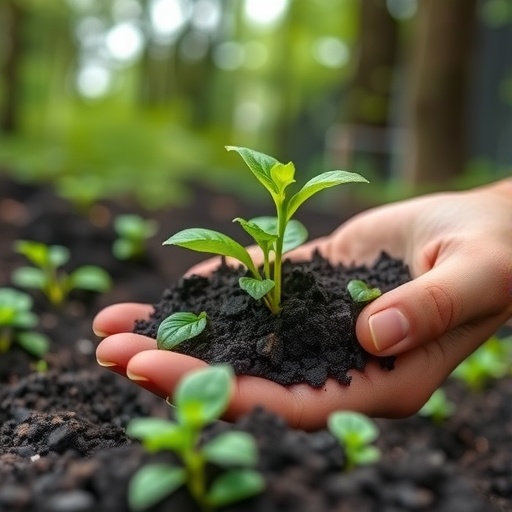
Biochar, a carbonaceous material derived from the pyrolysis of agricultural residues, has long been embraced for its capacity to improve soil fertility and contribute to carbon sequestration. However, a recent comprehensive review has illuminated a less conspicuous yet profoundly impactful characteristic of biochar: its intrinsic redox capabilities. This property enables biochar not only to interact chemically with environmental contaminants but also to actively participate in electron transfer processes that underpin a myriad of environmental and energy applications.
Central to this emerging understanding is biochar’s role as an electron mediator or shuttle. Unlike conventional adsorbents, which primarily capture pollutants without further transformation, biochar’s redox-active sites enable it to donate and accept electrons, thus accelerating redox reactions often necessary to degrade or transform contaminants. These active sites predominantly arise from oxygen- and nitrogen-containing functional groups, persistent free radicals embedded in the carbon matrix, and associated mineral components. Together, they form a complex and dynamic network facilitating electron flow between environmental substrates and microbial or chemical reactants.
This electron shuttling phenomenon is especially salient in the context of soil and water remediation. Many pollutants, including heavy metals, organic xenobiotics, and nutrients, require electron transfer for their conversion from toxic to benign states. For instance, reductive dechlorination of chlorinated organic compounds—a process critical for detoxifying industrial pollutants—relies heavily on the availability of electrons. Biochar’s intrinsic redox prowess enhances these reaction pathways by bridging electrons to microbial communities or directly catalyzing abiotic redox transformations, thereby facilitating more efficient pollutant breakdown.
Beyond pollutant degradation, biochar exerts a pronounced positive influence on microbial metabolic processes that involve extracellular electron transfer. Microbial consortia involved in methanogenesis and other bioenergy-related reactions often depend on electron shuttling to optimize energy yields. Biochar, by enhancing electron mobility, supports these bioelectrochemical pathways, potentially bolstering the production of renewable energy carriers such as methane. This dual functionality—remediation coupled with bioenergy enhancement—underscores biochar’s versatility as a functional nanomaterial in environmental biotechnology.
Interestingly, the researchers reveal that biochar’s efficacy surpasses that of traditionally employed conductive materials like graphite and activated carbon. This superiority does not stem solely from electrical conductivity but rather from a combined measure known as electron exchange capacity (EEC). The EEC embodies the ability of biochar to not only transport electrons but also temporally store them within its structural matrix. This transient storage stabilizes reactive intermediates and sustains redox cycling, which is pivotal for maintaining reaction continuity and efficiency in variable environmental conditions.
Quantifying these redox behaviors requires sophisticated analytical techniques. The review delineates several methodologies, including chemical titrations, electrochemical assays such as cyclic voltammetry, and microbiological probes that assess biochar’s capacity to facilitate extracellular electron transfer. Each technique offers a window into different facets of biochar’s electron transfer dynamics, from surface-accessible redox moieties to the kinetic aspects of electron shuttling in complex biological systems. Such comprehensive characterization is vital for mechanistic insights and for tailoring biochar properties to specific applications.
A salient aspect influencing biochar’s redox performance is its aging process in environmental matrices. As biochar interacts with soil minerals, organic matter, and aqueous media, its physical and chemical landscape evolves. Fragmentation increases surface area, chemical oxidation generates new redox-active groups, and adsorptive interactions alter site availability. These transformations can modulate biochar’s electron exchange capacity, with implications for its longevity and sustained efficacy. Deciphering these aging pathways enables more accurate prediction of biochar’s functional lifespan and guides improvements in its design for enduring performance.
Despite these promising attributes, the translation of biochar’s redox functionality into practical, scalable technologies faces hurdles. Conventional enhancement strategies—such as chemical activation with harsh reagents or impregnation with metals—can amplify redox activity but often at the cost of economic and environmental sustainability. These approaches may introduce secondary contaminants or elevate production expenses, undermining the holistic benefits of biochar. Hence, a paradigm shift is encouraged toward intrinsic optimization through feedstock selection and precise pyrolysis control, fostering redox-active biochars inherently suited for target applications.
Emerging advances, including co-pyrolysis techniques where biochar is synthesized alongside complementary materials, and the application of machine learning algorithms to predict and engineer desirable biochar characteristics, hold substantial promise. These innovations can streamline the design of biochars with tailored redox properties while adhering to principles of green chemistry and sustainability. Such cross-disciplinary endeavors exemplify the next frontier in biochar research, harmonizing materials science, ecology, and data-driven engineering.
Positioning biochar as an active electron transfer agent challenges its traditional categorization as a passive soil amendment. Instead, it emerges as a multifunctional platform capable of controlling environmental reactions at the molecular level. By harnessing its redox capacity, biochar can be strategically deployed to remediate polluted ecosystems, enhance bioenergy recovery, and contribute to sustainable resource management, thereby aligning with global priorities for clean water, healthy soils, and carbon-neutral energy systems.
Reflecting on these findings, the authors emphasize the critical role that biochar’s intrinsic electron transfer ability may play in closing the gap between laboratory demonstrations and real-world implementation. Through systematic understanding and controlled material design, biochar could evolve into a cornerstone technology for environmental remediation and sustainable development. This represents a transformative leap, elevating biochar from an ancillary agricultural byproduct to a keystone of modern environmental engineering.
With increasing societal demands for cost-effective and carbon-negative technologies, the exploitation of biochar’s redox functionalities commands attention. Integrating this intrinsic property into environmental innovation strategies offers a pathway to scalable, efficient, and sustainable solutions against pollution and resource depletion. As the research community continues to unravel the complexities of biochar’s electron transfer mechanisms, it sets the stage for a new era where biochar not only captures carbon but actively drives chemical transformations crucial for ecosystem resilience.
In sum, this review lays a comprehensive foundation for future research and application, positioning biochar as a dynamic, redox-active material. Its unique electron transfer characteristics inspire a reevaluation of biochar’s utility within environmental sciences and engineering disciplines. The convergence of mechanistic insights, advanced characterization techniques, and emerging production methodologies heralds a promising future wherein biochar’s redox supremacy is fully harnessed to address pressing environmental challenges worldwide.
—
Subject of Research: Biochar’s intrinsic redox properties and electron transfer mechanisms in environmental applications
Article Title: Driving biochar applications via intrinsic redox superiority: electron transfer mechanisms, quantification, aging effects, and design strategies
News Publication Date: 31-Mar-2026
Web References: http://dx.doi.org/10.1007/s42773-026-00593-0
References: Li, S., Zhang, Z., Ren, Y. et al. Driving biochar applications via intrinsic redox superiority: electron transfer mechanisms, quantification, aging effects, and design strategies. Biochar 8, 87 (2026).
Image Credits: Shasha Li, Zimeng Zhang, Yanling Ren, Fan Lü, Xiaoying Hu, Zhenhan Duan, Lili Yang, Jianwei Du, Pinjing He, Mingyang Zhang & Yong Wen
Keywords
Biochar, redox activity, electron transfer, environmental remediation, pollutant degradation, electron shuttle, electron exchange capacity, aging effects, pyrolysis, electrochemical characterization, extracellular electron transfer, sustainable environmental technology


