

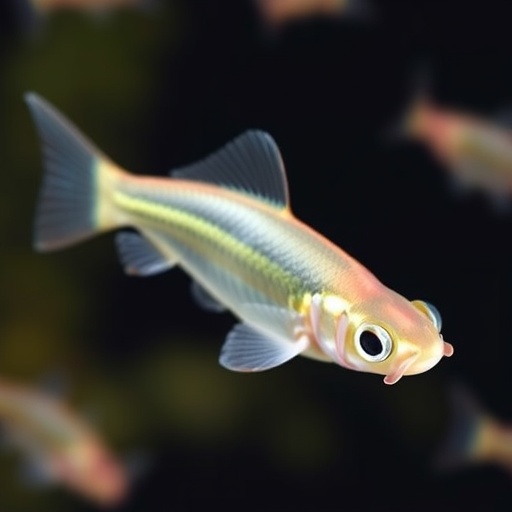
The University of Cincinnati College of Medicine has unveiled a cutting-edge zebrafish research facility, uniquely positioned as the premier institution of its kind within the university. Central to this initiative is Dr. Michelle Kossack, PhD, an assistant professor in the Division of Environmental Genetics and Molecular Toxicology under the Department of Environmental and Public Health Sciences. Since joining the faculty recently, Dr. Kossack has established her laboratory in the Kettering Lab Complex, supported partially by a substantial $250,000 career transition grant from the National Institute of Environmental Health Sciences.
This specialized laboratory currently maintains approximately 750 zebrafish tanks arranged on ten racks, and it possesses the scalable infrastructure to expand and sustain upwards of 7,000 fish within roughly 600 square feet of space. The zebrafish, as a model organism, is invaluable for dissecting reproductive toxicology mechanisms due to its genetic, physiological, and developmental parallels with humans, making it an exemplary vertebrate model for complex biological inquiry.
Dr. Kossack’s research focuses on elucidating the intricate molecular pathways underlying human reproductive biology and the pathogenesis of infertility, using zebrafish as a proxy system. The zebrafish model permits the simulation of human reproductive development and the assessment of exposure impacts to environmental contaminants on fertility at a molecular and systemic level. This approach to modeling is pivotal to unraveling the effects of environmental toxicants in a controlled, reproducible context.
Zebrafish share approximately 70% of their genes with humans, facilitating the study of conserved biological processes in a simplified vertebrate model. Unlike many other animal models, zebrafish embryos are transparent and develop ex utero, enabling direct observation and manipulation throughout developmental stages. Additionally, their circadian rhythm, which aligns closely with that of humans by being diurnal (active during daylight and rest at night), offers further experimental advantages for studying physiological responses under temporal environmental influences.
The zebrafish’s high fecundity and rapid reproductive cycle significantly enhance the throughput of experiments, permitting expansive genetic and toxicological screenings. Equally important, the zebrafish research community is highly collaborative, frequently sharing genetically characterized specimens and resources. Dr. Kossack’s lab capitalizes on these collaborative networks to expand their specimen population through in-house spawning programs, which progressively amplify research capabilities and genetic diversity.
Integral to the care of these aquatic organisms is a sophisticated recirculating water purification system that minimizes water consumption by continuously filtering and removing metabolic wastes. This system ensures optimal water quality that mimics natural freshwater environments, thereby maintaining fish health and reducing variability in experimental parameters related to environmental exposure.
Despite zebrafish requiring less day-to-day maintenance compared to traditional mammalian models, consistent husbandry is essential. Dr. Kossack plans to employ dedicated lab personnel and integrate students into the care routine to ensure the well-being of the fish, including regular feeding and environmental monitoring, even over weekends. This stewardship is crucial for maintaining the integrity and reproducibility of biological studies.
A principal subject of Dr. Kossack’s investigation is the ecological and reproductive toxicity posed by dioxins, a widely prevalent class of persistent environmental pollutants. Dioxins are byproducts of industrial processes involving combustion, such as fuel burning, waste incineration, and wildfire smoke events, and they are known to bioaccumulate heavily in the fatty tissues of animals, infiltrating the human food chain predominantly through consumption of contaminated animal fats.
Human exposure to dioxins is nearly ubiquitous, as these compounds persist in the environment and accumulate in the body over time. Dioxins function as endocrine disruptors and carcinogens and have been conclusively linked to developmental toxicity. The pervasive nature of these compounds presents a significant challenge for public health, as even low-level chronic exposure can impair reproductive function and elevate risks of infertility.
Kossack’s research probes the molecular mechanisms by which dioxin exposure alters fertility, focusing specifically on how these toxicants disrupt endocrine signaling and developmental pathways in reproductive tissues. While epidemiological data link dioxin exposure to reduced fertility, the exact biophysical and biochemical pathways remain incompletely characterized. The zebrafish model offers a tractable system to dissect these mechanisms with unparalleled resolution.
By applying zebrafish genetics and toxicological assays, Kossack aims to identify the gene networks and signaling cascades affected by dioxin exposure. These insights will facilitate translational research avenues to better understand human infertility linked to environmental contaminants and inform the design of therapeutic interventions or preventative measures.
Ultimately, the goal of this research is not only to deepen scientific understanding of environmental toxicology impacts on reproductive health but also to provide a knowledge base that can influence regulatory policy and public health strategies aimed at mitigating the human reproduction crisis. Given the global increase in infertility rates, largely attributed to environmental factors, such data are urgently needed.
Through a combination of state-of-the-art laboratory infrastructure, interdisciplinary collaboration, and a deep commitment to environmental health sciences, Dr. Kossack’s zebrafish facility at the University of Cincinnati stands at the forefront of reproductive toxicology research. This initiative exemplifies how modern biological models can be leveraged to address pressing human health challenges resulting from anthropogenic environmental changes.
Subject of Research: Environmental toxicology effects on human reproductive biology using zebrafish as a model organism.
Article Title: University of Cincinnati Launches State-of-the-Art Zebrafish Facility to Study Environmental Impacts on Human Fertility
News Publication Date: Information not provided
Web References: https://mediasvc.eurekalert.org/Api/v1/Multimedia/5dc915b1-14ee-49a9-9ab8-2cb5e2a41aea/Rendition/low-res/Content/Public
Image Credits: University of Cincinnati
Keywords: Zebrafish, reproductive toxicology, environmental contaminants, dioxins, infertility, molecular mechanisms, animal model, reproductive biology, environmental health sciences, endocrine disruptors, developmental toxicology, environmental pollution


