

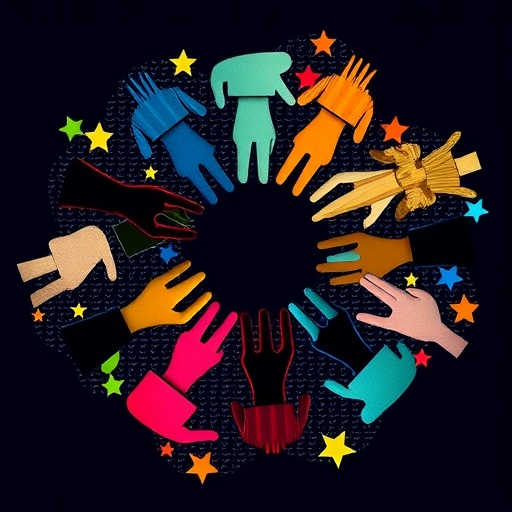
The human brain possesses a remarkable degree of flexibility in social perception, especially in how it navigates the complex web of ethnic and national identities. Recent groundbreaking research conducted through a collaboration between the University of Trento, Italy, and Nanyang Technological University (NTU) in Singapore reveals that the brain can rapidly reconfigure its responses to social group boundaries under the influence of salient shared identities. This discovery redefines our understanding of how social cohesion might be neurologically facilitated amidst diverse populations.
Published in the prestigious journal Proceedings of the National Academy of Sciences (PNAS), the study entitled “National identity reconfigures brain responses from ‘them’ to ‘us’” sheds new light on the neural mechanisms underpinning social identity and belonging. By employing functional magnetic resonance imaging (fMRI), the researchers explored how the brain processes faces from different ethnic groups and how these brain responses shift when a shared national identity is emphasized.
The research focused on Singapore’s unique multicultural milieu, a society marked by three predominant ethnic communities: Chinese, Malay, and Indian. Ninety-two participants from these groups were involved, allowing the team to analyze brain activity when participants viewed images of faces from their own and other ethnic groups under different identity cues. These cues alternated between ethnic identity reminders—such as ethnic language phrases and cultural symbols—and national identity cues, like hearing a common language or seeing the Singaporean flag.
Findings reveal that even brief exposure to national identity cues engages a specific area of the frontal cortex, pivotal for self-other relatedness. This engagement reflects an increased neural representation of out-group faces as part of an inclusive ‘we’ identity instead of an exclusive ‘them.’ Importantly, while the brain reorients its perception toward unity, it simultaneously preserves the nuanced details of ethnic identity. This suggests that social categorization in the brain is not a zero-sum game but rather a dynamic balancing act between shared and subgroup identities.
Dr. Gianluca Esposito, co-lead of the project and Director of the Department of Psychology and Cognitive Science at the University of Trento, articulates the profound implications of this neural flexibility. According to him, the brain’s ability to expand its sense of belonging is a neuropsychological substratum for reducing social distance and fostering openness in multipolar social landscapes. This reframing from “us versus them” to a more inclusive “we” highlights the brain’s potential role in promoting peaceful coexistence and social reconciliation through the affirmation of common goals and identities.
Annabel Chen, co-lead of the project and President’s Chair in Psychology at NTU Singapore, emphasizes that this dual identification does not erase or suppress ethnic differences. Instead, it empowers individuals to hold multiple social identities simultaneously, celebrating subgroup uniqueness within a broader national framework. This nuanced coexistence challenges traditional assimilationist models of social cohesion, which often demand that minority group identities be downplayed or relinquished.
Kelly Sng, the lead author and PhD candidate at NTU Singapore, adds that the brain’s rapid, yet not absolute, adaptation underscores an inherent cognitive flexibility. The persistence of ethnic-specific processing indicates that identity-based distinctions remain cognitively salient, even as overarching inclusive group identities emerge. This finding critically informs social policy by underscoring that harmony does not necessitate the erasure of diversity but rather its integration within a shared existential narrative.
Technically, the study’s innovative methodology combined auditory and visual priming techniques with high-resolution neuroimaging. Participants were exposed to short phrases in different ethnic languages or national slogans, as well as visual symbols emblematic of ethnic or national identity, immediately before observing the faces. Functional MRI data captured brain activation patterns, revealing that the frontal cortex, among other regions, modulated its activity dependent on the priming condition. Such neuroplastic shifts occurred rapidly, showcasing the brain’s dynamic response to social contextual cues.
The implications span far beyond academic neuroscience. In a world environment marked by increasing ethnic polarization and cultural fragmentation, these findings suggest practical avenues for fostering social cohesion. Strategies that simultaneously affirm both a shared overarching identity and the preservation of ethnic sub-identities could be instrumental in peacebuilding, policymaking, and educational programs targeting intercultural understanding.
This work also contributes to the growing field of social cognitive neuroscience by providing empirical evidence that social identity frameworks are neurally encoded and malleable. It opens doors for future research into how other superordinate identities, such as professional affiliations or ideological groups, might similarly reconfigure brain-based social categorization. Furthermore, understanding that these neural processes are flexible and context-dependent challenges deterministic views of group bias.
In summary, the interplay between ethnic and national identities within the brain is more fluid and integrative than previously assumed. The brain’s capacity to reinterpret social boundaries in response to shared national identity cues underscores a biological foundation for social inclusion. This neuropsychological adaptability does not threaten subgroup identities but instead enriches human social experience by enabling coexistence and mutual recognition. These insights are a beacon of hope for multicultural societies striving to transcend division through empathy and unity.
The study’s findings encourage a re-examination of how societies might design identity-affirming interventions that harness the brain’s plasticity, ultimately fostering more harmonious and resilient communities. The dual affirmation of “both/and” identity—recognizing common national belonging alongside ethnic diversity—may be the key to unlocking peaceful pluralism in our increasingly interconnected global landscape.
Subject of Research: People
Article Title: National identity reconfigures brain responses from ‘them’ to ‘us’
News Publication Date: 30-Mar-2026
Web References:
https://www.pnas.org/doi/10.1073/pnas.2531563123
References:
Esposito, G., Chen, S.H.A., Sng, K.H.L., & Nasser, N.S. (2026). National identity reconfigures brain responses from ‘them’ to ‘us’. Proceedings of the National Academy of Sciences, DOI:10.1073/pnas.2531563123.
Keywords: Brain plasticity, social identity, ethnic identity, national identity, fMRI, social cohesion, multiculturalism, neural flexibility, frontal cortex, social perception, shared identity, intergroup relations


