

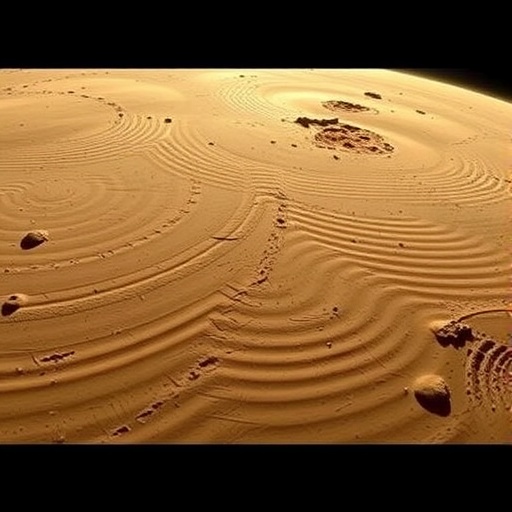
In an extraordinary breakthrough that deepens our understanding of Mars’ ancient environment, scientists have uncovered tangible evidence of a sandstorm that ravaged the Gale crater more than three billion years ago. This discovery not only underscores the dynamic nature of the Martian atmosphere during its early history but also significantly enhances our comprehension of the planet’s climatic conditions when water was far more abundant on its surface.
At the forefront of this research is planetary geologist Steven Banham from Imperial College London, who, alongside a dedicated team, identified unique sedimentary structures captured by NASA’s Curiosity rover. These structures, known as supercritical climbing wind ripples, are distinctive millimeter-thick laminations formed by the rapid movement of sand grains under intense, sustained winds. Unlike typical dune or ripple formations caused by seasonal winds or long-term climate patterns, these ripples are signatures of severe, short-duration windstorms—sandstorms that lasted only minutes to hours—a phenomenon previously undocumented on Mars.
The significance of these findings lies in the rarity and nature of the sedimentary deposit. On Earth, wind ripple strata like these are seldom observed because they require very specific conditions of wind velocity and sediment availability to form and be preserved in the rock record. Their discovery on Mars is unprecedented and represents the first definitive proof that the Red Planet once experienced windstorms of considerable intensity. Until now, while it was accepted that Mars had an atmosphere capable of generating wind, direct evidence of such extreme meteorological events had eluded scientists.
The Curiosity rover’s imaging systems played a pivotal role in this discovery. The team first noticed anomalies in black-and-white panoramic images obtained at the end of one of Curiosity’s drives. These features piqued their curiosity, prompting them to employ higher-resolution color cameras, including the MASTCAM, for detailed examination. This targeted imaging revealed intricate ripple patterns with supercritical climbing geometries—structures indicative of sand grains moving in a highly dynamic environment, where sand avalanching and migration occur simultaneously under powerful gusts.
The presence of such wind ripple strata also carries critical implications for the ancient Martian atmosphere. Current modeling and measurements indicate that today’s atmosphere on Mars is too thin to generate winds strong enough to transport and deposit sand on this scale. Therefore, the newly discovered ripples implicate a past atmosphere denser than today’s, potentially approaching conditions more akin to early terrestrial environments. This denser atmosphere would have had a profound impact on climate, weather, and the potential habitability of Mars during the period when water activity was pronounced.
Furthermore, the timing of this event is crucial, occurring roughly 3.6 billion years ago—a window when Mars was transitioning from a wetter and potentially life-supporting world to the cold, dry planet we observe now. The sandstorm’s occurrence provides context for understanding shifts in atmospheric density, composition, and surface interactions during this transformative era. It paints a vivid picture of episodic, extreme weather phenomena playing a role in shaping the Martian landscape and its sedimentary record.
Banham emphasizes the almost cinematic nature of this occurrence: envisioning a sudden, turbulent sandstorm sweeping across Gale crater, generating these exquisite ripple deposits and leaving behind a momentary record in the geological record. The notion that such ephemeral events, lasting mere hours and fleeting in the planet’s deep time history, can now be reconstructed with such clarity through rover instruments is truly remarkable.
The serendipity involved in this discovery adds an intriguing narrative layer to the findings. Rather than a planned investigation, it was by chance and sharp observation that Banham and his colleagues identified these unusual formations. This underscores the importance of real-time analysis and the diverse expertise of the scientific teams operating Mars rovers, who continuously monitor countless images and data streams for subtle clues about the planet’s past.
Looking forward, the team hopes this discovery will catalyze further explorations into Mars’ sedimentary structures and atmospheric history. One particularly enticing prospect is the search for rain impact marks—physical evidence of precipitation on Mars’ surface. While there is abundant indirect evidence for ancient water flows, like riverbeds and lake sediments, direct traces of rainfall impacts remain elusive. Their identification would dramatically advance our understanding of Martian hydrology and climate cycles.
This revelation also carries vital implications for planetary science and astrobiology. Understanding the dynamic ancient weather conditions helps constrain models of atmospheric evolution and surface habitability. Although the sandstorm evidence does not directly prove past life on Mars, it enriches our understanding of environmental variables that would have influenced potential habitable niches and the preservation of biosignatures.
The research is meticulously documented in the journal Geology, providing a technical framework for interpreting these supercritical climbing wind ripple strata. The work not only highlights the versatility and power of the Curiosity rover but also the synergy between engineering marvels and scientific inquiry in remote planetary environments.
In sum, the documentation of a supercritical climbing wind ripple sandstorm in Gale crater serves as a testament to Mars’ once-active and complex environment, offering a glimpse into the meteorological forces that sculpted its surface billions of years ago. This discovery exemplifies the spirit of exploration and the continual rewriting of planetary history as new evidence is unearthed from the Martian terrain.
Subject of Research: Ancient sandstorm evidence on Mars through sedimentary wind ripple structures
Article Title: An ancient sandstorm recorded by supercritical climbing wind ripple strata in Gale crater, Mars
News Publication Date: 2026
Web References:
- DOI link: http://dx.doi.org/10.1130/G54158.1
References:
Banham, S., et al., 2026, An ancient sandstorm recorded by supercritical climbing wind ripple strata in Gale crater, Mars; Geology.
Image Credits:
NASA/JPL-Caltech/MSSS
Keywords
Mars, Gale crater, Curiosity rover, supercritical climbing wind ripples, sandstorm, sedimentary structures, ancient atmosphere, Martian climate, planetary geology, wind erosion, sediment transport, extraterrestrial weather phenomena


