

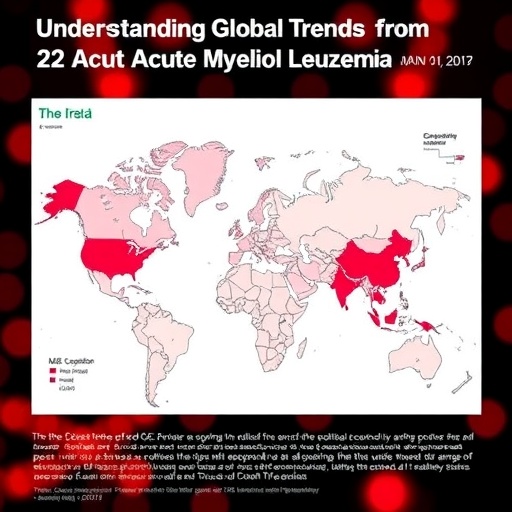
Acute myeloid leukemia (AML) stands as one of the most aggressive hematological malignancies confronting the global medical community today. Its incidence escalates predominantly with advancing age and exhibits enormous geographic variability, influenced by an intricate tapestry of factors. These include environmental exposures, genetic predispositions, regional healthcare capabilities, and disparities in diagnostic infrastructure. Recent advances in molecular biology and immunotherapy have ushered in an era of novel targeted therapies, profoundly changing the landscape of AML treatment, but such progress remains disproportionately accessible. The burden of AML continues to be unequally distributed, disproportionately impacting low-income and middle-income countries where older, less effective therapies persist as standard care, highlighting glaring inequities in global health.
The epidemiological footprint of AML reveals stark contrasts between high-income countries and those with constrained healthcare resources. In affluent nations, the incidence of AML has witnessed a gradual increase over recent decades, a phenomenon attributable primarily to population aging and enhanced diagnostic sensitivity. Sophisticated molecular diagnostics enable early and precise identification of AML subtypes, fostering timely intervention strategies. Conversely, in many low- and middle-income countries, AML incidence appears lower on paper but is linked to disproportionately higher mortality rates and disease-related complications. This troubling paradox reflects systemic inadequacies in healthcare delivery, including delayed diagnosis, limited access to effective chemotherapy, and the paucity of allogeneic hematopoietic stem cell transplantation (HSCT) programs.
The pathogenesis of AML is multifactorial, underpinned by a complex interplay between inherited genetic variants, environmental influences, and prior medical treatment exposures. Germline mutations affecting genes involved in hematopoiesis and DNA repair pathways can significantly elevate AML susceptibility, laying the foundation for malignant transformation. Beyond genetics, environmental elements such as prolonged exposure to benzene, ionizing radiation, and industrial chemicals augment leukemogenic risk. Additionally, lifestyle factors – including tobacco use and obesity – have emerged as modifiable exposures that may contribute to AML pathogenesis. Prior chemotherapy, especially alkylating agents and topoisomerase II inhibitors, as well as therapeutic radiation, drastically increase the incidence of therapy-related AML (t-AML), a subtype notoriously resistant to standard treatments.
Demographic disparities further complicate the global epidemiology of AML. Age remains the strongest determinant of disease incidence, with the median age at diagnosis surpassing 65 years in developed countries. However, in some lower-income regions, diagnosis occurs at significantly younger ages, potentially reflecting different etiologic factors or healthcare access patterns. Gender also influences AML risk, with males exhibiting higher incidence rates worldwide. Socioeconomic status intersects with these demographic variables, shaping both exposure to risk factors and access to timely, effective treatment. Ethnic and racial differences in AML incidence and outcomes reflect a combination of genetic predispositions and structural inequities in healthcare systems that demand nuanced exploration.
Treatment paradigms for AML have evolved substantially in the past decade, propelled by breakthroughs in targeted therapy and improvements in supportive care. High-income countries have embraced new agents such as FLT3 inhibitors, IDH1/2 inhibitors, and BCL-2 antagonists, which have substantially improved remission rates and overall survival. Furthermore, progressive refinements in HSCT protocols – including reduced-intensity conditioning and enhanced graft-versus-host disease prophylaxis – have expanded transplant eligibility and safety. Despite these strides, patients in less affluent settings often remain reliant on cytotoxic chemotherapy regimens developed in the mid-20th century, highlighting the critical gap in global treatment equity and underscoring the need for broader dissemination of novel therapies.
The disparity in AML outcomes is glaring, with survival rates in high-income countries climbing steadily due to early diagnosis and improved treatment strategies. Five-year survival in some regions now exceeds 40%, a remarkable milestone compared with historical data. However, survival in low- and middle-income countries lags considerably, frequently falling below 20%. Contributing factors include late-stage disease presentation, lack of supportive care infrastructure for managing complications, and the absence of allogeneic HSCT programs, which remain the only curative modality for many AML subtypes. This global discrepancy highlights the urgency for international collaboration, resource sharing, and capacity building in under-resourced regions.
Globally, cancer registries serve as the backbone for epidemiological surveillance, yet AML is frequently underreported or inaccurately classified, particularly in less developed countries. Strengthening population-based cancer registries is crucial to capturing precise incidence and outcome data, enabling evidence-driven public health interventions. The heterogeneity in data collection standards across countries compounds challenges in global AML epidemiology analysis. Harmonized data protocols and integration of molecular diagnostic results into registries could transform understanding of AML burden and guide resource allocation effectively.
Artificial intelligence (AI) offers promising avenues to revolutionize AML surveillance and research. By leveraging machine learning algorithms and big data analytics, AI can integrate diverse data modalities – including genomics, clinical records, and epidemiological data – to uncover novel risk patterns, predict treatment responses, and stratify patient risk profiles with unparalleled precision. Deploying AI-driven tools in low-resource settings could augment diagnostic capabilities and optimize treatment regimens, ultimately narrowing the survival disparity gap. However, ethical considerations and infrastructure investments remain pivotal prerequisites for widespread AI adoption in global health systems.
Clinical trial representation remains another critical hurdle in addressing AML globally. Patients from low- and middle-income countries are vastly underrepresented in pivotal clinical studies, limiting the generalizability of therapeutic advances. Overcoming barriers such as regulatory complexities, logistical challenges, and financial constraints is imperative to democratize clinical research participation. Enhancing clinical trial networks and fostering international partnerships could facilitate inclusive studies that reflect diverse patient populations, ensuring that therapeutic innovations benefit all corners of the world.
Environmental and occupational risk factor mitigation holds substantial promise in reducing AML incidence worldwide. Policies aimed at minimizing exposure to leukemogenic agents like benzene and radiation, stricter industrial safety regulations, and public health campaigns targeting smoking cessation and healthy lifestyle adoption could alleviate population risk burdens. Integrating such preventive strategies within broader cancer control programs would complement advances in treatment and improve overall hematologic health outcomes on a global scale.
The integration of germline genetic screening into routine AML assessment may identify at-risk individuals before disease onset, enabling targeted surveillance and early intervention. Advances in next-generation sequencing have made such approaches increasingly feasible, albeit currently limited to high-income settings. Expanding equitable access to genetic counseling and testing is essential to harness the full preventive potential of precision medicine in AML.
Demographic and epidemiological shifts, driven by urbanization, environmental pollution, and changing population structures, will continue to shape the AML landscape. Robust, coordinated efforts encompassing healthcare system strengthening, innovation dissemination, and policy reforms are vital to address the dynamic AML burden effectively. Mapping these epidemiological currents with precision requires ongoing investment in data infrastructure and cross-sectoral collaboration among clinicians, researchers, public health experts, and international organizations.
In conclusion, the global epidemiology of AML is characterized by increasing incidence in developed countries concurrent with persistent disparities in outcomes worldwide. Multifaceted risk factors interplay intricately to influence disease patterns, underscoring the complexity of AML as a public health challenge. Advances in diagnostics, therapeutics, and supportive care herald hope for better patient survival, but these gains must be made universally accessible through concerted global efforts. Strengthening cancer registries, leveraging AI, promoting equitable clinical trial access, and advancing preventive strategies are essential pillars to bridge current gaps. Only through integrative, multidisciplinary approaches can the promise of recent scientific breakthroughs be transformed into tangible improvements for all patients battling AML.
Subject of Research:
Global epidemiology, risk factors, demographic disparities, and treatment outcomes of acute myeloid leukemia (AML).
Article Title:
The global epidemiology of acute myeloid leukaemia.
Article References:
El Chaer, F., Bewersdorf, J.P., Stahl, M. et al. The global epidemiology of acute myeloid leukaemia. Nat Rev Clin Oncol (2025). https://doi.org/10.1038/s41571-025-01099-7
Image Credits:
AI Generated


