

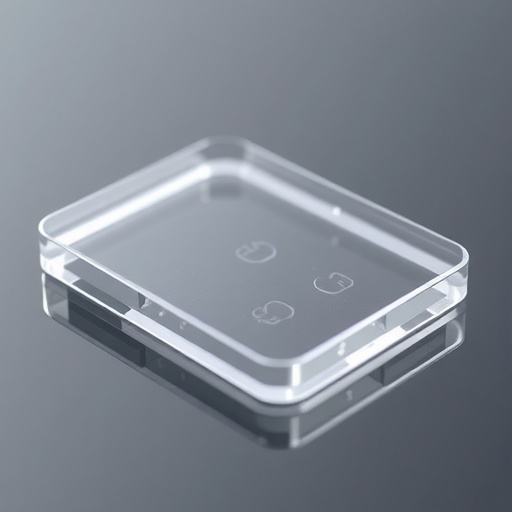
In the relentless pursuit of materials that seamlessly blend functionality and clarity, researchers have engineered a groundbreaking polymer brush coating that marries exceptional transparency with formidable antibacterial properties. This innovation promises to redefine the standards of optical device coatings, overcoming the persistent dilemma of preserving optical clarity while ensuring long-term resistance to microbial colonization—a challenge that has hindered the durability and performance of imaging and display technologies in diverse settings.
At the heart of this advancement lies the creation of a surface-grafted poly(methacrylic acid) (PMAA) polymer brush layer, meticulously fabricated to achieve a nanoscale thickness of approximately 52 nanometers. The ultrathin nature of this brush layer is critical, offering a minimized impact on light transmission while establishing a robust scaffold for further functionalization. The strategic inclusion of transition metal ions—chiefly copper and silver—into the polymer matrix via precise coordination to the carboxyl groups of PMAA breathes new life into this interface.
The synthesis involves a nuanced in situ reduction process facilitated by dimethylformamide, which transforms the coordinated metal ions into their metallic states within the brush architecture. This metalation process results in coatings with thicknesses incrementally adjusted to approximately 60.07 nanometers for copper and 57.45 nanometers for silver incorporations—dimensions that maintain intimate control over optical properties. The successful integration of these metals, as affirmed by advanced spectroscopic analysis, reveals a complex surface chemistry where metallic and oxide species coexist, delivering the desired bioactive functionalities without compromising the coating’s structural integrity.
A pivotal characterization technique, X-ray photoelectron spectroscopy (XPS), validates the presence of these metals spread uniformly across the coating surface, registering atomic concentrations of 7.49% for copper and 7.12% for silver. These specific ratios underscore an optimized balance, maximizing antibacterial potency while safeguarding optical clarity. Remarkably, despite the embedded metallic agents, the composite coatings sustain a high optical transmittance rate near 86%, which is vital for applications demanding uncompromised light throughput.
The antimicrobial efficacy of the metalated brushes is nothing short of extraordinary. The coatings demonstrate inhibitory effects exceeding 99.99% against polymorphic bacterial strains including Escherichia coli and Staphylococcus aureus. This level of inhibition dramatically surpasses the capabilities of the bare polymer brush coatings, illustrating the profound impact of metal ion incorporation. In parallel, antifouling tests reveal minimal adsorption of proteinaceous foulants, a crucial factor in mitigating biofilm formation and extending the lifespan of optical components in real-world environments prone to biological contamination.
Further pushing the boundaries of applied science, the research team deployed the copper-enhanced coating on a commercial camera lens. Subjected to continuous immersion in natural outdoor waters—encompassing both clear and turbid conditions—for an extended span of 31 days, the coated lens maintained its visual performance and structural stability. Notably, the optical transmittance decreased by less than 2%, and elemental analysis post-immersion recorded a marginal decrease in surface copper content from 7.49% to 7.12%, highlighting exceptional durability under challenging environmental exposures.
These findings resonate profoundly in the realm of underwater imaging, medical optics, and interactive touch displays, where the dual necessity for transparency and biofouling resistance is paramount. Traditional surface treatments often force a compromise: enhance antibacterial activity at the expense of optical clarity or vice versa. The metalated polymer brush coating surmounts this trade-off, delivering robust antibacterial defense while preserving the optical fidelity essential for high-performance devices.
The nanoscale fabrication approach employed here is particularly noteworthy. By grafting polymer brushes directly onto the substrate, the researchers have designed a functional surface that is both chemically versatile and physically thin. This architecture allows for precise spatial control over metal ion distribution and oxidation states, tailoring the antibacterial response while maintaining compatibility with delicate optical systems.
The incorporation of copper and silver as bioactive agents leverages their well-documented antimicrobial mechanisms—primarily the generation of reactive oxygen species and disruption of microbial membranes—providing a multifaceted attack against potential colonizers. Unlike bulk metal coatings, which can scatter light and degrade transparency, the metalated polymer brush matrix immobilizes these agents at an ultrathin interface, ensuring sustained efficacy with minimal optical interference.
Beyond laboratory metrics, the pragmatic validation of the coating in authentic environmental settings establishes its real-world applicability. The stability of the metal content and the negligible degradation in optical transmission under prolonged water exposure suggest that this coating technology can withstand the rigors of dynamic and biologically active aquatic environments.
Taken together, these results propel the frontier of transparent antibacterial coatings forward, unlocking new avenues for enhancing the operational lifetime and reliability of optical instruments subjected to biofouling. By marrying sophisticated polymer brush technology with strategic metal integration, this research offers a transformative solution addressing a longstanding challenge in materials science and biointerface engineering.
As industries increasingly demand multifunctional coatings capable of operating flawlessly under biological assault, this metalated polymer brush represents a promising blueprint. Future research may extend this platform toward other bioactive metals, further tailoring antimicrobial spectra and biocompatibility profiles, while exploring scaling and integration strategies for diverse optical substrates.
In summary, the innovative approach pioneered here balances the seemingly incompatible demands of optical transparency and persistent antibacterial action. It sets a precedent for the design of next-generation coatings that are both technologically advanced and environmentally resilient, meeting the escalating requirements of modern optical applications across healthcare, environmental monitoring, and consumer electronics.
Subject of Research: Not applicable
Article Title: Metalated polymer brush coatings with excellent transparence and antibacterial properties
News Publication Date: 5-Dec-2025
Web References: http://dx.doi.org/10.1007/s11705-025-2589-3
Image Credits: HIGHER EDUCATION PRESS
Keywords
Physical sciences / Chemistry


