

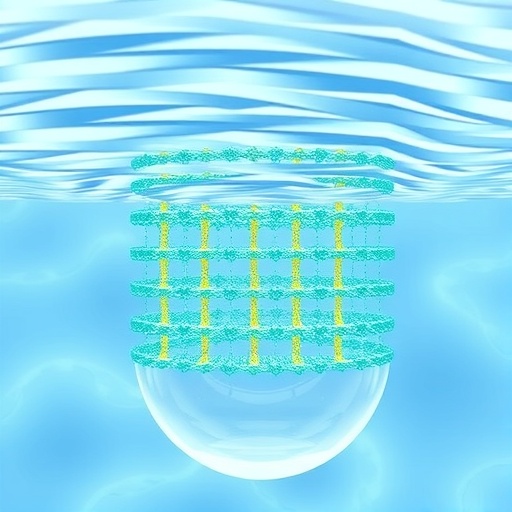
In the quest to solve one of humanity’s most pressing challenges—providing clean, drinkable water—scientists have continuously pushed the boundaries of desalination technology. The latest breakthrough comes from a team led by Zhao, Wang, Zhu, and colleagues, who unveiled a novel solar–vacuum dual-driven desalination system capable of producing fresh water from high-salinity brine with unprecedented speed and efficiency at low temperatures. This innovation leverages the unique properties of photo-responsive covalent organic framework (COF) membranes to transcend the limitations of existing methods, offering a glimmer of hope for sustainable water treatment in a warming world.
Traditional desalination methods like reverse osmosis have long been employed to convert seawater and brackish water into potable water. However, reverse osmosis struggles with highly saline water, as the energy required to push water through semipermeable membranes rises exponentially with increased salt concentration. Alternative techniques like pervaporation membranes have shown promise, especially for salt concentrations that challenge reverse osmosis. Yet, the performance of pervaporation membranes has been dampened by their relatively low water flux, particularly at low operating temperatures. Addressing this bottleneck has remained a critical hurdle for advancing membrane technologies.
The team introduced an ingenious solar–vacuum dual-driven approach to circumvent the conventional trade-offs between water flux, temperature, and salt rejection. Central to this technique is the employment of photo-responsive COF membranes structured at the nanoscale, whose architecture allows precise manipulation of water transport pathways. By harnessing solar energy to activate both photothermal and photoelectric effects at the nanochannel entrances of these membranes, the researchers ingeniously disrupt hydrogen bonding networks among water molecules. This disruption effectively lowers the energy barrier for water entry, facilitating rapid permeation even at ambient temperature conditions.
This photonic activation plays a pivotal role in advancing pervaporation, which traditionally relies on thermal energy to vaporize water molecules for separation. By applying solar energy directly to membrane surfaces, the system stimulates water transport without requiring the elevated temperatures conventionally needed—an advancement that drastically reduces energy consumption. The subsequent vacuum-driven transport further accelerates water passage through the membrane’s functionalized nanochannels, exploiting the pressure differential to maximize throughput. This synergy of solar excitation and vacuum suction results in exceptional water flux rates.
Quantitatively, the system achieved a staggering water flux of 120 kilograms per square meter per hour when purifying highly saline brine solutions with salt content as high as 7.5 wt% at just 30°C. Equally impressive is the desalination performance’s salt rejection efficiency, which exceeded 99%, affirming the membrane’s capability to effectively exclude salt ions while allowing water molecules to permeate swiftly. Notably, this water flux is comparable to conventional pervaporation processes operating at significantly higher temperatures—around 70°C—demonstrating a breakthrough in low-temperature membrane performance.
Further assessments revealed the system’s robust versatility across a broad salinity range, from relatively mild seawater conditions at 0.1 wt% salinity up to hypersaline solutions at 7.5 wt%. Even at these extremes, the membranes maintained structural integrity and high performance, underscoring their exceptional stability. The researchers attributed this durability to the strategic design of the COF membrane structure, which exhibits a well-tuned polarity and hydrophilicity balance. This molecular-level tailoring optimizes water interactions while resisting fouling and degradation over extended use periods.
Behind the remarkable membrane performance lies the elegant chemistry and engineering of the covalent organic framework. These frameworks comprise highly ordered organic linkers connected by strong covalent bonds, creating well-defined nanopores with uniform size distributions. By incorporating photo-responsive moieties into this matrix, the membranes respond actively to incident light, altering their physicochemical environment dynamically. This capacity to modulate hydrogen bonding and water molecule interactions on demand marks a significant leap in membrane science, integrating photonics into traditional separation processes.
The photothermal effect induced by solar illumination heats localized regions at the nanochannel entrances, aiding water molecule evaporation and mobility. Meanwhile, the photoelectric effect introduces charge dynamics that disrupt the hydrogen bond network more directly, easing the transition of water molecules through the nanochannels. The simultaneous exploitation of these two photophysical phenomena differentiates this system from prior designs that rely solely on bulk heating or passive membrane filtration.
Importantly, this technology offers meaningful implications for sustainable desalination on a global scale. Conventional thermal desalination approaches consume substantial fossil fuel energy, while reverse osmosis depends heavily on electricity-intensive high-pressure pumps. By contrast, this hybrid solar-vacuum system harnesses clean, abundant solar radiation as a primary energy source, dramatically cutting carbon emissions associated with freshwater production. Moreover, operating effectively at ambient or modestly elevated temperatures reduces thermal stress on materials, promising longer membrane lifetimes and lower maintenance costs.
The high water flux rates achieved here also translate to smaller membrane surface requirements for equivalent output, furnishing a pathway to reduce plant footprints and scaling complexity. This facet could be especially beneficial for decentralized or off-grid desalination installations in remote or resource-limited settings. The system’s ability to handle highly concentrated brines, often discarded as waste in other processes, points to new opportunities for brine management and zero-liquid discharge frameworks.
Beyond desalination, the insights gained in coupling photothermal and photoelectric effects at the nanoscale open frontiers for other molecular separation technologies. For instance, recovery of valuable solutes from industrial effluents or selective solvent extraction could benefit from similar membrane designs responsive to tailored light stimulation. The marriage of covalent organic frameworks with optoelectronic functionalities heralds a new paradigm where membranes are no longer passive sieves but active, tunable interfaces.
The study’s robustness was further validated through extended testing durations and exposure to varied feed water compositions, where the membranes sustained performance with minimal flux decline and retained salt rejection above 99%. This endurance underscores the practical readiness of the technology and foreshadows swift translation from laboratory prototypes to pilot-scale and commercial implementations. The team emphasized ongoing work to integrate scalable fabrication methods and assess long-term environmental impacts.
Critically, this dual-driven system resolves the central challenge of balancing membrane permeability and selectivity at low temperatures. The conventional trade-off, where increasing flux often comes at the cost of salt passage, is sidestepped owing to the intelligent mechanism disrupting energetic barriers selectively for water molecules. This molecular discrimination, empowered by photo-responsive chemistry, aligns well with the wider goals of precision engineering in separation science.
In conclusion, Zhao and co-authors have carved a transformative path in membrane desalination technology, leveraging a sophisticated cross-disciplinary approach uniting nanomaterials, photophysics, and fluid dynamics. Their solar–vacuum dual-driven photo-responsive COF membranes exemplify how fundamental advances in material science can directly address global water scarcity through energy-efficient, scalable solutions. As water demands swell amid climatic uncertainties, innovations like this will be critical to securing resilient, sustainable water supplies worldwide.
This work not only expands the frontiers of membrane processes but also redefines the roles that light and energy coupling can play in selective molecular transport. The paradigm shift embodied in this technology promises a future where low-energy, high-flux desalination can be deployed broadly, improving access to clean water with reduced environmental footprints.
With these promising results freshly reported, the scientific community eagerly anticipates the next stages of development, including field demonstrations and integration with renewable energy infrastructures. The advancement spotlights photo-responsive covalent organic frameworks as a versatile platform with broad applicability, inspiring further exploration across membrane and separation disciplines. Ultimately, it marks a significant milestone towards realizing sustainable water systems powered by sunlight and cutting-edge materials engineering.
Subject of Research: Advanced membrane desalination technology utilizing photo-responsive covalent organic framework membranes for low-temperature, high-flux water purification.
Article Title: Ultrafast low-temperature pervaporation desalination with photo-responsive covalent organic framework membranes.
Article References:
Zhao, J., Wang, Y., Zhu, Z. et al. Ultrafast low-temperature pervaporation desalination with photo-responsive covalent organic framework membranes. Nat Water (2025). https://doi.org/10.1038/s44221-025-00538-0
Image Credits: AI Generated


