

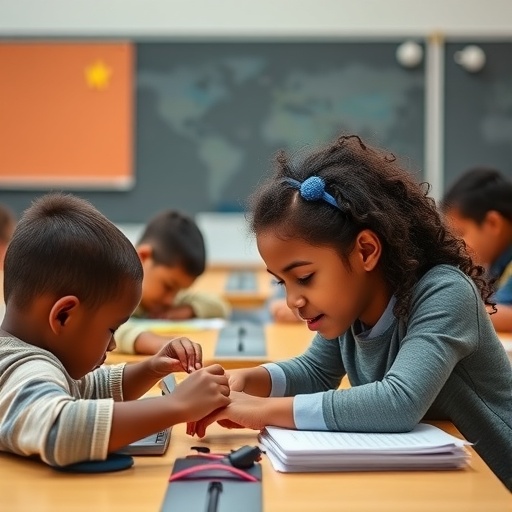
A groundbreaking international study spearheaded by Universidad Carlos III de Madrid (UC3M), with significant contributions from the WZB Berlin Social Science Center, provides transformative insights into the intersection of socioeconomic background and educational effort among children. This research, recently published in the prestigious American Sociological Review, ventures beyond traditional assumptions to illuminate the nuanced ways in which social class shapes the cognitive engagement of schoolchildren, and more importantly, how strategic classroom incentives can effectively mitigate these disparities.
The research emerges from a pressing question long debated but insufficiently answered in educational sociology: Which children exert more effort in school, and how is this influenced by their socioeconomic milieu? While previous studies often lacked robust empirical backing, this inquiry presents rigorously collected data that clarifies the socioeconomic gradient in children’s willingness to apply cognitive effort during learning tasks. Central to the findings is the recognition that children from socioeconomically privileged backgrounds demonstrate a noticeably higher degree of intrinsic motivation and sustained cognitive effort compared to their less privileged peers, especially in environments devoid of external rewards.
However, the study disrupts deterministic narratives about innate ability or personality traits being the root causes of effort disparities. It compellingly argues that these behavioral differences stem principally from the social environment, particularly the availability of family resources and the daily security children perceive. Children raised amidst scarcity—characterized by limited financial means and reduced parental attention—experience significant challenges in maintaining consistent concentration and motivation, pointing to a contextual rather than an individual deficit.
The investigation unfolds against the backdrop of a large-scale experimental design involving 1,360 fifth-grade students across diverse urban settings in Madrid and Berlin. These participants engaged in carefully constructed cognitive tasks that measured facets such as concentration, attention, and self-control. The children’s performances were observed under three distinct motivational conditions: a baseline with no incentives, a rewarded scenario offering small tangible prizes, and a competitive tournament framework that incorporated symbolic recognition and social validation.
Intriguingly, while intrinsic motivation fueled by personal achievement drives privileged students to outperform their disadvantaged counterparts under no-incentive conditions, the introduction of even modest external incentives dramatically levels the playing field. Small rewards—ranging from toys to forms of social acknowledgment—significantly uplift the engagement and cognitive effort of children from lower socioeconomic backgrounds. Under these incentivized conditions, the engagement gap narrows substantially, suggesting that motivation is malleable and highly responsive to structured reinforcement mechanisms.
The lead author, Jonas Radl, a distinguished Associate Professor of Sociology at UC3M and Visiting Research Professor at WZB, emphasizes how these findings challenge the simplistic meritocratic ideal, which postulates that all children’s outcomes are solely a function of their effort. Instead, the research advocates for an understanding that children’s motivational capacities are deeply entwined with the social and economic contexts that frame their daily experiences, underscoring that lack of resources—not a lack of desire—is a chief barrier to effort and achievement among disadvantaged groups.
This study’s practical implications resonate powerfully for educational policy and practice. If schools recalibrate their approaches to student evaluation—placing greater emphasis on progress and effort alongside final academic outcomes—they could foster a more inclusive learning environment. The use of gamification and playful learning emerges as particularly promising. By harnessing the natural human proclivity for play, educational methods can be reimagined to sustain engagement and incentivize effort effectively, especially for those students facing social and economic challenges.
The experimental results advocate for a paradigm shift that sees classroom incentives not merely as superficial rewards but as critical tools for addressing entrenched social inequalities in education. When small prizes or public recognition become integral to learning environments, they help democratize motivation, bringing children from diverse backgrounds to comparable levels of participation and cognitive effort. This intervention thereby grants educational equity not by reducing standards but by adjusting motivational mechanics.
Embedded within the broader EFFORT project, funded by the European Research Council (ERC), this research contributes to a sophisticated understanding of how parental origin and social inequality perpetuate through patterns of effortful behavior. Rather than focusing solely on cognitive ability or intelligence, the project illuminates how motivational dynamics serve as a conduit for reproducing or challenging social stratification within educational systems.
The methodological rigor of this study, combining experimental psychology with sociological analysis across national contexts, imbues the findings with remarkable validity and relevance. The cross-cultural replication in both Madrid and Berlin underscores the universal applicability of the insights, reinforcing that socioeconomic influences on effort transcend unique local circumstances.
Ultimately, this research signals hope for the creation of learning ecosystems where effort is nurtured equitably through thoughtfully designed incentive structures. The amplification of social recognition and the deployment of gamified learning strategies stand out as promising avenues for education systems worldwide striving to minimize class-based disparities and foster equal opportunities.
By redefining effort as a socially conditioned phenomenon responsive to environmental cues and structured rewards, the study reshapes the conversation on educational inequality. It encourages policymakers, educators, and researchers alike to pivot towards interventions that strategically harness motivation dynamics, thereby promoting social mobility and enhancing the fairness of educational experiences.
Subject of Research: People
Article Title: The Social Origins of Effort: How Incentives Reduce Socioeconomic Disparities among Children
News Publication Date: 13-Jan-2026
Web References: http://dx.doi.org/10.1177/00031224251401933
Image Credits: Barbara Schlüter
Keywords: Social class, Social research, Sociology, Sociological data, Social inequality, Human social behavior, Group dynamics


