

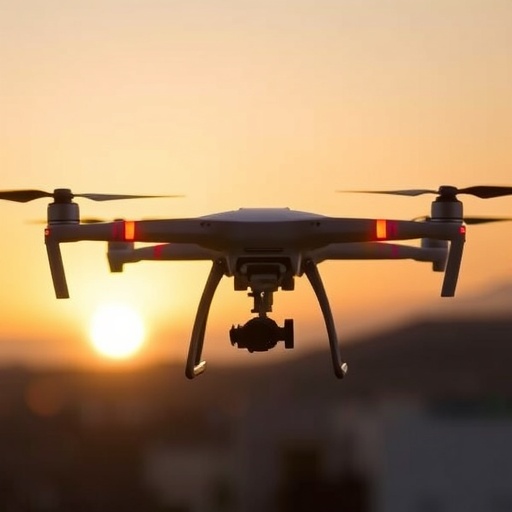
In a groundbreaking revelation that underscores the vulnerabilities of modern autonomous drone technologies, researchers at the University of California, Irvine have uncovered a significant security flaw in commercially available target-tracking drones. This discovery casts a shadow on the burgeoning use of AI-powered autonomous systems in sensitive fields such as public safety, border control, and law enforcement. The UCI team demonstrated an innovative attack vector using an everyday object—an umbrella—adorned with a specially crafted visual pattern to manipulate drones into drawing nearer to the attacker, thereby exposing critical weaknesses in drone autonomy and object-tracking algorithms.
The crux of this research revolves around the development of a physical-world attack framework named FlyTrap. This method exploits systemic deficiencies in the camera-based, neural network-driven autonomous tracking capabilities integral to many consumer and professional drones. Often marketed under names such as “active track” or “dynamic track,” these systems enable drones to independently follow designated targets without real-time human control, making them appealing for myriad operational scenarios, including security monitoring and law enforcement pursuits.
Presented at the prestigious Network and Distributed System Security Symposium held in San Diego, the findings highlight a dimension of risk hitherto unexplored comprehensively in academic and industry circles. According to co-author Alfred Chen, an assistant professor at UC Irvine’s Department of Computer Science, while autonomous tracking technologies hold immense promise for enhancing law enforcement and border security efficiency, their susceptibility to malicious exploitation demands urgent scrutiny and preemptive countermeasures.
The attack detailed by the research team is ingeniously termed a “distance-pulling” attack. The mechanism subverts drone autonomy by manipulating the drone’s perception of target distance via misinterpretation of the visual cues presented by the umbrella’s patterned surface. The aircraft’s onboard neural networks are deceived into interpreting the stationary umbrella as a receding human target. Consequently, the drone compensates by continuously moving forward to maintain what it erroneously perceives as an optimal tracking distance, thus effectively “pulling” the drone into physical proximity with the attacker.
Three commercial drone models—DJI Mini 4 Pro, DJI Neo, and HoverAir X1—were subjected to rigorous testing to validate the FlyTrap methodology. In each case, the attack succeeded in breaching the drones’ autonomy and eliciting behavior that made them vulnerable to capture via net guns or induced crash landings. This tangible proof-of-concept showcases not only the feasibility but also the potential severity of such attacks in operational environments where drones are relied upon for surveillance and security.
The implications of this security breach are multifaceted and alarming. Criminal entities could harness the FlyTrap technique to evade surveillance and detection by law enforcement drones, undermining public safety initiatives. Border patrolling operations utilizing autonomous drones also face the risk of adversarial interference, potentially allowing unauthorized crossings or contraband transport under drone radar. Conversely, individuals subjected to unlawful surveillance or harassment by drones might exploit this vulnerability defensively, neutralizing invasive devices through a low-tech yet scientifically sophisticated approach.
Significantly, the FlyTrap attack functions independently of any wireless signals or external data inputs, instead relying solely on visual perception manipulation. This local operational nature renders conventional cybersecurity defenses, such as encryption or network security protocols, ineffective. Moreover, the attack’s robustness across varying environmental conditions—including diverse lighting and weather scenarios—demonstrates a practical threat level considerably higher than previous theoretical or lab-bounded adversarial examples.
The research team has proactively disclosed the vulnerabilities and their findings to drone manufacturers DJI and HoverAir, fostering a collaborative environment aimed at fortifying drone security. The broader academic release includes comprehensive documentation, publicly accessible datasets, evaluation metrics, and multimedia demonstrations that collectively enable further exploration and mitigation strategies within the cybersecurity and autonomous systems communities.
Technical aspects of the FlyTrap framework include a progressive, iterative distance-pulling strategy that capitalizes on weaknesses in the drone’s target-tracking neural networks. By generating visual patterns optimized to induce false distance inferences, the researchers exploited the gap between AI perception models and the unpredictable complexity of real-world environments. This approach is distinguished by its elegance and reliance on physical-world inputs rather than cyber-intrusions, marking a new frontier in adversarial attacks on autonomous systems.
This revelation emphasizes a broader challenge in deploying AI-powered autonomous technologies—ensuring resilience not only against digital cyber threats but also novel physical and optical attack methodologies. As autonomous systems increasingly interface with critical infrastructure and public domains, safeguarding these technologies from exploitation is imperative. The FlyTrap project serves as a clarion call for interdisciplinary efforts bridging AI, cybersecurity, and robotics engineering to develop robust, fail-safe defense mechanisms.
The UC Irvine researchers’ contribution marks a pivotal advancement in understanding and countering drone vulnerabilities. The collaboration involves a diverse team comprising graduate and postdoctoral scholars, alongside faculty experts in computer science and electrical engineering, reflecting the multi-dimensional expertise essential for tackling contemporary technological risks. Support from prominent institutions like NASA and the National Science Foundation underscores the strategic importance accorded to this field of inquiry.
In summary, the FlyTrap study lays bare a critical security gap with significant societal and operational ramifications. By exposing a straightforward yet profound method to subvert drone autonomy using everyday items, the research invigorates dialogue on drone ethics, policy, and security best practices. As autonomous aerial vehicles continue to penetrate civil and governmental applications, such rigorous, transparency-driven research initiatives are vital to ensuring these technologies augment rather than compromise collective security.
Subject of Research: Security vulnerabilities and adversarial attacks on autonomous target-tracking drones.
Article Title: This information is not explicitly provided.
News Publication Date: February 25, 2026.
Web References:
- Network and Distributed System Security Symposium: https://www.ndss-symposium.org/
- Project Website: https://sites.google.com/view/av-ioat-sec/flytrap
- Demonstration Videos: https://www.youtube.com/playlist?list=PLlViq2qGRmiYQUEovXYaP3ww9AlWH4ZBt
- Extended Research Paper: https://arxiv.org/abs/2509.20362
References: The project paper as listed above (arXiv:2509.20362).
Image Credits: Not provided.
Keywords
Autonomous drones, target-tracking security, FlyTrap attack, adversarial AI, neural network deception, physical-world attacks, drone vulnerabilities, distance-pulling attack, drone capture and crash, drone surveillance risks, cybersecurity for robotics, autonomous system manipulation.


