

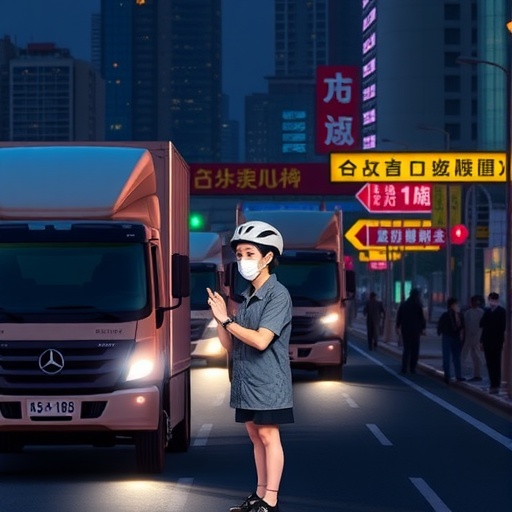
In the face of mounting environmental challenges and the urgent need to curb carbon emissions, China’s road freight sector is emerging as a critical battlefield for climate change mitigation. Recent research spearheaded by Xu, Ou, Peng, and their colleagues sheds compelling light on a transformative approach that promises to recalibrate the entire logistics landscape in the world’s largest economy. The study, published in Nature Communications, explores the untapped potential of truck-hailing platforms coupled with operational efficiency enhancements as pivotal drivers for decarbonizing China’s vast road freight system. This research represents not just an incremental step but a paradigm shift, offering a blueprint for sustainable freight management that could resonate far beyond national borders.
China’s road freight industry, characterized by its mammoth scale and deeply entrenched inefficiencies, stands as a significant contributor to greenhouse gas emissions. Traditional freight operations typically suffer from issues such as underutilized truck capacities, high empty miles, and fragmented shipment processes. These inefficiencies exacerbate energy consumption and carbon footprint, making the sector a formidable challenge in China’s broader climate strategy. The new study delves into how digital platforms, specifically truck-hailing services, can optimize truck utilization, streamline logistics flows, and reduce unnecessary emissions by orchestrating demand and supply with unparalleled precision.
Truck-hailing services, akin to ride-hailing systems in passenger transport, offer a dynamic, data-driven matchmaking mechanism between cargo owners and available trucks. This logistical innovation leverages real-time information and predictive analytics to minimize waiting times, optimize routing, and enhance vehicle load factors. Xu and colleagues’ analysis demonstrates that widespread adoption of these platforms could revolutionize freight movements by dramatically cutting down the frequency and distance of empty return trips, thereby slashing fuel consumption. The interplay between technology and operational reform presents a compelling case for policymakers aiming to decarbonize transport without compromising economic throughput.
Central to the research is an in-depth operational efficiency framework that considers various dimensions, including vehicle routing algorithms, shipment consolidation techniques, and digitalized freight brokerage. By simulating different scenarios within China’s unique logistical context, the researchers quantified the emissions reductions achievable when integrating truck-hailing platforms with systematic routing improvements. The findings reveal that operational changes alone, such as reducing empty truck travel and increasing shipment density, could lead to substantial reductions in carbon output—highlighting the critical synergy between technology and process optimization.
Beyond emissions benefits, the study accounts for economic impacts, emphasizing how operational improvements can also drive cost savings for trucking companies and shippers alike. Optimized truck-hailing reduces downtime and idle capacity, translating into higher asset utilization and profitability. This economic incentive aligns with environmental goals, suggesting a market-driven, sustainable trajectory for China’s freight industry. The research underscores that digital logistics platforms do not merely serve environmental interests but also present a robust business case for stakeholders across the freight value chain.
The research methodology employed by Xu et al. is notable for its rigor and comprehensiveness. Utilizing a combination of empirical data collection, simulation modeling, and scenario analysis, the team was able to dissect the multifaceted aspects of freight decarbonization. This allowed for an authentic representation of complex logistical dynamics and real-world operational constraints. Such a thorough approach ensures that the recommendations put forth are grounded in practical feasibility, providing a reliable foundation for policymakers and industry practitioners looking to implement change.
One of the innovative aspects of the study lies in its holistic policy implications. The authors argue for a coordinated regulatory and infrastructural framework that supports the scaling of truck-hailing platforms and the adoption of advanced operational protocols. This could take the form of incentives for digital platform usage, investments in digital infrastructure, and the integration of freight data standards nationwide. China’s unique logistical fabric—characterized by a myriad of small and medium-sized trucking enterprises—necessitates tailored policies that can facilitate interoperability and broad participation in these emerging platforms.
Importantly, the study situates its findings within the global context of freight decarbonization, illustrating lessons that extend to other regions wrestling with similar environmental and logistical challenges. As road freight remains a dominant contributor to transport emissions worldwide, the demonstrated efficacy of truck-hailing platforms and efficiency improvements in China could serve as a scalable model for other countries. This research encourages an international discourse on leveraging digital innovation in tandem with operational reforms to achieve climate goals effectively.
Furthermore, the paper touches on the complementary potential of emerging technologies such as electric trucks and alternative fuels. While the current focus is on optimizing internal combustion vehicle operations through digital platforms, the integration of clean vehicle technologies will multiply decarbonization impacts. The research lays the groundwork for future investigations into how truck-hailing networks could accelerate the adoption of electric freight vehicles by facilitating demand aggregation and efficient charging infrastructure planning.
The human dimension embedded in the freight transport transformation also receives consideration. The transition toward digital platforms may alter workforce dynamics, requiring new skill sets related to data management, fleet coordination, and technology adoption. The authors advocate for inclusive strategies that equip truck drivers and logistics operators with digital literacy and training to fully harness the benefits of these innovations. Sociotechnical changes of this magnitude demand holistic attention to avoid exacerbating inequalities within the sector.
The environmental gains projected are staggering: the study concludes that the combined implementation of truck-hailing platforms and operational efficiency upgrades could reduce road freight emissions by a significant margin within the next decade. This reduction is not only critical for China’s national carbon neutrality targets but also for managing urban air quality and public health concerns associated with freight movements. The cascading benefits underscore the multifaceted advantages of embracing technology-enabled logistics reforms.
Technological infrastructure is pivotal to this vision. The paper highlights advancements in cloud computing, the Internet of Things (IoT), and machine learning algorithms as enablers of real-time freight matching and adaptive routing. These digital capabilities empower platforms to respond to fluctuating demand patterns and traffic conditions with agility, elevating operational excellence. Investment in data security and privacy measures is emphasized to build trust among stakeholders and encourage widespread engagement with the platforms.
The trajectory outlined by Xu and colleagues implies a future freight ecosystem where individual truck operators, shippers, and platform providers collaborate seamlessly through digital interfaces. This networked approach transcends traditional centralized freight brokerage models, democratizing access and enhancing market efficiency. The ripple effects extend beyond carbon management, potentially facilitating greater transparency, resilience, and innovation within China’s freight logistics environment.
As China accelerates its green transition, research like this offers actionable intelligence that bridges the gap between bold policy aspirations and on-the-ground implementation. By harnessing both technology and operational expertise, China can harness the full potential of its freight sector to become a global exemplar in sustainable transport. The study by Xu, Ou, Peng, et al., thus marks a significant milestone in reimagining road freight as a catalyst for climate solutions rather than a persistent problem.
In conclusion, the study expertly combines quantitative insights and strategic foresight to present a compelling vision for China’s freight decarbonization. The integration of truck-hailing digital platforms and operational efficiency improvements stands out as a transformative solution with far-reaching implications. As industries and governments worldwide grapple with the challenge of reducing carbon emissions, the lessons from China’s innovative freight sector offer a hopeful pathway toward a cleaner, smarter, and more connected future of goods movement.
Subject of Research:
The potential role of truck-hailing platforms and operational efficiency improvements in decarbonizing road freight transportation in China.
Article Title:
The potential role of truck-hailing and operational efficiency improvement in China’s road freight decarbonization.
Article References:
Xu, X., Ou, S., Peng, T. et al. The potential role of truck-hailing and operational efficiency improvement in China’s road freight decarbonization. Nat Commun (2026). https://doi.org/10.1038/s41467-026-71160-1
Image Credits:
AI Generated


