

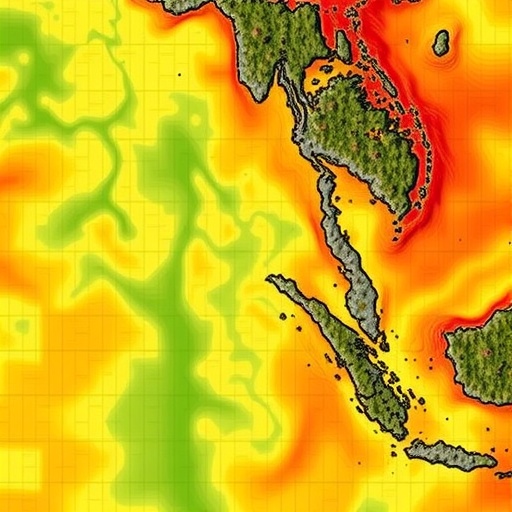
In a groundbreaking interdisciplinary study, researchers from the University of Tokyo, led by Assistant Professor Kanon Kino, have unveiled a profound connection between tropical volcanic eruptions over the last millennium and widespread droughts across Asia. This revelation emerges from an innovative combination of paleoclimate proxies and advanced climate modeling that elucidate how colossal volcanic events trigger atmospheric patterns detrimental to the Asian monsoon system. Their research not only advances the fundamental understanding of volcanic impacts on hydroclimate but also carries significant implications for future climate prediction and disaster preparedness in monsoon-dependent regions.
Volcanic eruptions, long recognized for their immediate hazardous effects such as explosive activity and lava flows, are now increasingly understood to exert prolonged influences on global climate. These eruptions inject massive quantities of sulfate aerosols high into the stratosphere, which then reflect incoming solar radiation. This aerosol-induced solar dimming leads to hemispheric or even global surface cooling. However, the downstream effects of this cooling on regional rainfall systems, particularly monsoons—seasonal wind patterns crucial for agriculture—have remained elusive until now.
Kanon Kino and her colleagues have employed a meticulous synthesis of tree-ring derived hydroclimate reconstructions and comprehensive climate model simulations to unravel this mystery. Tree rings provide annually resolved data that reflect local variations in moisture availability and temperature, serving as precise proxies for past hydroclimatic conditions. By integrating these records with model outputs capable of simulating atmospheric circulation patterns, the team reconstructed a panorama of large-scale drought events and corresponding shifts in atmospheric dynamics contingent upon volcanic activity.
Central to their findings is the identification of a repeating negative phase of the circumglobal teleconnection (CGT)—a planetary-scale wave pattern in the mid-latitude atmosphere that modulates precipitation across Eurasia. The CGT’s negative phase characteristically suppresses rainfall over northern East and South Asia, resulting in monsoon weakening and drought. Remarkably, this drought-inducing phase was found to consistently follow significant tropical volcanic eruptions over the past 1000 years, a pattern that appears robust across diverse background climatic states.
The mechanism instrumental to this climatic cascade is not a simple redistribution of cooler or drier air from the volcanic aerosols themselves but is tied to fundamental disruptions in the atmospheric energy budget. Volcanic aerosol layers curtail solar radiation reaching the earth’s surface, decreasing regional surface temperatures, particularly over the tropical landmasses. This cooling inhibits the vigorous convective activity that typically drives the South Asian monsoon, as convection relies on the surface heating for buoyancy and latent heat release. The resultant suppression of latent heat flux into the atmosphere diminishes the thermal driving forces that maintain the monsoonal circulation.
The subdued convective heating triggers a perturbation in the atmospheric circulation, giving rise to a wave pattern akin to the negative phase of the CGT. This teleconnection pattern extends across vast geographic scales and leads to a widespread reduction in monsoon rainfall across much of Asia. Crucially, this atmospheric fingerprint and the resulting drought conditions most strongly manifest in the boreal summer immediately succeeding a large tropical volcanic eruption, underscoring a direct cause-effect relationship with an identifiable temporal window.
The research also reveals that this response pattern does not rely on other intrinsic climate variability modes but is a fundamental and repeated feature directly attributable to volcanic forcing. By establishing this consistent link, the study paves the way for improved seasonal to interannual forecasting following volcanic eruptions. Knowing that a major eruption can precipitate a pan-Asian monsoon drought could inform agricultural planning and water management policies in affected regions, which depend heavily on predictable monsoon rains.
Notably, the last recorded negative CGT phase associated with volcanic activity was observed during the 1960s, following mid-20th-century tropical eruptions. Given the historical recurrence of such volcanic events, the study underscores that similar drought-inducing atmospheric patterns could reoccur. However, armed with this new understanding, affected countries and communities might gain crucial preparatory lead time to mitigate potential socio-economic impacts, thereby enhancing resilience.
The methodology applied in this work exemplifies the power of paleoclimate proxies combined with state-of-the-art simulation tools. Reconstruction of ancient atmospheric circulation patterns through tree rings presents a high-resolution window into climate variability that purely instrumental data cannot achieve, especially for periods predating modern observational networks. This approach sets a precedent for future investigations into past extreme weather and climate phenomena, contributing to a more nuanced grasp of Earth’s climate system behavior over historical timescales.
Looking ahead, the research team expresses ambitions to extend their paleoclimate reconstructions further back in time. By delving into deeper geological epochs, they aim to decode even more profound climate anomalies and feedbacks, ultimately enriching our understanding of how the Earth’s climate has responded to natural forcings over millennia. Such knowledge is indispensable in an era of anthropogenic climate change, where understanding natural variability remains critical for accurate future projections.
The study exemplifies the crucial interplay between natural events and atmospheric teleconnections, revealing hidden dynamics that govern regional hydroclimate extremes. As volcanic eruptions remain an inherent aspect of Earth’s geophysical behavior, discerning their broader climatic repercussions is essential for both scientific advancement and practical mitigation strategies. This research thus not only illuminates a remarkable facet of Earth’s climate history but also serves as a beacon guiding future climate resilience efforts in monsoon-dependent regions across Asia.
In conclusion, this pioneering work by Kino and colleagues demonstrates how tropical volcanism induces pan-Asian droughts through a circumglobal teleconnection mechanism, bridging the gap between large-scale volcanic forcing and regional hydroclimate variability. Such insights underscore the complexity of Earth’s climatic interconnections and the potential for leveraging historical data to inform contemporary climate responses. The findings herald a new chapter in deciphering volcanic-climate interactions with pressing implications for a climatologically vulnerable Asia.
Subject of Research: Not applicable
Article Title: Tropical volcanism triggers pan-Asian monsoon droughts via circumglobal teleconnection
News Publication Date: 30-Mar-2026
Web References:
https://www.nature.com/articles/s41467-026-70710-x
References:
Wenzheng Nie, Jun Xia, Kanon Kino, Dunxian She, and Taikan Oki, “Tropical volcanism triggers pan-Asian monsoon droughts via circumglobal teleconnection”, Nature Communications, DOI: 10.1038/s41467-026-70710-x
Image Credits:
©2026 Nie et al. CC-BY-ND
Keywords:
Volcanic eruptions, tropical volcanism, Asian monsoon, drought, circumglobal teleconnection, sulfate aerosols, atmospheric circulation, climate modeling, hydroclimate reconstruction, tree rings, climate proxies, Earth’s past climate


