

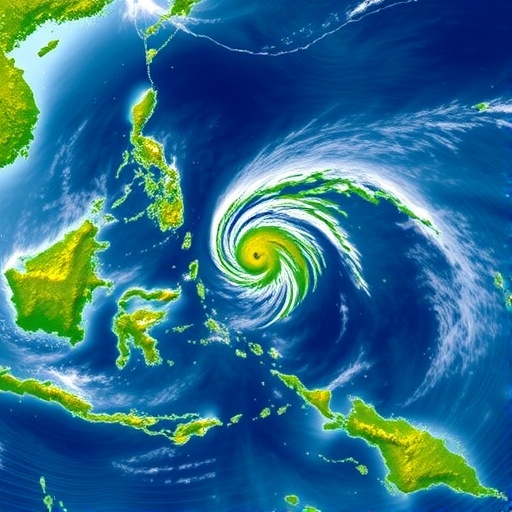
In a groundbreaking new study published in Nature Communications, researchers have unveiled a critical atmospheric phenomenon that is reshaping the behavior and trajectories of typhoons, shifting their paths towards densely populated cities in Asia’s higher latitudes. This discovery centers around what the authors term the “Tropical-leaning Atlantic Oscillation” (TLAO), a previously underappreciated variation of the well-known Atlantic Oscillation, revealing its profound influence on typhoon activity across the Pacific basin. The implications of this finding are immense, as millions of people in high-latitude urban centers face increasing risks from devastating tropical storms in the coming decades.
Traditionally, the Atlantic Oscillation—an atmospheric pressure pattern over the North Atlantic Ocean—has been studied primarily in the context of its impact on European and North American weather. However, the TLAO introduces a novel form of this oscillation, characterized by a tropical-leaning phase that realigns the dynamics of large-scale circulation patterns influencing not only the Atlantic but also distant regions such as the western Pacific. The study’s lead authors, Wu, Hu, Cai, and their colleagues, employed advanced climate modeling and empirical data sets spanning several decades to identify how this tropical bias in the Atlantic Oscillation modulates typhoon genesis locations, intensity distributions, and ultimate trajectories.
The scientists utilized a combination of reanalysis data, remote sensing observations, and high-resolution atmospheric models to decipher the mechanistic links between the TLAO and Western Pacific typhoon pathways. Their analyses revealed that when the TLAO enters its tropical-leaning phase, it promotes altered jet stream configurations and modifies the subtropical high-pressure systems over the Pacific Ocean, which in turn steer typhoons more poleward than historically typical. This shifting steering flow tends to favor typhoon tracks that landfall on or near urban centers at mid- to high-latitudes of East Asia, including major metropolitan areas in regions such as northern China, South Korea, and Japan.
Beyond delineating the physical processes, the research confronts the critical question of societal vulnerability. High-latitude Asian cities, often assumed to be relatively shielded from intense tropical cyclone impacts, may be under a growing threat. Urban populations in these zones have expanded rapidly in recent decades, accompanied by infrastructure and economic development that heightens potential damage in the event of a significant typhoon strike. The researchers emphasize that understanding the TLAO’s role in driving typhoon tracks is essential for improving regional forecasting models and allocating resources for disaster preparedness.
Intriguingly, the authors link the tropical-leaning Atlantic Oscillation to broader patterns of climate variability and change. Anthropogenic warming is not only impacting the intensity of tropical cyclones but also influencing atmospheric circulation regimes on a planetary scale. The study conjectures that warming-induced changes in ocean-atmosphere interactions may be intensifying the TLAO’s tropical bias, thereby increasing the likelihood of high-latitude typhoon incursions. This assertion is grounded in both model projections and observed trends over recent decades, underscoring the urgency with which climatologists must refine predictive frameworks.
The coupling between the Atlantic and Pacific atmospheric systems, mediated by the TLAO, represents one of the more intricate teleconnections identified in recent climate research. The study meticulously documents how shifts in sea surface temperature gradients across the tropical Atlantic can ripple through the atmosphere, affecting convection patterns and Rossby wave trains that alter weather regimes far downstream. These wave trains interact with the Western Pacific subtropical highs and midlatitude westerlies to create corridors conducive to typhoon recurvature toward East Asia’s burgeoning cities.
Methodologically, the research leverages an ensemble of ensemble simulations employing coupled ocean-atmosphere general circulation models (GCMs) with embedded regional downscaling capabilities. This hierarchical modeling approach allowed the team to isolate the climatic footprint of the TLAO from other overlapping influences such as the El Niño-Southern Oscillation (ENSO) and the Pacific Decadal Oscillation (PDO). Their findings suggest that while ENSO remains a dominant modulator of interannual typhoon variability, the TLAO exerts a consistent and independent influence that must now be integrated into seasonal and longer-term predictions.
An essential advancement outlined by Wu and colleagues is the quantification of risk shifts attributed solely to the TLAO-driven weather patterns. Using probabilistic hazard modeling, the researchers mapped the increased frequency and intensity of typhoon impacts on metropolitan areas including Shanghai, Seoul, and Tokyo. These maps indicate not only an increment in typhoon occurrences but also suggest a trend towards more intense storms due to longer residence time in warm water corridors enabled by altered circulation. This coupling between atmospheric steering and ocean thermal structure amplifies storm intensity potential at landfall.
The study also contemplates the implications for emergency management and urban planning in the face of these newfound climatic risks. It calls for enhanced integration of the TLAO index in operational meteorological forecasting and disaster simulation exercises. Governments and agencies across East Asia are urged to factor in this emerging threat pattern into infrastructure resilience measures, early warning systems, and public education campaigns aimed at typhoon preparedness. In doing so, there is an opportunity to mitigate some of the human and economic tolls anticipated as climate forcings evolve.
Moreover, the researchers have laid the groundwork for future studies that seek to understand the complex feedback loops between tropical Atlantic variability, Pacific typhoon behavior, and regional climate impacts. The work highlights numerous open scientific questions relating to the amplitude modulation of the TLAO in response to further global warming, interaction with Arctic climate changes, and potential nonlinear thresholds in atmospheric circulation that could exacerbate or attenuate observed trends. This research arena is fertile, with implications for global climate policy and hazard management strategies.
Complementing the climate science narrative, the paper underscores the societal dimension of these atmospheric shifts. The ascending vulnerability of high-latitude East Asian cities is a call to rethink urban expansions, emergency response logistics, and cross-border cooperation in disaster preparedness. The expanded climatological footprint of tropical systems necessitates innovative approaches that integrate climate science insights with urban governance and community resilience frameworks, ensuring that the hard lessons of past typhoon seasons translate into proactive risk reduction.
In summary, the discovery of the tropical-leaning Atlantic Oscillation’s influence on typhoon tracks is a paradigm-shifting contribution to climate science. It challenges existing assumptions about typhoon climatology by evidencing a teleconnected mechanism that preferentially directs intense tropical cyclones toward Asian high-latitude cities. As the climate crisis intensifies, this refined understanding equips meteorologists, policy-makers, and the global community with vital intelligence to anticipate and prepare for the elevated risks that lie ahead.
Wu et al.’s study is a testament to the synergistic power of observational data and advanced modeling to unravel atmospheric complexities. It reveals how interconnected our planetary climate systems are, defying the artificial compartmentalization of ocean basins and regional weather patterns. This insight not only enriches fundamental atmospheric science but also fundamentally redefines the frontiers of tropical cyclone risk assessment in the 21st century.
With unprecedented detail and clarity, the research elucidates an emergent climatic oscillator whose reach extends well beyond the Atlantic basin, touching the shores of some of the world’s greatest urban economies situated in subtropical and midlatitude East Asia. Moving forward, the challenge will be to incorporate the TLAO into global climate monitoring frameworks and operational storm forecasting models to enhance resilience and reduce disaster risk from these increasingly pervasive natural hazards.
As this compelling narrative unfolds in the pages of Nature Communications, it behooves the climate science community and society at large to heed the warning signals presented. The atmospheric dance choreographed by the TLAO is an urgent reminder that our world’s weather is deeply interconnected—and that understanding these connections is critical to protecting millions of lives from the shifting threats of tropical cyclones.
Subject of Research: Atmospheric dynamics and teleconnections influencing typhoon trajectories, specifically the impact of the tropical-leaning Atlantic Oscillation on typhoon behavior in the Western Pacific.
Article Title: Tropical-leaning Atlantic Oscillation favors more typhoons toward Asian high-latitude cities.
Article References:
Wu, Z., Hu, C., Cai, W. et al. Tropical-leaning Atlantic Oscillation favors more typhoons toward Asian high-latitude cities. Nat Commun (2025). https://doi.org/10.1038/s41467-025-67946-4
Image Credits: AI Generated


