

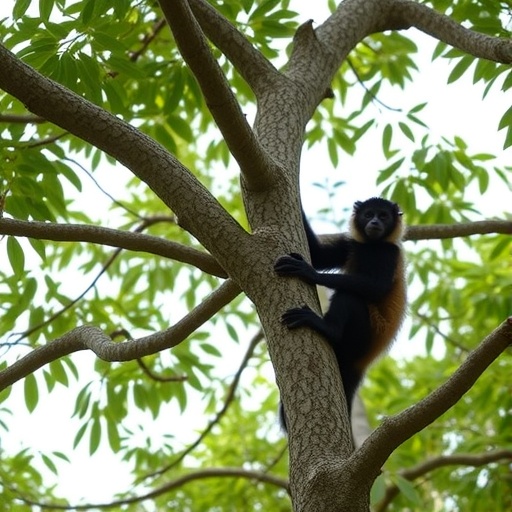
In a groundbreaking study published in eLife, researchers have unraveled the complex biomechanics and evolutionary significance of how arboreal mammals navigate the vertical world of trees, focusing specifically on their descent strategies. This comprehensive investigation sheds light on the nuanced postural adaptations and locomotor tactics these animals employ when climbing down, a dimension of arboreal motion that has received far less attention compared to ascent behaviors. By exploring the kinematics and morphology behind these descent strategies, the work offers profound insights into the evolutionary origins of upright postures within the primate lineage.
Unlike the wealth of studies that have traditionally focused on how mammals climb upward, this research uniquely centers on the often-overlooked act of descending tree trunks and branches. Arboreal mammals must master both ascent and descent to efficiently and safely traverse their three-dimensional habitats, where vertical supports vary widely in diameter, orientation, and compliance. The study highlights the critical role of these locomotor demands in shaping the anatomical and behavioral traits that likely influenced the evolutionary trajectory of early primates, suggesting that descent mechanics have been a driving force in arboreal adaptation.
Lead investigator Séverine Toussaint and her multidisciplinary team embarked on an ambitious comparative project examining 21 species spanning multiple taxonomic groups, including strepsirrhines, platyrrhines, rodents, carnivorans, marsupials, and scandentians. By meticulously quantifying changes in posture, speed, gait dynamics, and limb usage during climbs up and down vertical substrates of varying diameters, the researchers mapped how locomotor strategies shift with context and morphology. This dataset constitutes one of the most extensive to date addressing vertical locomotion across such a phylogenetically and morphologically diverse assemblage.
One of the most salient findings of the study is the identification of three distinctive modes of descent in arboreal mammals: head-first, side, and tail-first. These modes correspond closely to specific anatomical configurations and ecological niches. Notably, primates displayed a broader repertoire, frequently utilizing side and tail-first postures, particularly on narrow vertical supports. Non-primate species largely adhered to head-first descent, underscoring a significant functional and perhaps evolutionary divergence in arboreal locomotor strategies.
The authors emphasize the biomechanical underpinnings of these distinct behaviors. On narrower substrates, primates tend to adopt more upright postures during descent, facilitated by the use of their elongated tails as anchors or balancing organs. This indicates a sophisticated sensorimotor integration allowing for enhanced stability and grip when negotiating precarious vertical supports. Such versatility likely provided selective advantages in complex arboreal habitats, possibly setting the stage for the upright, grasping postures characteristic of some primate ancestors.
Kinematic analyses reveal that descending animals modulate their locomotion by reducing speed and increasing gait asymmetry compared to ascent. These adjustments presumably enhance stability and reduce the risk of falls during the more precarious descent process. The study details how these locomotor modulations are tightly linked to morphological traits including limb length ratios, tail length, and relative head mass. Animals with longer limbs and tails exhibit a propensity for tail-first descent, whereas species with limb proportions more balanced between fore and hindlimbs tend toward head-first descent.
In a pioneering application of their morphology-based model, the researchers extrapolated potential descent modes to extinct euarchontoglires, a superorder encompassing the common ancestors of primates and rodents. Their reconstructions suggest that early fossil species predominantly descended head-first, with the exception of certain adapiforms exhibiting elongated hindlimbs and tails that hint at the emergence of more varied descent postures. These findings support a gradual evolutionary narrative whereby early primates progressively acquired anatomical specializations permitting more diverse and stable arboreal locomotion.
The study also situates these biomechanical insights within a broader evolutionary framework. The initial small body sizes, shorter hindlimbs, and reduced brain volumes of early euarchontoglires likely constrained them to simpler, head-first descent strategies. As cognition, limb morphology, and tail length evolved, primates developed increasingly complex and versatile locomotor repertoires, facilitating the upright, grasping postures that underpin modern primate ecology. This evolutionary story aligns with observed postural behaviors and supports the role of ecological pressures in shaping locomotor versatility.
Despite its advances, the research acknowledges certain methodological limitations. Not all species engaged readily with the artificial vertical substrates in the controlled setting, potentially biasing behavioral proportions and kinematics recorded. Furthermore, the dataset lacked representation from larger-bodied arboreal mammals such as apes and big carnivorans. The authors advocate for future research encompassing a broader range of species and body sizes to refine models and deepen understanding of the biomechanical and evolutionary dynamics underlying vertical locomotion.
The implications of this work extend beyond the realm of animal locomotion into paleobiology and evolutionary biology, providing a refined framework for inferring locomotor behaviors from fossil morphology. By linking observable kinematic traits to anatomical metrics, the study facilitates more accurate reconstructions of how extinct species might have navigated arboreal environments. This advances our grasp of primate origins and offers a template for studying locomotion in other arboreal lineages.
In conclusion, this comprehensive analysis of arboreal mammal descent strategies uncovers key morphological and behavioral adaptations that resonate deeply with primate evolutionary history. Through a multidisciplinary approach blending kinematics, morphology, and phylogenetics, the research illuminates how upright postures and specialized locomotor patterns likely emerged gradually in euprimates. As such, it marks a significant milestone in our understanding of arboreal ecology, biomechanics, and the evolutionary pathways leading to the primate mode of life.
This study not only fills a critical gap in locomotor research by elucidating descent mechanics but also sets a foundation for future inquiries into the interplay between morphology, behavior, and environment in shaping arboreal mammal evolution. As arboreal habitats continue to be threatened globally, understanding the functional intricacies of species’ movement strategies becomes ever more pertinent for conservation and biological insight. This research exemplifies the profound knowledge gained by integrating detailed motion analysis with evolutionary theory.
Subject of Research: Animals
Article Title: Kinematics and morphological correlates of descent strategies in arboreal mammals suggest early upright postures in euprimates
News Publication Date: 17-Feb-2026
References: DOI 10.7554/eLife.108268.3
Image Credits: Séverine Toussaint (CC BY 4.0)
Keywords: Life sciences, Ethology, Animal locomotion, Kinematics, Ecology, Evolutionary biology, Morphology, Organismal biology


