

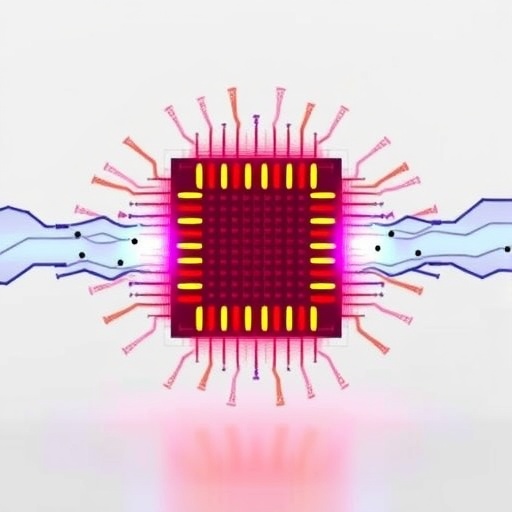
In a remarkable leap forward for human–machine interface (HMI) technology, researchers have unveiled a revolutionary air-breakdown triboelectric nanogenerator (AB-TENG) that is poised to transform the landscape of self-powered electronic devices. This cutting-edge innovation, developed at the MEMS and Nanotechnology Laboratory of Chonnam National University under the leadership of Professor Dong-Weon Lee, in collaboration with Kyungpook National University, introduces a transistor-inspired architecture to harness the electrical potential of skin electrons through air breakdown, all while requiring minimal mechanical force. This breakthrough not only challenges existing paradigms in triboelectric nanogenerator design but also offers a sustainable path for next-generation thin electronics, radically improving the efficiency and usability of self-powered HMIs.
Conventional triboelectric nanogenerators have faced significant limitations, chiefly the inefficient harvesting of electrical charges due to the unavoidable air breakdown effect — a phenomenon where high voltage electrostatic discharge causes charge loss in the surrounding air, rather than directing it into electrical output. These devices often require relatively high contact forces to generate usable electricity, which restricts their practical applications in everyday touch-based interfaces like keyboards or remote controls. The AB-TENG innovatively turns this challenge into an advantage by re-engineering air breakdown as a deliberate mechanism to enhance electron transfer efficiency, significantly boosting electrical output even under low contact forces typically exerted in daily human-machine interactions.
At the heart of the AB-TENG design lies a transistor-inspired architecture consisting of five distinct layers that work in concert to capture and convert skin electrical energy with unprecedented efficiency. These layers include a base terminal that collects electrons from human skin, an emitter, a charge-inducing layer, a dielectric layer, and a collector. This multilayer configuration facilitates air ionization, forming an ionized air channel that acts as a conduit for electron flow. This arrangement ingeniously mimics the internal processes of transistor function, allowing for controlled electron extraction and delivering output that is significantly more robust than that of traditional tactile TENGs.
The AB-TENG operates through two complementary modes to maximize energy harvesting: an indirect mode relies on electrostatic induction to accumulate charges over time, delivering a steady output, while the more dramatic direct mode facilitates instantaneous electron flow via air breakdown at the skin interface. In direct mode, output voltage reaches up to 165 volts with a minimal contact force of 2 newtons, and escalates to 290 volts at 24 newtons of force. This yields a peak power of 22 milliwatts, representing a twenty-two-fold increase compared to conventional tactile nanogenerators. Such performance signifies an impressive convergence of high voltage and low-force operation, essential for real-world applications.
One of the most compelling demonstrations of AB-TENG’s capability is its integration into a self-powered infrared remote control system. This prototype comprises four AB-TENG devices generating sufficient electrical energy to wirelessly operate LEDs with a success rate exceeding 80% at a gentle contact force of 15 newtons. This remarkable achievement underscores the potential for AB-TENGs to supplant batteries and wired power sources in everyday electronics, heralding a future where devices derive their operational energy directly from human touch or proximity.
Pushing the boundaries further, the research team fabricated an ultrathin, self-powered keyboard with only 600 micrometers thickness, featuring 30 responsive keys arranged in four rows and eight columns. This marvel of engineering not only captures typing inputs with high fidelity but simultaneously harvests the mechanical energy exerted by keystrokes to power the device itself. The keyboard supports both wired and wireless communication protocols, demonstrating the feasibility of integrating AB-TENG technology into widely used computer peripherals, potentially eliminating the need for external power or frequent battery replacements.
Environmental robustness is critical for the deployment of any HMI technology, and the AB-TENG exhibits commendable performance stability across a broad temperature range (20 to 80 degrees Celsius). Its output remains consistent in diverse operating conditions, although humidity presents certain challenges. While low to moderate humidity levels maintain device efficiency, elevated humidity tends to diminish the abundance of accumulated charge, due to moisture-driven dissipation. Addressing this environmental sensitivity will be essential for real-world applications, particularly in regions with fluctuating climatic conditions.
An intriguing feature of the AB-TENG is its ability to operate in a non-contact mode, generating voltage through arc discharge across air gaps ranging from 0.5 to 2 millimeters. This capability enables touchless sensing applications where physical contact is undesirable or unfeasible, opening up possibilities for hygiene-conscious healthcare interfaces, gesture-controlled devices, and proximity sensors. The device achieves voltages spanning 6 to 16 volts in this non-contact mode, sufficient to trigger various electronic functions without direct touch.
This pioneering research does not come without challenges. For instance, while the AB-TENG’s architecture is optimal for small-scale, thin-film electronics, scaling the technology for large-area or flexible substrates suitable for wearable devices will require careful material selection and engineering refinements. Moreover, improving performance under highly humid conditions remains an active area of investigation. The research team envisions that future iterations will extend the AB-TENG concept into the Internet of Things (IoT) ecosystem, potentially enabling a myriad of distributed self-powered sensors and interfaces that operate autonomously in diverse environments.
By harnessing the electrostatic properties of human skin and transforming the traditionally detrimental air breakdown phenomenon into a mechanism of charge collection, the AB-TENG embodies a paradigm shift in energy harvesting. Its transistor-inspired architecture offers a novel template that could inspire a new generation of self-sustained, intelligent HMIs that are thinner, more responsive, and less reliant on external power sources. The implications extend beyond consumer electronics, promising advancements in robotics, wearable health monitors, and environmental sensing.
This breakthrough provides a compelling vision for the future of human-machine symbiosis, where user interactions naturally generate the energy required to power devices, significantly reducing the carbon footprint and environmental burden of electronic waste. As researchers continue refining this technology, the prospect of seamlessly integrated, self-powered electronic interfaces becomes increasingly tangible, enhancing usability and autonomy in ways previously unattainable.
Professor Dong-Weon Lee and his team’s pioneering work not only addresses fundamental limitations in triboelectric nanogenerator design but also lays a practical foundation for the commercial realization of self-powered HMIs. Their approach exemplifies the power of cross-disciplinary innovation, blending principles of microelectronics and materials science to overcome entrenched technical obstacles. As this technology matures, it promises to redefine how humans interact with machines, setting new standards for efficiency, responsiveness, and sustainability.
In summary, the air-breakdown triboelectric nanogenerator represents a monumental advancement in the realm of energy harvesting and human-machine interfacing. Its transistor-like structure, dual operational modes, and superior electrical output at low mechanical stress challenge the status quo of tactile energy devices. With successful demonstrations in remote control systems and ultrathin keyboards, combined with its robust environmental adaptability, the AB-TENG is poised to catalyze the evolution of self-powered electronics. This work not only enriches the scientific understanding of triboelectric phenomena but also propels forward the practical realization of autonomous, intelligent human-machine ecosystems.
—
Subject of Research: Air-breakdown triboelectric nanogenerator design and human–machine interfaces
Article Title: Air‑Breakdown Triboelectric Nanogenerator Inspired by Transistor Architecture for Low‑Force Human–Machine Interfaces
News Publication Date: 11-Feb-2026
Web References: http://dx.doi.org/10.1007/s40820-026-02103-0
Image Credits: Karthikeyan Munirathinam, Longlong Li, Arunkumar Shanmugasundaram, Jongsung Park, Dong-Weon Lee*
Keywords: triboelectric nanogenerator, air breakdown, human-machine interface, energy harvesting, thin-film electronics, self-powered devices, transistor architecture, low-force operation, wearable technology


