

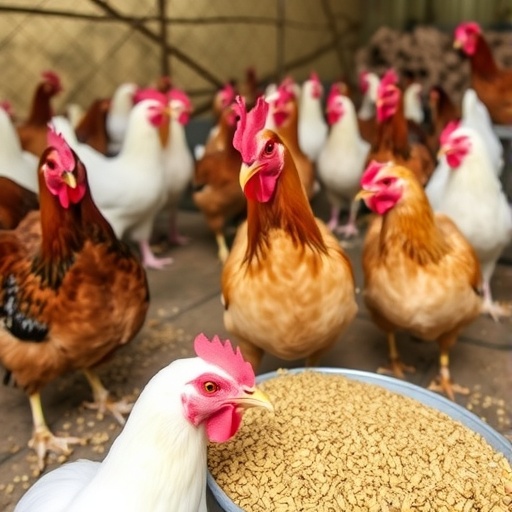
In an era of rising global population and increasing demands for food production, agricultural practices are continuously being examined and innovated. In a pioneering study titled “Utilizing High-Nutrient Agricultural Biomass as an Alternative Poultry Feed for a Sustainable Food Supply,” researchers led by Alias J. and his team explore an innovative approach towards enhancing food security through the optimization of agricultural waste. This intriguing work sheds light on an underappreciated resource, high-nutrient agricultural biomass, which could serve as a sustainable alternative feed to support the poultry industry. The implications of this research extend far beyond poultry farming, intertwining with broader concerns about sustainability, waste reduction, and food security.
Historically, agriculture has generated vast amounts of biomass waste, including leftover plant materials, husks, and other residuals. These materials are often seen as burdensome byproducts, leading to detrimental impacts on the environment when disposed of improperly. However, the new paradigm shifts this perspective by focusing on the potential nutritional value of these materials. This transformative approach challenges conventional thinking about food production and waste management, suggesting that what is often discarded could actually be repurposed into highly nutritious feed.
One of the highlights of their study is the substantial nutrient density found within certain types of agricultural biomass. Materials such as rice husks, corn stover, and various legumes contain not only carbohydrates but also essential proteins, vitamins, and minerals. This nutrient profile suggests that instead of clearing out these materials as agricultural waste, they could be processed into quality feed options for poultry. High-nutrient biomass could enhance growth rates, improve egg production, and optimize overall poultry health.
Moreover, the economical aspect of this innovation cannot be overlooked. Traditional feed ingredients for poultry such as corn and soybean meal have soared in price due to increased global competition and unforeseen climatic events. In contrast, utilizing agricultural byproducts could help stabilize feed costs by relying on resources that are already abundant and locally sourced. This redirection of agricultural flows not only makes economic sense but promotes a circular economy, fostering resilience within the agricultural sector.
In addition to these economic advantages, the environmental benefits associated with using agricultural biomass are significant. By repurposing waste into feed, the study aligns with principles of sustainable agriculture and regenerative practices. Not only would this reduce the environmental footprint associated with traditional feed production, but it would also mitigate greenhouse gas emissions linked to waste decomposition. The nascent field of bioeconomy emphasizes resource efficiency, suggesting that such practices can help achieve sustainability goals set forth by international agreements.
Interestingly, the researchers also highlight the potential for these high-nutritional feeds to decrease reliance on synthetic additives and other chemicals often found in commercial feed. This shift towards more natural feeding strategies could lead to healthier poultry products, ultimately benefiting consumers and market demands for organic and wholesome food products. Such developments align perfectly with the contemporary trend of consumer awareness regarding food sources and health implications, making this research highly relevant.
It’s also essential to consider the socio-economic implications of this study. Countries that rely heavily on poultry farming could see a positive impact on rural livelihoods and food security. With many communities dependent on poultry as a primary protein source, implementing such feed solutions could bolster local economies and reduce malnutrition rates. This aspect of food security is particularly crucial in developing nations where resource scarcity is pronounced.
The researchers conducted extensive trials to assess the viability of these alternative feeds. By comparing performance metrics of poultry fed with traditional diets against those offered high-nutrient biomass, they were able to draw compelling conclusions that support their hypothesis. Their findings indicate not only comparative growth rates but also various health parameters reinforcing the potential for widespread adoption of such practices.
In addition, the study emphasizes the potential for diversifying feed sources, which strengthens the resilience of food systems against climate change variables and market fluctuations. Reliance on a limited number of feed crops can be perilous; by advocating for a diversified approach, food security can be fortified against unexpected disruptions. This diversification strategy is vital for a sustainable food nexus, one that must adapt to future demand pressures and environmental challenges.
As the poultry sector navigates an increasingly complex landscape, the integration of agricultural byproducts as feed sources signifies a promising avenue for innovation. Stakeholders in poultry farming, including farmers, feed manufacturers, and policymakers, are urged to reconsider traditional practices and embrace alternatives that align with sustainable goals. This research is not merely about alternative feed; it’s a call for a systemic change within the agricultural framework.
This study is poised to contribute to the growing dialogue surrounding sustainability in agriculture, signifying a shift from linear to circular frameworks by minimizing waste and maximizing resource utilization. Given the pressing nature of food insecurity due to climate change and population growth, research such as this is not just timely—it is essential.
In conclusion, the journey towards sustainable food systems will likely be complex, involving multiple stakeholders and a range of innovations. However, with research findings like those of Alias and his team, there exists a tangible pathway towards enhancing poultry nutrition while addressing the ever-looming challenges posed by agricultural waste within these systems. As the poultry industry remains under scrutiny for its environmental impact, exploring high-nutrient agricultural biomass could represent a win-win scenario for producers and consumers alike, paving the way for a more sustainable future in food production.
The exploration into utilizing high-nutrient agricultural biomass emphasizes that the solutions to global challenges often lie in unexpected places. Harnessing agricultural byproducts for poultry feed not only offers a dual benefit of waste reduction and enhanced nutrition but also reflects a broader shift towards environmentally conscious practices. As the conversation surrounding sustainable agriculture continues to evolve, studies like this one provide a crucial foundation for future innovations, ensuring that our food systems can thrive sustainably rather than merely survive.
Subject of Research: The use of high-nutrient agricultural biomass as an alternative poultry feed.
Article Title: Utilizing High-Nutrient Agricultural Biomass as an Alternative Poultry Feed for a Sustainable Food Supply.
Article References: Alias, J., Abu Hasan, H., Said, N.S.M. et al. Utilizing High-Nutrient Agricultural Biomass as an Alternative Poultry Feed for a Sustainable Food Supply. Waste Biomass Valor (2025). https://doi.org/10.1007/s12649-025-03407-9
Image Credits: AI Generated
DOI: https://doi.org/10.1007/s12649-025-03407-9
Keywords: Agricultural Biomass, Sustainable Feed, Poultry Nutrition, Food Security, Waste Reduction, Environmental Impact, Bioeconomy, Circular Economy.


