

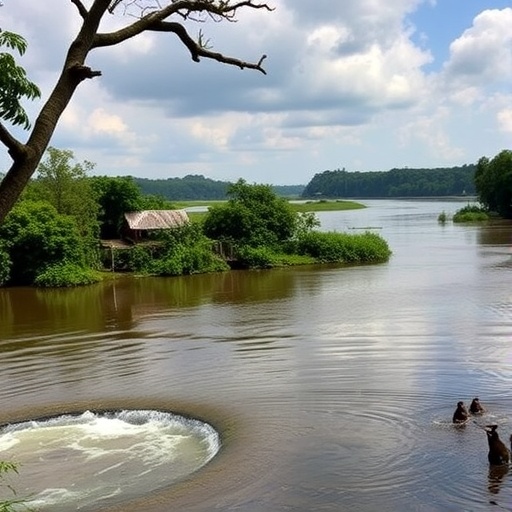
In the vast and dynamic ecosystem of the Amazon Basin, water flow and loss play a critical yet often overlooked role in regional and global environmental processes. Despite the Amazon River’s reputation for its colossal discharge, a substantial volume of water is invisibly lost to the atmosphere through evaporation long before it reaches calm reservoirs or the ocean. This unseen evaporation contributes significantly to the hydrological cycle and influences the climate system, yet it remains insufficiently quantified. Addressing this knowledge gap, Anshul Yadav, a promising doctoral researcher in civil and environmental engineering at Texas A&M University, has secured the distinguished Future Investigators in NASA Earth and Space Science and Technology (FINESST) fellowship. His project aims to elucidate the processes governing open-water evaporation from the Amazon’s flowing rivers, a critical but understudied component of the water budget.
The fellowship award, accompanied by a $100,000 grant, empowers Yadav to embark on a pioneering study of riverine evaporation within the Amazon Basin. Traditional studies have largely focused on evaporation rates from still water bodies such as lakes and reservoirs, which differ significantly in dynamics from flowing rivers. Given that Amazonian rivers contribute approximately 27,000 square miles of open water surface—surpassing the extent of lakes and reservoirs by nearly threefold—this evaporation source can no longer be ignored in regional water balance assessments. Through his research, Yadav aims to generate novel insights into the spatial and temporal patterns of evaporation, which hold profound implications for hydrology, climate modeling, and ecosystem sustainability in the region.
Central to this research is the comparative analysis of evaporation fluxes between moving river channels and surrounding stagnant water bodies. Rivers, owing to their flow momentum and changing surface conditions, exhibit unique evaporation characteristics that differ from those of lakes. Capturing these differences is critical to understanding regional water availability, especially as climate change intensifies the frequency and severity of droughts and heat waves. Identifying “hotspots” — geographic zones exhibiting elevated evaporation or higher temperature anomalies — can provide actionable data for water resource management. By pinpointing these critical areas, policymakers and local communities can better prepare for the altered hydrological regimes anticipated in the coming decades.
Yadav’s investigation leverages cutting-edge satellite missions and data integration techniques to realize a comprehensive, basin-wide evaporation record covering the last four decades. Employing observations from the Surface Water and Ocean Topography (SWOT) and NASA-ISRO Synthetic Aperture Radar (NISAR) missions, his work harnesses high-resolution spatial and temporal datasets that capture surface water extent and dynamics with unprecedented accuracy. These satellite-derived measures, combined with sophisticated hydrodynamic modeling, allow for a detailed reconstruction of evaporation rates from approximately 1985 to 2025. This longitudinal dataset will serve as a critical benchmark for future hydrological and climate research in the Amazon.
The collaboration with Dr. Huilin Gao, a seasoned professor in civil and environmental engineering at Texas A&M University, ensures the application of rigorous scientific methodologies and computational approaches. Gao’s expertise in remote sensing and hydrodynamic modeling complements Yadav’s innovative direction, enabling the project to transcend traditional observational limitations. Together, they are pioneering methodological frameworks that integrate big-data analytics with environmental physics, setting new standards for studying coupled river-atmosphere interactions in large tropical river systems.
Understanding evaporation from the Amazon River holds immense importance beyond academic curiosity. The river forms the lifeblood of numerous ecosystems, supports a vast array of biodiversity, and sustains millions of people, including Indigenous populations whose livelihoods are tightly linked to water access. As climate variability exacerbates environmental stresses, quantifying how much water escapes to the atmosphere is crucial for sustainable water resource management. Improved measurements enable improved forecasting and adaptation strategies for navigation agencies, hydropower utilities, agricultural sectors, and local communities facing the challenges of a warming and drying climate.
Moreover, the project addresses critical gaps in the global carbon cycle understanding. The Amazon basin is a major source and sink of greenhouse gases such as carbon dioxide and methane. Water evaporation from river surfaces plays an integral role in mediating the exchange—or “breathing”—of these gases between aquatic ecosystems and the atmosphere. Accurate evaporation data can refine carbon budget models by elucidating how water fluxes influence greenhouse gas emissions. This linkage between hydrology and biogeochemistry positions Yadav’s work at the intersection of climate science and environmental sustainability.
With environmental monitoring increasingly reliant on satellite platforms, Yadav’s integration of multi-mission remote sensing data exemplifies the synergistic potential of space-based Earth observations. The SWOT mission contributes unique high-resolution topographic measurements of water surface elevations, while NISAR can penetrate cloud cover and vegetation to reveal subtle surface changes. Combining these datasets within hydrodynamic models allows for precise simulation of water temperature, flow dynamics, and evaporative losses over complex riverine terrains. This multi-faceted approach unearths previously hidden patterns and informs water balance estimations with unprecedented fidelity.
The significance of this research is highlighted by its competitive selection: Yadav’s proposal was chosen as one of only 54 winners from a rigorous pool of 539 submissions within NASA’s Earth Science Division. This honor reflects both the scientific merit and societal relevance of addressing evaporative water loss in one of the world’s most critical river systems. As the first efforts to compile a continuous 40-year evaporation record over the entire Amazon basin, this work will set new benchmarks and provide a vital baseline for future climate resilience initiatives.
Scientists and environmental managers alike will benefit from the characterization of evaporation “hotspots,” where intensified water loss may exacerbate local drought conditions or influence riverine ecosystems. Tailored interventions can be designed based on these insights to mitigate adverse effects and optimize water usage. The enhanced understanding of how river geography and climate variability modulate evaporation furthers our grasp of hydrological processes under changing climatic conditions—knowledge essential for global environmental stewardship.
Ultimately, the research conducted by Yadav and his team is emblematic of a new era in Earth system science, where advanced remote sensing, computational modeling, and interdisciplinary collaboration converge to unravel complex environmental phenomena. By making visible what was once invisible—the subtle breath of riverine water evaporating into the atmosphere—this work transforms our comprehension of water cycles and bolsters efforts to manage one of the planet’s most precious and vulnerable resources.
Subject of Research:
Open-water evaporation dynamics and water balance in the Amazon River basin
Article Title:
Unveiling the Amazon’s Invisible Breath: Pioneering Satellite Studies Illuminate River Evaporation Dynamics
News Publication Date:
Not specified
Web References:
https://engineering.tamu.edu/civil/profiles/hgao.html
https://mediasvc.eurekalert.org/Api/v1/Multimedia/7fefac84-8e09-4dcd-9ebe-4f5875adca06/Rendition/low-res/Content/Public
Image Credits:
Stephanie Wilt, Texas A&M University
Keywords:
Amazon River, evaporation, hydrology, remote sensing, satellite missions, SWOT, NISAR, NASA FINESST fellowship, climate variability, water balance, hydrodynamic modeling, carbon cycle, environmental sustainability


