

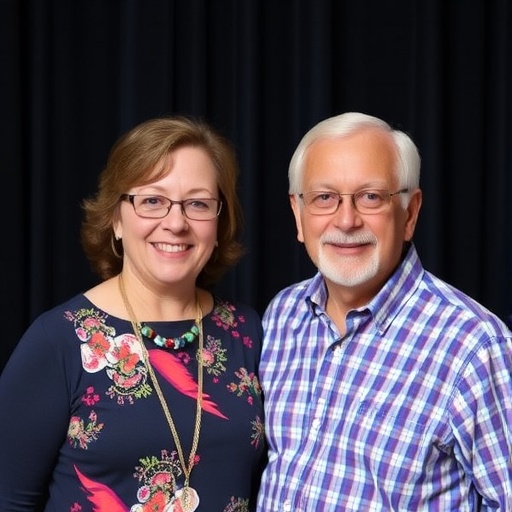
In the heart of the American Midwest, a groundbreaking chapter in particle physics is unfolding, spearheaded by University of Tennessee physicists Tova Holmes and Larry Lee. These distinguished researchers have temporarily traded the warmth of Knoxville for the winter chill near Chicago at Fermilab, the U.S. Department of Energy’s national laboratory renowned for its cutting-edge accelerator and particle physics research. Their mission centers on probing the unseen fabric of the universe by leveraging sophisticated instruments aimed at unveiling the mysteries of dark matter and dark energy—enigmatic components that constitute the majority of the cosmos’s mass-energy content yet remain invisible to direct observation.
Fermilab functions as a nexus where theory meets experimentation, pushing the boundaries of our understanding of the subatomic domain. At the core of Holmes and Lee’s research is their involvement with the Compact Muon Solenoid (CMS) experiment, situated at CERN’s Large Hadron Collider (LHC). The CMS experiment is instrumental in detecting new particles and phenomena that elude standard models of particle physics. By participating in the Fermilab LHC Physics Center (LPC), they become part of a vibrant collaboration that integrates over 700 U.S.-based physicists. The LPC not only fosters innovative data analysis and presentation but also facilitates hardware development crucial for maintaining the CMS’s cutting-edge performance.
The CMS outer tracker upgrade represents a pivotal focus for Holmes and Lee. This component is vital for reconstructing the trajectories of charged particles resulting from high-energy collisions within the detector. As the LHC transitions to its forthcoming high-luminosity phase by 2030, the influx of collision events will surge, demanding enhanced detector capabilities to process and analyze the voluminous data accurately. The upgraded tracking system is engineered to endure increased particle flux, improve resolution, and provide more reliable identification, ensuring the CMS detector can continue to decipher the fundamental components and forces shaping our universe.
Beyond hardware advancements, Holmes expresses a keen enthusiasm for maximizing the upgraded detector’s capabilities. She envisions developing sophisticated trigger menus—specialized algorithms that sift through billions of particle collisions per second to pinpoint the rare signals indicating new physics. This selective process is critical, as only approximately 0.03% of collision data are stored for deeper analysis. By fine-tuning these triggers to target novel phenomena, she aims to enhance the sensitivity of the CMS experiment, opening potential pathways to discover particles that may redefine our understanding of matter and energy.
Within their roles as Distinguished Researchers at Fermilab, Holmes and Lee’s responsibilities extend beyond immediate experimental upgrades. They are actively engaged in exploring theoretical frameworks and strategies for future colliders. The concept of a muon collider, a promising frontier in high-energy physics due to muons’ unique properties, is gaining momentum with Fermilab as a leading candidate site. Both physicists play instrumental roles in advancing this endeavor, applying their expertise to conceptualize and plan the infrastructure and scientific potential of such a facility that could unlock unprecedented insights into fundamental particles.
The importance of fostering the next generation of scientists underpins much of their work. Through the Distinguished Researcher program, Larry Lee has delivered motivational talks designed to inspire emerging physicists, while upcoming workshops on leveraging machine learning for muon collider experiments aim to accelerate innovations in data processing and interpretation. This educational emphasis is exemplified by their collaboration with UT graduate student Adam Vendrasco and postdoctoral associate Daisy Kalra, who are deeply involved in project activities at Fermilab. Such mentorship ensures the continuity of expertise and fresh perspectives necessary for sustained scientific breakthroughs.
Despite spending a significant portion of their year at Fermilab—around 75%—Holmes and Lee remain committed to maintaining strong ties with their research groups at the University of Tennessee. They actively work to bridge campus-based theoretical research and national laboratory experiments, fostering a synergistic environment where ideas and technologies can cross-pollinate. This integration is critical for advancing particle physics research, ensuring that students and faculty benefit from direct access to state-of-the-art facilities while contributing original insights that shape experimental designs and objectives.
The LHC’s upcoming high-luminosity phase heralds a new era of data richness, with intense particle collision environments offering both opportunities and challenges. Holmes and Lee’s involvement in hardware upgrades directly addresses these challenges through advanced detector designs that enhance particle trajectory resolution and timing precision. By mitigating the effects of pile-up—multiple overlapping collisions during a single event—they improve the signal clarity, allowing researchers to extract meaningful patterns from complex data landscapes.
Simultaneously, the duo’s work at Fermilab encompasses the development of sophisticated software frameworks for data analysis. The LPC facilitates this by hosting working groups devoted to optimizing algorithms capable of handling petabytes of collision data. These computational tools are indispensable for mining rare event signatures and validating theoretical models. The cross-disciplinary synergy between physicists and computer scientists within these teams exemplifies the future of large-scale physics experiments, where data science is as vital as experimental hardware.
Holmes and Lee’s dedication not only drives scientific discovery but also addresses fundamental questions about the universe’s composition and fate. By probing the characteristics of dark matter and dark energy, they contribute to defining the parameters of the Standard Model of particle physics and beyond. Their work may help illuminate the mechanisms that govern cosmic expansion and structure formation, linking the microcosm of subatomic particles with the macrocosm of galaxies and the overall universe.
The vision articulated by Holmes emphasizes the potential transformative impact of their research hub at Fermilab. By attracting scientists, students, and postdoctoral researchers with dynamic programming and collaborative opportunities, the LPC aspires to become a crucible for groundbreaking ideas. This effort not only enhances the scientific community’s capabilities but also positions the United States as a central player in the global pursuit of fundamental physics.
In summary, the partnership between University of Tennessee physicists Tova Holmes and Larry Lee and Fermilab’s LHC Physics Center embodies a confluence of technical prowess, visionary planning, and educational commitment. Their work on the CMS tracker upgrade, the development of novel data analysis strategies, and future collider concepts represents a multi-faceted approach to unraveling the universe’s deepest secrets. As they pave the way for the next generation of discoveries in particle physics, their endeavors underscore the enduring human quest to comprehend the building blocks of reality.
Subject of Research: Particle physics, CMS experiment, detector upgrades, muon collider development, dark matter, dark energy
Article Title: University of Tennessee Physicists Lead Frontiers in Particle Physics Research at Fermilab
News Publication Date: Not specified
Web References:
- University of Tennessee Physics Department: https://physics.utk.edu/
- Fermilab Official Site: https://www.fnal.gov/
- CMS Experiment Homepage: https://sites.google.com/utk.edu/utkcms/home
- Fermilab LHC Physics Center Distinguished Researcher Program: https://lpc.fnal.gov/fellows/index_2026.shtml
- HL-LHC Project at CERN: https://www.home.cern/science/accelerators/hilumi-lhc
- Fermilab and Muon Collider: https://physics.utk.edu/the-art-of-muon-collisions/
Image Credits: University of Tennessee
Keywords
Physics, Particle Physics, Dark Matter, Dark Energy, Particle Accelerators, Large Hadron Collider, Compact Muon Solenoid, Detector Upgrade, Muon Collider, Fermilab, High-Luminosity LHC


