

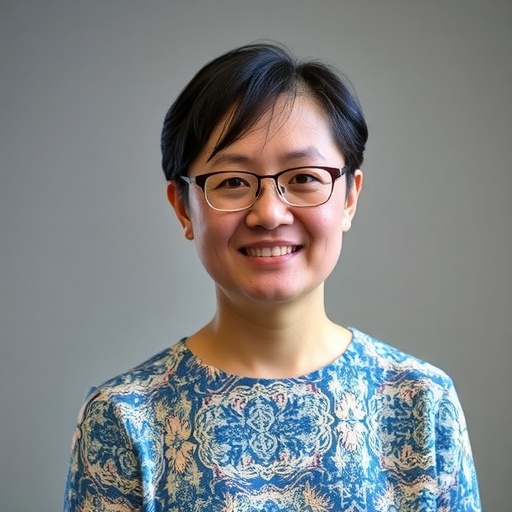
Dr. Tingxiang Zou is embarking on an ambitious new chapter in mathematical research as she prepares to lead a cutting-edge Emmy Noether research group at the renowned Hausdorff Center for Mathematics, part of the University of Bonn’s Mathematical Institute. Set to begin in September, this appointment is supported by a substantial grant of up to 1.6 million euros from the German Research Foundation (DFG), underscoring the high expectations and significant potential impact of her work. Zou’s group will focus on advancing the understanding of the Elekes-Szabó problem, a deep and intriguing question that sits at the crossroads of combinatorics, algebra, geometry, and model theory.
The Elekes-Szabó problem arises from a rich context of additive and multiplicative structures within finite sets and extends to complex algebraic relations defined by polynomial equations. This problem generalizes the classical sum-product phenomenon, which explores the tension between additive and multiplicative configurations within numerical sets. To illustrate, consider the sequence of even numbers: their sums yield relatively few unique outcomes, indicating limited additive diversity, whereas their products create a broader range of distinct values, highlighting more complex multiplicative structure. Contrarily, geometric progressions demonstrate the opposite pattern, boasting strong multiplicative regularity but weak additive variation. The Elekes-Szabó framework formalizes this dichotomy in higher-dimensional and more abstract algebraic settings.
Central to the Elekes-Szabó problem is the observation that when a polynomial equation over real or complex fields admits an unexpectedly large number of solutions clustered in finite grids, there must be a hidden algebraic group structure underlying the phenomenon—often resembling familiar operations like addition or multiplication. This profound insight opens the door to disentangling complex algebraic behaviors by uncovering latent symmetries and group actions that govern solution sets. Dr. Zou’s research group aims to push the boundaries of this theory by examining higher-dimensional variants, which may reveal new algebraic symmetries governing intricate geometric and combinatorial patterns.
Dr. Zou’s background, spanning philosophy at Peking University, logic in Amsterdam, and mathematics in Lyon, equips her with a uniquely interdisciplinary perspective. Her training is emblematic of the modern mathematical landscape where abstract logic and formal reasoning sharply intersect with deep, structural algebraic and combinatorial problems. Prior to joining Bonn, she honed her expertise through research appointments at prestigious institutions, including the Hebrew University of Jerusalem and the University of Münster’s Mathematics Cluster of Excellence. Her transition to Bonn as an Emmy Noether group leader represents not just a personal milestone but also an important institutional investment in fostering groundbreaking research at the intersection of model theory and combinatorics.
The Emmy Noether Program, under whose aegis Dr. Zou’s group has been funded, is a strategic initiative by the DFG to cultivate emerging research leaders by enabling them to assemble and direct their own research teams. This six-year program not only provides financial support but also serves as a springboard for participants to gain professorship qualifications. By leading her own Emmy Noether group, Dr. Zou is empowered to attract talented collaborators and forge new networks of intellectual exchange, contributing to an invigorated and dynamic research environment at the University of Bonn.
Collaboration is a hallmark of Dr. Zou’s approach. Her research initiative already involves close partnerships with distinguished scholars worldwide, including Martin Bays from the University of Oxford, Jan Dobrowolski at Xiamen University Malaysia, and Yifan Jing from Ohio State University. Upcoming collaborations with eminent figures like Artem Chernikov and Ehud Hrushovski promise to infuse fresh perspectives and innovative methods into the study of higher-dimensional polynomial solutions and their algebraic underpinnings. These alliances position the Emmy Noether group at the forefront of international research in algebraic combinatorics and model theory.
At a technical level, the core of the Elekes-Szabó problem is to analyze the behavior of polynomial functions when restricted to Cartesian products of finite sets. The challenge lies in characterizing those polynomials whose values have an unexpectedly large intersection with such structured grids, a situation that frequently signals the presence of underlying algebraic groups. Beyond the classical cases resembling addition and multiplication, Dr. Zou’s group aspires to explore a more general taxonomy of these hidden structures, potentially uncovering new algebraic identities and combinatorial invariants that explain anomalously dense solution patterns.
Mathematicians working in this field blend tools from several domains: algebraic geometry provides the language to handle polynomial equations and their solution sets; model theory offers a framework to analyze the logical structure and definability properties of these sets; combinatorics supplies quantitative measures of solution density and growth; and group theory elucidates the symmetries that govern these structures. Dr. Zou’s interdisciplinary expertise uniquely situates her to integrate these perspectives, thereby advancing a holistic understanding of the Elekes-Szabó phenomenon and its extensions.
The potential impact of this research reaches beyond pure mathematics, as understanding algebraic relations among finite sets has implications for theoretical computer science, complexity theory, and cryptographic applications. Discovering new structural patterns in polynomial solution sets could inform algorithmic strategies and shape how computational models deal with algebraic data. Through the Emmy Noether group, Dr. Zou’s research may thus initiate ripples that extend into applied fields concerned with discrete structures and their symmetries.
As Dr. Zou prepares to lead this newly established research unit, the University of Bonn consolidates its reputation as a hub of excellence in mathematics. The Hausdorff Center for Mathematics, supported by significant institutional and federal funding, fosters a vibrant ecosystem of inquiry and innovation. By embracing emerging talents like Dr. Zou and providing them with platforms such as the Emmy Noether Program, Bonn reinforces its commitment to advancing frontier mathematical research with global collaboration and profound theoretical depth.
The group’s initial funding phase spans three years with the possibility of a renewable extension, contingent upon evaluation and grant approval, ensuring a stable yet performance-driven research trajectory. This structured support grants Dr. Zou the intellectual and financial freedom to pursue ambitious projects, mentor doctoral candidates, and build a lasting legacy within the mathematical community.
Dr. Zou herself expresses enthusiasm about the opportunity to deepen the connections between model theory and combinatorics, projecting that this interplay will yield rich theoretical insights and novel problem-solving techniques. The group’s activities will likely encompass seminars, workshops, and intensive collaborative exchanges, amplifying knowledge dissemination and fostering a new generation of mathematicians attuned to the subtleties of algebraic combinatorial structures.
In summary, Dr. Tingxiang Zou’s forthcoming leadership of the Emmy Noether research group at the University of Bonn signifies a vital advance in the investigation of the Elekes-Szabó problem. Backed by substantial funding and a network of international collaborations, this project promises to illuminate higher-dimensional algebraic phenomena that intertwine polynomial equations, combinatorial density, and hidden group structures. It exemplifies the vibrant synergy achievable when interdisciplinary expertise converges on profound mathematical enigmas, heralding exciting developments in the theory and applications of algebraic combinatorics.
Subject of Research: Higher-dimensional algebraic structures and combinatorial solutions related to the Elekes-Szabó problem, focusing on algebraic group behaviors in polynomial equations over finite grids.
Article Title: Exploring Hidden Algebraic Structures: Dr. Tingxiang Zou’s Emmy Noether Group Tackles the Elekes-Szabó Problem at the University of Bonn
News Publication Date: Information not provided in the content.
Web References: Information not provided in the content.
References: Information not provided in the content.
Image Credits: Photo: Shiqi Zhai
Keywords: Elekes-Szabó problem, Emmy Noether Program, algebraic combinatorics, model theory, polynomial equations, finite grids, hidden algebraic groups, sum-product phenomena, University of Bonn, Hausdorff Center for Mathematics, interdisciplinary mathematics, higher-dimensional algebraic structures


