

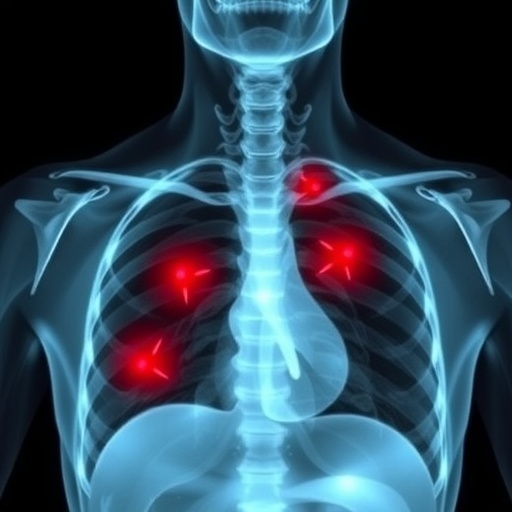
In the ever-evolving landscape of medical science, the integration of artificial intelligence into clinical decision-making is reshaping our understanding of complex health conditions. A groundbreaking study emerging from a collaboration between two leading medical centers has unveiled a critical link between thoracic muscle loss and the increased requirement for mechanical ventilation in elderly patients suffering from pulmonary embolism. This investigation not only sheds light on the intricate physiological interplay inherent in aging and acute cardiovascular conditions but also pioneers a novel machine learning model poised to revolutionize patient care in geriatric medicine.
Pulmonary embolism (PE), a condition marked by the obstruction of pulmonary arteries by blood clots, remains a significant cause of morbidity and mortality, especially among the elderly. Despite advances in anticoagulation therapies and diagnostic modalities, the management of PE in aged populations faces unique challenges. Among these is the role of skeletal muscle integrity, or lack thereof, which until now has been an underappreciated factor influencing respiratory function and recovery trajectories.
The investigators embarked on a comprehensive analysis of clinical data drawn from a robust, two-center cohort encompassing elderly PE patients. Their objective was to architect a predictive model that quantifies how thoracic muscle atrophy exacerbates respiratory compromise, thereby escalating the necessity for invasive mechanical ventilation. This approach leverages state-of-the-art machine learning algorithms, a testament to the intersection of computational intelligence and clinical insight.
In their rigorous study design, researchers meticulously extracted computed tomography (CT) imaging data to quantify thoracic muscle mass. This imaging biomarker, often overlooked, serves as a surrogate for the patient’s respiratory muscle reserve and overall physiological robustness. By mapping these quantitative muscle metrics against patient outcomes, particularly the need for ventilatory support, the team elucidated a clear and statistically significant association.
The machine learning model developed operates by integrating multidimensional clinical and imaging variables, enabling the stratification of patients on a personalized risk scale. Its predictive capacity surpasses traditional risk factors, indicating that thoracic muscle depletion is an independent and formidable predictor of ventilatory requirement. This insight emphasizes the critical importance of muscular health assessment in managing elderly patients with PE.
The implications of these findings are profound. Mechanical ventilation, while often lifesaving, carries substantial risks, including ventilator-associated pneumonia, muscle deconditioning, and prolonged hospital stays. Identifying patients at high risk before ventilation becomes necessary could allow for preemptive interventions aimed at muscle preservation or rehabilitation, potentially altering clinical outcomes and reducing healthcare burdens.
Furthermore, this research underscores the utility of integrating imaging biomarkers with machine learning frameworks to enhance precision medicine. The adaptability of such models means they can, in the future, incorporate other physiological parameters or be recalibrated for different patient demographics and comorbidities, highlighting the scalability and transformative potential of this approach.
From a mechanistic standpoint, the study invites deeper exploration into how muscle wasting, a hallmark of aging known as sarcopenia, influences respiratory mechanics. The thoracic muscles, including the intercostals and diaphragm, are essential for effective ventilation. Their atrophy diminishes respiratory efficiency, lowering the threshold at which respiratory failure ensues in the face of pulmonary insults like embolism.
Clinicians and researchers alike will find value in this study’s methodological rigor. The use of a two-center cohort enhances the generalizability of findings, while cross-validation techniques ensure that the machine learning model maintains reliability when applied to new patient data. This strengthens the argument for incorporating such models into clinical decision support systems.
Importantly, the study advocates for a paradigm shift in geriatric care, where assessment of muscle health becomes as routine as monitoring cardiovascular or pulmonary parameters. Such comprehensive evaluations could pave the way for multidisciplinary interventions combining nutrition, physiotherapy, and pharmacological strategies aimed at maintaining thoracic musculature integrity.
As the burden of PE and other acute cardiopulmonary conditions grows in aging populations worldwide, the timely prediction of mechanical ventilation necessity not only has prognostic value but can fundamentally transform care pathways. Early identification of high-risk patients facilitates tailored ventilatory management strategies, including non-invasive ventilation or timely intubation, optimizing resource allocation and patient prognosis.
The research further sparks discussion on the role of artificial intelligence in unraveling complex interactions in human pathophysiology. Machine learning models excel in detecting non-linear patterns and interdependencies among variables that traditional statistical tools may overlook. Their deployment in this context exemplifies the future of personalized medicine, where data-driven insights guide therapeutic decisions.
In sum, the pioneering work led by Deng, Luo, Zhou, and colleagues represents a vital step forward in our understanding of the interplay between muscle health and respiratory function in elderly PE patients. Their machine learning model not only enhances prediction capabilities but points toward the necessity of holistic patient assessments. By addressing thoracic muscle loss proactively, medical professionals may mitigate the need for mechanical ventilation, improving survival and quality of life.
The study’s innovative approach, combining imaging, clinical data, and advanced computational techniques, is likely to inspire similar endeavors targeting other critical illness phenotypes. As we stand on the cusp of integrating AI into everyday clinical practice, such models will become invaluable tools in managing complex diseases, especially in vulnerable populations.
Moreover, the integration of thoracic muscle assessment into clinical routines calls for the development of standardized imaging protocols and muscle quantification methods. Future research may focus on refining these techniques and exploring the therapeutic efficacy of interventions designed to augment respiratory muscle strength.
In conclusion, this landmark research underscores the intricate, multifactorial nature of pulmonary embolism management in the elderly and highlights the transformative potential of machine learning. It advocates for a future where enhanced predictive analytics enable clinicians to preempt complications, personalize interventions, and ultimately, improve patient outcomes in an aging world facing mounting healthcare challenges.
Subject of Research:
Thoracic muscle loss and its impact on the use of mechanical ventilation in elderly patients with pulmonary embolism, studied through a machine learning predictive model.
Article Title:
Thoracic muscle loss increases the use of mechanical ventilation in elderly patients with pulmonary embolism: constructing and validating a machine learning model on a two-center cohort.
Article References:
Deng, Z., Luo, D., Zhou, J. et al. Thoracic muscle loss increases the use of mechanical ventilation in elderly patients with pulmonary embolism: constructing and validating a machine learning model on a two-center cohort. BMC Geriatr (2026). https://doi.org/10.1186/s12877-026-07241-z
Image Credits: AI Generated


