

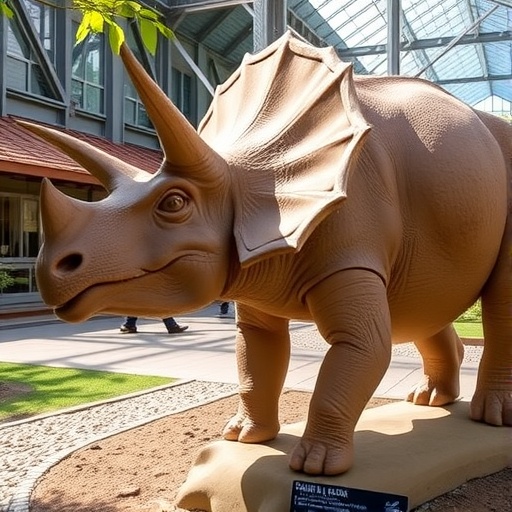
The Enigmatic Nasal Anatomy of Triceratops Illuminated Through Cutting-Edge CT Technology
Triceratops, a genus of horned dinosaurs that roamed the Earth millions of years ago, has long fascinated paleontologists and dinosaur enthusiasts alike, largely for its massive skull and iconic three-horned face. Yet, despite its fame, much of the internal anatomy of its skull has remained an enigma. A team of researchers, including scientists from the University of Tokyo, has embarked on a pioneering study utilizing CT scans and comparative anatomy to unravel the mysteries of the Triceratops’ nasal cavity, revealing unexpected complexity that reshapes our understanding of dinosaur physiology.
Unlike most modern reptiles, Triceratops possessed an unusually large nasal cavity whose internal structures have been elusive due to the impossibility of directly observing soft tissues in fossils. By performing high-resolution X-ray computed tomography (CT) scans on fossilized skulls and integrating this data with anatomical knowledge derived from extant reptiles such as birds and crocodilians, the researchers constructed a detailed 3D model of the nasal cavity. This sophisticated approach allowed them to hypothesize the arrangement of nerves, blood vessels, and respiratory structures that once inhabited this enormous snout.
One of the study’s striking breakthroughs is the revelation that Triceratops had unique neural and vascular pathways within their noses. Typically, in reptiles, nerves and blood vessels reach the nostrils via routes associated with the jaw and nose. However, due to the skull morphology of the Triceratops, the usual jaw routes were obstructed, compelling these vital tissues to traverse through the nasal branch alone. This adaptation indicates an evolutionary rewiring that supports the demands of the dinosaur’s disproportionately massive nasal region, a feature that correlates with its iconic head size.
Further investigation into the nasal soft tissues uncovered something groundbreaking: evidence for a respiratory turbinate within the nasal cavity. Respiratory turbinates are delicate, curled bony or cartilaginous structures which amplify the surface area inside the nose to facilitate heat and moisture exchange. While rare among dinosaurs, this trait is present in their closest living relatives, birds, as well as mammals. The presence of such structures in Triceratops suggests an advanced physiological mechanism to regulate internal body temperature and moisture retention.
This discovery challenges the traditional paradigm that most dinosaurs were ectothermic or “cold-blooded.” Although Triceratops was not likely fully warm-blooded, the respiratory turbinate may have provided a means to mitigate the heat generated by its large skull and maintain homeostasis, enhancing its ability to survive in varied climatic conditions. Such complexity points to a nuanced thermal physiology that blurs the boundaries between cold- and warm-bloodedness.
The researchers base their conclusions on detailed analysis of the turbinate’s anatomical marker — a distinctive ridge on the nasal cavity wall. This ridge matches the location of attachment points observed in modern birds, which possess known respiratory turbinates. Despite the scarcity of direct fossil evidence of soft tissues, comparative morphology has enabled the team to infer the likely presence of these structures in horned dinosaurs. This methodological innovation highlights how paleontologists can bridge massive evolutionary gaps using contemporary analogues.
The evolutionary implications of this study are profound. As the last group of dinosaurs to have their cranial soft tissues systematically investigated, horned dinosaurs like Triceratops close a pivotal chapter in dinosaur biology. Researchers have now pieced together a comprehensive hypothesis about the soft-tissue anatomy that once filled their skulls, providing fresh insight into how these animals might have lived, interacted, and adapted to their environments.
Lead researcher Seishiro Tada, who has been studying reptilian cranial evolution since his graduate studies, emphasized the intricate puzzle-like nature of this work. “Piecing together 3D-printed segments of a Triceratops skull allowed me to visualize how nerve and blood vessel pathways adapted to support their massive noses,” he noted. This hands-on, spatial approach to paleontological reconstruction is revolutionizing our ability to interpret fossilized remains beyond bone structure alone.
Looking beyond the nose, the research team plans to expand their investigations to other distinctive cranial features, such as the frills adorning the back of Triceratops skulls. These frills have captivated scientists for decades, yet their functional anatomy remains poorly understood. Exploring the soft tissues associated with these structures could shed light on their role in thermoregulation, communication, or defense.
This research also underscores the value of multidisciplinary collaboration, combining paleontology, anatomy, evolutionary biology, and advanced imaging technology. By bridging these fields, scientists have achieved a level of anatomical resolution previously deemed impossible for extinct taxa, opening avenues for reinterpreting dinosaur biology with a newfound clarity.
The study has been published in The Anatomical Record, providing a detailed methodology and comprehensive illustrations of the reconstructed nasal anatomy. Its implications extend beyond Triceratops to other ceratopsian dinosaurs, refining our broader understanding of how these magnificent creatures functioned in their ecosystems.
Funding from the Japan Society for the Promotion of Science (JSPS), alongside the support of the JSPS Overseas Challenge Program for Young Researchers, facilitated this technologically intensive research. The team’s efforts continue a tradition of pioneering anatomical work emanating from the University of Tokyo, a leading institution in natural sciences.
In conclusion, these findings illuminate not only the anatomy but also the physiology and perhaps the evolutionary trajectories of horned dinosaurs. The integration of modern technology with foundational comparative anatomy offers an unparalleled window into the prehistoric past, casting new light on how the iconic Triceratops and its kin might have navigated their world. As soft tissue reconstructions advance, our perception of dinosaurs evolves beyond static skeletons into dynamic, living creatures adapting in complex ways.
Subject of Research: Animal tissue samples
Article Title: Nasal soft-tissue anatomy of Triceratops and other horned dinosaurs
News Publication Date: 7-Feb-2026
Web References: https://anatomypubs.onlinelibrary.wiley.com/doi/10.1002/ar.70150
References: Seishiro Tada, Takanobu Tsuihiji, Hiroki Ishikawa, Noriyuki Wakimizu, Soichiro Kawabe, Kodai Sakane, “Nasal soft-tissue anatomy of Triceratops and other horned dinosaurs”, The Anatomical Record, DOI: 10.1002/ar.70150
Image Credits: ©2026 K. Sakane CC-BY-ND
Keywords: Triceratops, horned dinosaurs, nasal cavity, soft tissue anatomy, respiratory turbinate, CT scan, paleontology, dinosaur physiology, evolutionary biology, cranial anatomy, thermal regulation


