

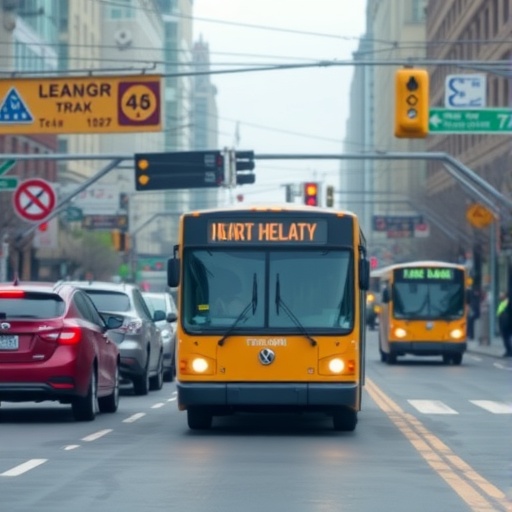
New research presented at the American College of Cardiology’s Annual Scientific Session (ACC.26) delivers compelling evidence linking prolonged exposure to transportation noise to an increased risk of major adverse cardiovascular events. This study, conducted on a large and diverse cohort in Houston, reveals that chronic noise pollution from road, rail, and aviation sources may exert significant stress on cardiovascular health, prompting calls for urban planning interventions that mitigate the impact of environmental noise on communities.
Transportation noise is a ubiquitous yet often underestimated environmental hazard. Unlike air pollution, which has been extensively studied and regulated, noise exposure rarely features in cardiovascular risk assessments. Dr. Jad Ardakani, the study’s lead author and a clinical research fellow at Houston Methodist Hospital, emphasizes that noise represents a modifiable risk factor that deserves greater attention. “These new findings urge the integration of environmental noise into cardiovascular health frameworks, highlighting the necessity of assessing individual noise exposure and identifying practical mitigation strategies,” Ardakani remarks.
Prior investigations have documented that sustained noise exposure triggers physiological stress responses involving the autonomic nervous system and hypothalamic-pituitary-adrenal axis. Such activation can elevate blood pressure, release stress hormones, and promote systemic inflammation, all of which are established contributors to cardiovascular disease. Furthermore, emerging data indicates that noise-induced disruption of sleep architecture exacerbates these deleterious effects by impairing restorative processes critical to cardiovascular recovery and regulation.
The latest study is among the largest U.S.-based analyses exploring the relationship between transportation noise and cardiovascular outcomes. Reviewing the medical records of over 1.2 million adults from the Houston metropolitan area between 2016 and 2023, researchers quantified noise exposure using the National Transportation Noise Map developed by the U.S. Department of Transportation. This map allows assignment of average noise decibel levels (dB) to residential locations, stratifying exposure into quiet (<45 dB), moderate (45–54 dB), and loud (≥55 dB) categories.
Notably, sustained noise levels at or above 55 decibels, akin to typical conversational volume or ambient background music, do not cause auditory damage but have been found to disrupt neurophysiological pathways involved in stress and sleep regulation. Individuals residing in these noisier environments had a 17% greater likelihood of experiencing fatal or nonfatal cardiovascular events, including myocardial infarction, stroke, or needing coronary artery revascularization. When broken down by noise source, loud road noise was linked to a 17% increased risk, road combined with aviation noise to 16%, and loud rail noise to 10%.
Intriguingly, the cardiovascular impacts of transportation noise appear source-dependent. When evaluating incremental risk per 10-decibel increases, rail noise posed a particularly heightened threat, associated with a 14% increase in major adverse cardiac events, in stark contrast to the more modest 3% increase observed for road noise. Dr. Ardakani clarifies that rail noise tends to be characterized by abrupt, intermittent loud sounds often accompanied by underlying vibrations. These sudden stimuli, particularly intense at night, may provoke stronger physiological disturbances than the more continuous, less variable soundscape of roadway traffic.
Although the study’s design did not directly elucidate the mechanistic pathways linking noise to cardiovascular outcomes, sleep fragmentation likely plays a pivotal role. Noise-induced activation of stress responses can occur even without awakening, interrupting the critical restorative phases of sleep. Additionally, the physical vibrations transmitted by rail traffic may represent a novel stressor, potentially affecting cardiovascular function through mechanotransduction pathways not triggered by steady road noise.
The research team meticulously accounted for multiple confounding factors including demographic variables, socioeconomic status, insurance type, known cardiometabolic risk factors, neighborhood social vulnerability, and fine particulate air pollution exposure. Significantly, the observed associations between transportation noise and cardiovascular risk persisted despite these adjustments, underscoring the independent contribution of noise pollution to heart health.
Implications of these findings extend to public health policy and urban development strategies. City planners, architects, and developers are encouraged to incorporate noise mitigation techniques such as enhanced building insulation, strategic urban green spaces, and noise barriers along transportation corridors. Prospective homebuyers or renters concerned about cardiovascular risk may also benefit from considering ambient noise exposure as a factor in residential choice. Practical measures like improved insulation or keeping windows closed during sleep can reduce night-time noise infiltration.
The study acknowledges limitations including potential misclassification bias stemming from reliance on 2020 noise data over a longitudinal health outcome assessment window spanning 2016 to 2023. Individual-level noise modifiers such as window opening habits, air conditioning usage, or localized soundproofing measures could not be accounted for, implying that actual personal noise exposure may vary within neighborhoods. These factors highlight the complexity of accurately quantifying environmental stressors in epidemiological research.
Looking forward, the research team plans to investigate the synergistic effects of other environmental exposures such as nocturnal light pollution and vulnerability to climate-related stressors on cardiovascular risk. This holistic approach aims to unravel the multifactorial nature of urban environmental determinants of heart health, advancing toward comprehensive strategies for disease prevention at the population level.
The compelling evidence presented during ACC.26 accentuates an urgent need to reposition environmental noise from an overlooked nuisance to a recognized cardiovascular risk factor. As Dr. Ardakani states, “Understanding and reducing the cardiovascular burden imposed by transportation noise offers a promising avenue for enhancing population health, especially as urbanization and traffic volumes continue to rise globally.” This paradigm shift could catalyze innovative public health interventions aimed at designing healthier cities for the 21st century.
For clinicians, researchers, and policymakers, these findings underscore the necessity of incorporating noise exposure into clinical risk assessments and environmental health frameworks. Collaborative efforts between cardiovascular specialists, urban planners, and environmental scientists are essential to develop multifaceted strategies that address the complex interplay between transportation infrastructure and human health. In doing so, societies can ensure the creation of urban environments conducive to cardiovascular well-being and long-term sustainability.
The study titled “Transportation Noise Exposure and Incident Major Adverse Cardiovascular Events in a Large Healthcare System Cohort” will be presented by Dr. Jad Ardakani on March 29 at 11:00 a.m. CT during a poster session in Hall E at ACC.26. This conference, held from March 28-30, 2026, in New Orleans, unites global cardiovascular experts to disseminate cutting-edge discoveries in heart disease treatment and prevention.
Subject of Research: Impact of transportation noise on cardiovascular health
Article Title: Transportation Noise Exposure and Incident Major Adverse Cardiovascular Events in a Large Healthcare System Cohort
News Publication Date: March 29, 2026
Web References:
- Study in JACC: Advances: https://www.jacc.org/doi/10.1016/j.jacadv.2025.101787
- Joint society statement on environmental stressors and cardiovascular health: https://www.jacc.org/doi/10.1016/j.jacc.2026.01.015
Keywords: Noise pollution, Transportation infrastructure, Roads, Railways, Aircraft, Cardiovascular disease, Traffic noise, Sleep disruption, Public health, Urban planning, Environmental health, Cardiometabolic risk


