

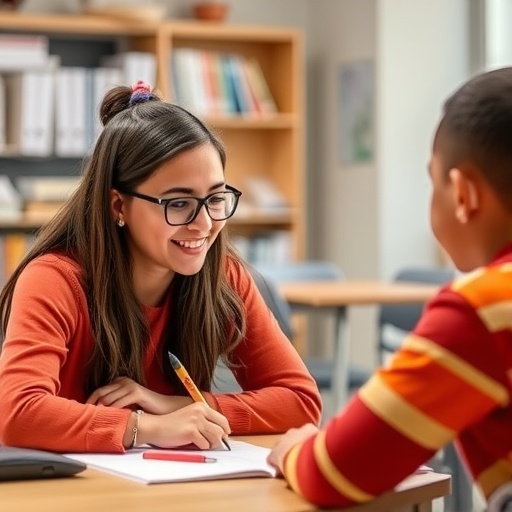
In recent years, artificial intelligence (AI) has increasingly penetrated the education sector, promising personalized learning experiences and improved student outcomes. Intelligent Tutoring Systems (ITS), a key manifestation of AI in classrooms, offer customized hints, feedback, and performance tracking to students. However, a new study from North Carolina State University uncovers intriguing insights about how teachers engage with these AI tools, revealing a tendency among educators to repeatedly assist a consistent subset of students rather than evenly distributing their attention across the classroom.
This study sought to explore the decision-making processes behind teacher interventions when utilizing AI-powered tutoring systems in middle school math classrooms. “Teachers remain indispensable even as AI tools grow more sophisticated,” says Qiao Jin, an assistant professor of computer science at NC State and the study’s lead author. By dissecting both qualitative and quantitative data, the research sheds light on the nuanced human factors that influence when, why, and to whom teachers allocate their time and attention.
The research focused on intelligent tutoring systems which monitor student interactions and dynamically respond by providing tailored guidance. These systems flag engagement states such as “struggle,” where students enter repeated incorrect answers, or “idle,” where prolonged inactivity is detected. Such signals are designed to guide teachers in identifying students in need of support. To understand teacher usage patterns, the researchers conducted interviews with nine middle school math teachers who regularly employed ITS in their classrooms.
During the interviews, it became clear that while teachers aim to support every student individually, constraints on time and resources prevent them from doing so consistently. Instead, teachers rely on heuristics shaped by their prior experiences and pedagogical training. A striking factor influencing intervention decisions was a student’s history of needing assistance. Teachers expressed a natural inclination to revisit students they had aided before, viewing these students as more likely to require ongoing support.
This “stickiness” in teacher help was further examined through a massive dataset capturing more than 1.4 million student-ITS interactions from 339 students across 14 classes in 10 U.S. middle and high schools during the 2022-2023 academic year. The dataset allowed the researchers to correlate teacher behaviors with student engagement states visible through the ITS dashboards, to which teachers had continuous access. The quantitative analysis confirmed that once a teacher had intervened with a student, subsequent interventions were more probable for that student, independent of current levels of engagement or struggle.
This pattern raises important questions about equity and instructional strategy. Teachers operate based on personal definitions of fairness and perceptions of student need, informed by professional training and classroom experience. However, the research suggests that these subjective factors can lead to uneven distribution of teacher attention, with some students potentially underserved. According to Jin, this does not necessarily reflect negligence or bias, but rather the natural human inclination to build on known information and relationships.
The findings point to practical applications in the design of AI-powered educational tools. Enhanced dashboard features could provide teachers with analytics to balance their interventions more equitably while respecting their unique pedagogical values. By surfacing data on intervention patterns, these tools could alert teachers if certain students are being overlooked or if time is being disproportionately spent on others. Ultimately, such guidance could support teachers in aligning their limited time with strategic instructional goals and definitions of fairness.
This intersection of human judgment and AI assistance underlines the ongoing complexity of integrating technology into education at scale. Although ITS offer real-time, data-driven insights, the human element remains crucial in translating those insights into effective teaching strategies. The study reveals that technology alone does not guarantee balanced attention distribution; instead, thoughtful design informed by teacher behavior is essential to foster equitable learning environments.
Highlighting the interplay between AI and human agency, the research underscores the challenges teachers face in large classrooms where individual attention is constrained. Teachers must continuously make judgment calls about when to intervene, balancing competing demands and responding to dynamic student needs. The confirmation that teachers tend to revisit familiar students may reflect an effort to optimize limited support resources by focusing on those perceived to benefit most.
The study’s authors advocate for thoughtful collaboration between educators and technologists to develop software that augments, rather than replaces, teacher decision-making. By leveraging analytics from ITS, future tools could better scaffold equitable intervention patterns, enabling teachers to monitor their own tendencies and adjust their approach dynamically throughout lessons. This might lead to improved outcomes not only in academic achievement but also in student motivation and engagement.
Furthermore, the integration of such AI-driven analytics in classrooms represents a promising frontier for educational research and policy. As schools increasingly adopt ITS and other AI technologies, understanding their influence on teacher behavior is critical. This research provides vital empirical data and theoretical frameworks to inform the development and deployment of tools that empower teachers and promote fairness without overwhelming educators.
The study, titled “Sticky Help, Bounded Effects: Session-by-Session Analytics of Teacher Interventions in K-12 Classrooms,” will be presented at the upcoming 16th Annual Learning Analytics & Knowledge Conference in Bergen, Norway. It was produced through a collaboration between North Carolina State University and Carnegie Mellon University, with funding support from the Institute of Education Sciences of the U.S. Department of Education. The insights generated promise to inspire further exploration into the balanced integration of AI in education.
Teachers are often tasked with managing complex classrooms and diverse learning needs, demanding not only pedagogical skill but also efficient use of time and interventions. This research emphasizes that AI tools, though powerful, must be designed to complement human priorities and fairness standards. By embracing a hybrid approach that merges data-driven prompts with teacher expertise, the future of AI-powered education can aspire to more personalized, equitable, and effective learning experiences for all students.
Subject of Research: People
Article Title: Sticky Help, Bounded Effects: Session-by-Session Analytics of Teacher Interventions in K-12 Classrooms
Web References:
– Paper: https://arxiv.org/abs/2601.13520
– Conference: https://www.solaresearch.org/events/lak/lak26/
Keywords: artificial intelligence, intelligent tutoring systems, teacher interventions, education technology, K-12 education, middle school math, student engagement, equitable teaching, AI dashboards, educational analytics, human-computer interaction, personalized learning


