
Saturday, February 28, 2026
Science
No Result
View All Result
  • Login
  • HOME
  • SCIENCE NEWS
  • CONTACT US
  • HOME
  • SCIENCE NEWS
  • CONTACT US
No Result
View All Result
Scienmag
No Result
View All Result
Home Science News Policy

Taking steps for improving the biodiversity monitoring methods in support of the EU Biodiversity Strategy for 2030

July 22, 2024
in Policy
Reading Time: 2 mins read
0
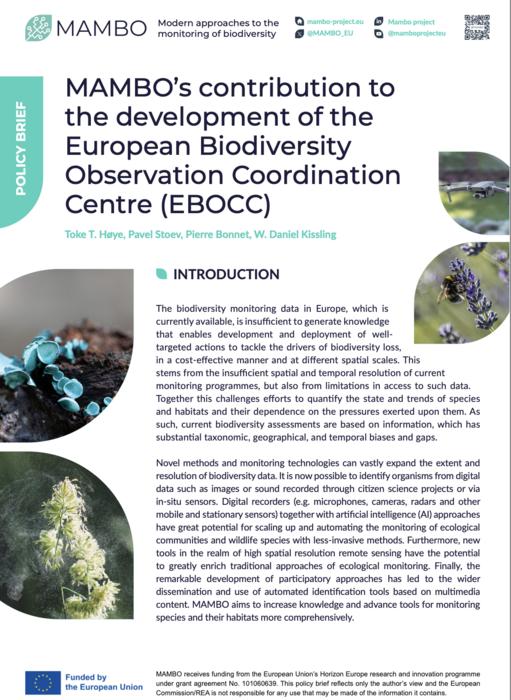
MAMBO's contribution to the development of the European Biodiversity Observation Coordination Centre (EBOCC)
66
SHARES
598
VIEWS
Share on FacebookShare on Twitter
ADVERTISEMENT

The EU-funded project MAMBO (Modern Approaches to the Monitoring of Biodiversity) announces the release of its first policy brief, which highlights MAMBO’s contribution to the development of the European Biodiversity Observation Coordination Centre (EBOCC).

MAMBO's contribution to the development of the European Biodiversity Observation Coordination Centre (EBOCC)

Credit: PENSOFT

The EU-funded project MAMBO (Modern Approaches to the Monitoring of Biodiversity) announces the release of its first policy brief, which highlights MAMBO’s contribution to the development of the European Biodiversity Observation Coordination Centre (EBOCC).

EBOCC aims to coordinate biodiversity monitoring across Europe by fostering collaboration among Member States and organisations, integrating monitoring results, and analysing data to derive indicators that support policies. By 2030, EBOCC envisions establishing harmonised data flows to conserve Europe’s ecosystems, aligning with the EU Biodiversity Strategy for 2030.

The EU Parliament and Commission have initiated actions to establish EBOCC, with its mission formulated by key stakeholders through the EuropaBON project. EBOCC focuses on supporting coordination, ensuring harmonised data flows, and analysing information at the EU level to aid conservation efforts and provide regular biodiversity updates.

Coordinated by the University of Aarhus in Denmark, the MAMBO consortium involves researchers from 10 organisations across 8 European countries. MAMBO’s work programme aims to provide the knowledge, tools and infrastructure for monitoring wildlife and their habitats more comprehensively. MAMBO has the potential to improve the ecological monitoring landscape in Europe by developing innovative monitoring tools and engaging with stakeholders. The project is mapping stakeholder landscapes, synthesising user needs, and co-designing future monitoring tools. MAMBO’s tools are meant to integrate with existing research infrastructures, and enhance the current databases with images and sounds to improve machine-learning models.

These advancements will lead to new image-based monitoring applications and improved habitat condition indicators derived from remote sensing and LiDAR data. MAMBO’s tools will feed into models that enhance biodiversity monitoring and adaptive strategies, highlighting regions with high uncertainty. Continuous cost-efficiency assessments are conducted to ensure these tools deliver maximum value.

Through these efforts, MAMBO seeks to demonstrate its impact on enhancing biodiversity monitoring, with a particular focus on its role in the development of the European Biodiversity Observation Coordination Centre (EBOCC). By doing so, MAMBO supports the overall objectives of the EU Biodiversity Strategy for 2030. 

For more information, please access the full policy brief through MAMBO’s website or the project’s collection in the Research Ideas and Outcomes Journal (RIO).

***

This project receives funding from the EU Horizon Europe Research and Innovation Action programme under Grant agreement No. 101060639.

Views and opinions expressed are those of the author(s) only and do not necessarily reflect those of the European Union or the European Commission. Neither the EU nor the EC can be held responsible for them.



Share26Tweet17
Previous Post

Pusan National University researchers revolutionize environmental health with advanced explainable machine learning approach

Next Post

STEM skills-based economy focus for Scismic’s new Chief Commercial Officer

Related Posts

blank
Policy

Leading Scientists Challenge DOE Climate Report, Calling It ‘Demonstrably Incorrect’ in New Analysis

February 27, 2026
blank
Policy

THRIVE: Revolutionizing Health by Restoring Innate Vitality for All

February 27, 2026
blank
Policy

IP4OS Releases the Synergy Framework for Enhancing Knowledge Valorisation

February 26, 2026
blank
Policy

New Georgia Tech Study Shows Safe AI Alone Isn’t Sufficient

February 26, 2026
blank
Policy

Experts Propose Enhanced Strategies for Strengthening Genetic Privacy Laws

February 26, 2026
blank
Policy

New Study Illuminates Gaps in Understanding Child Care Outcomes

February 26, 2026
Next Post
Peter Craig-Cooper

STEM skills-based economy focus for Scismic’s new Chief Commercial Officer

  • Mothers who receive childcare support from maternal grandparents show more parental warmth, finds NTU Singapore study

    Mothers who receive childcare support from maternal grandparents show more parental warmth, finds NTU Singapore study

    27618 shares
    Share 11044 Tweet 6902
  • University of Seville Breaks 120-Year-Old Mystery, Revises a Key Einstein Concept

    1022 shares
    Share 409 Tweet 256
  • Bee body mass, pathogens and local climate influence heat tolerance

    665 shares
    Share 266 Tweet 166
  • Researchers record first-ever images and data of a shark experiencing a boat strike

    532 shares
    Share 213 Tweet 133
  • Groundbreaking Clinical Trial Reveals Lubiprostone Enhances Kidney Function

    517 shares
    Share 207 Tweet 129
Science

Embark on a thrilling journey of discovery with Scienmag.com—your ultimate source for cutting-edge breakthroughs. Immerse yourself in a world where curiosity knows no limits and tomorrow’s possibilities become today’s reality!

RECENT NEWS

  • Physical Activity Slows Aging-Related Physical Decline
  • X-ray Activated Platinum Complex Boosts Cancer Immunotherapy
  • New Study Shows Belzutifan and Pembrolizumab Combo Extends Cancer-Free Survival in High-Risk Kidney Cancer Patients After Surgery
  • Botulinum Toxin Causes Masseter Atrophy via Autophagy Impairment

Categories

  • Agriculture
  • Anthropology
  • Archaeology
  • Athmospheric
  • Biology
  • Biotechnology
  • Blog
  • Bussines
  • Cancer
  • Chemistry
  • Climate
  • Earth Science
  • Editorial Policy
  • Marine
  • Mathematics
  • Medicine
  • Pediatry
  • Policy
  • Psychology & Psychiatry
  • Science Education
  • Social Science
  • Space
  • Technology and Engineering

Subscribe to Blog via Email

Enter your email address to subscribe to this blog and receive notifications of new posts by email.

Join 5,190 other subscribers

© 2025 Scienmag - Science Magazine

Welcome Back!

Login to your account below

Forgotten Password?

Retrieve your password

Please enter your username or email address to reset your password.

Log In
No Result
View All Result
  • HOME
  • SCIENCE NEWS
  • CONTACT US

© 2025 Scienmag - Science Magazine

Discover more from Science

Subscribe now to keep reading and get access to the full archive.

Continue reading