

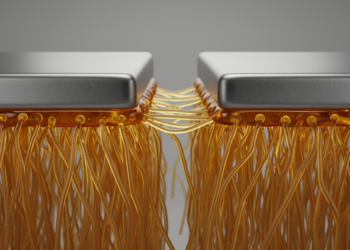
Polymer Additives Rewire Friction at the Nanoscale in Boundary Lubrication
Every time an engine starts, a hidden molecular drama unfolds on its metal surfaces. As lubricants grow thinner in the ...
Every time an engine starts, a hidden molecular drama unfolds on its metal surfaces. As lubricants grow thinner in the ...
Researchers have built a hybrid machine learning framework that predicts how graphene-enhanced grease heats up, wears down, and transitions between ...
Molecular dynamics simulations show that polycrystalline CuCrCoFeNi high-entropy alloy coatings absorb most scratch-induced deformation through stacking faults, dislocation structures, and ...
Chinese researchers report that adding polyimide pulp and graphitized carbon nanotubes to PTFE cuts friction by nearly 70 percent and ...
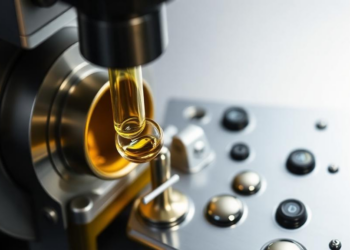
A gallium-based liquid metal cuts molybdenum wear by up to 99.4 percent across room temperature to 300 degrees Celsius, but ...

A Taguchi-TOPSIS study shows that solution treatment temperature, holding time and cooling method strongly control the hardness, wear rate and ...
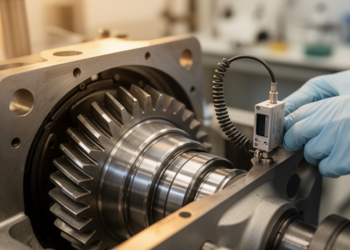
Researchers have built a dynamic wear prediction model for helical gear pairs that couples real-time contact stress, sliding, and lubrication ...

New research reveals that milk proteins and coffee components form friction-increasing aggregates while fat globules break them apart, explaining why ...

Researchers in India have developed self-healing epoxy composites reinforced with graphene oxide and carbon nanotube microcapsules, showing that a titanium ...

Researchers have combined verified finite element simulations with machine learning to predict fretting dissipated energy and slip regimes in under ...


Embark on a thrilling journey of discovery with Scienmag.com—your ultimate source for cutting-edge breakthroughs. Immerse yourself in a world where curiosity knows no limits and tomorrow’s possibilities become today’s reality!