

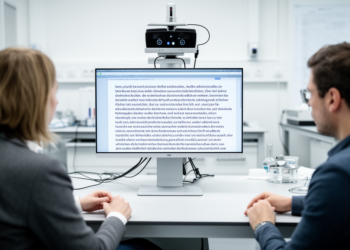
Eye-Tracking Reveals How Native and Second-Language Readers Resolve Conflicts in German Sentences
An eye-tracking study of 139 readers of German shows that gender-stereotype conflicts are resolved locally during lexical access in both ...
An eye-tracking study of 139 readers of German shows that gender-stereotype conflicts are resolved locally during lexical access in both ...

A study of 36 Chinese-speaking university students found that body-part congruency affected reaction times most reliably when a task explicitly ...

A study of 136 American English speakers found people can deliberately control whether they imitate an Australian accent, but socially ...

Researchers have released ENRuN-2, a database of valence, arousal, and five discrete emotion ratings for 6,708 Russian nouns collected from ...

A new study in Current Psychology shows that people primed with high power exhibit weaker syntactic priming effects than those ...

A new cross-linguistic study shows that speakers of click languages such as Zulu and Xhosa detect paralinguistic click sounds in ...

A new theoretical analysis argues that patronizing language toward older adults persists not because people fail to notice it, but ...

A four-experiment study of adult low-literacy readers in Germany finds that idiom comprehension in Easy German is driven by familiarity ...

A new tutorial in Behavior Research Methods provides a seven-step automated procedure for detecting hidden cognate confounds in second-language priming ...

A new analysis in Frontiers in Cognition evaluates whether predictive coding, a leading theory of perception, can explain how the ...


Embark on a thrilling journey of discovery with Scienmag.com—your ultimate source for cutting-edge breakthroughs. Immerse yourself in a world where curiosity knows no limits and tomorrow’s possibilities become today’s reality!