

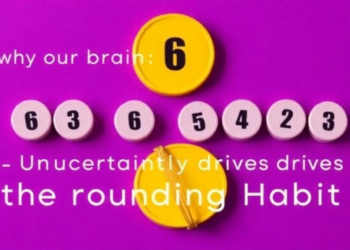
Why Our Brains Love Round Numbers: Uncertainty Drives the Rounding Habit
A new study in Current Psychology shows that people round their estimates to multiples of five precisely when their confidence ...
A new study in Current Psychology shows that people round their estimates to multiples of five precisely when their confidence ...

A new PLOS Computational Biology study shows that people distort explicit reliability labels when making decisions, letting even sources flagged ...
New research shows that the brain treats internal confidence as a reward, using reinforcement learning to divert limited visual processing ...
A cross-sectional study of 380 Iranian medical sciences students finds that general self-efficacy, mindfulness, and planning-focused emotion regulation are positively ...
A Norwegian survey of 150 footballers finds that amateur players suffer significantly more competitive anxiety than elites, and that beliefs ...
A three-level meta-analysis of 33 studies finds that technology-supported educational interventions are associated with moderately higher metacognitive outcomes, though the ...
A study of 460 Peruvian undergraduates found that emotional metacognition did not differ by academic year but showed modest variation ...
A personal essay in the Journal of General Internal Medicine describes how years of Zen meditation transformed one pediatrician's ability ...
A new study of 246 Brazilian adults finds that executive functions and metacognition are uncorrelated, yet each independently predicts distinct ...
A mini-ethnographic study of six Arabic- and Russian-speaking preschoolers learning Hebrew in Israel used play and art to reveal children's ...

Embark on a thrilling journey of discovery with Scienmag.com—your ultimate source for cutting-edge breakthroughs. Immerse yourself in a world where curiosity knows no limits and tomorrow’s possibilities become today’s reality!