

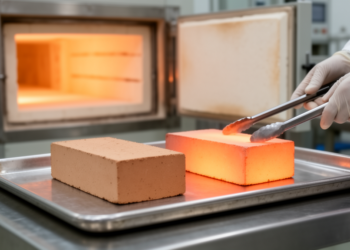
Chemically Activated Clay Bricks Keep Most of Their Strength After 800°C Fire Exposure
Researchers report that clay bricks doped with alumina and activated with sodium hydroxide retain nearly 76 percent of their strength ...
Researchers report that clay bricks doped with alumina and activated with sodium hydroxide retain nearly 76 percent of their strength ...

NJIT assistant professor Nutth Tuchinda has won a 2026 DOE Early Career Research Program award to study how entropy governs ...
Researchers at Nottingham Trent University have developed mixable, room-temperature luminescent ionic liquids containing lanthanide elements that could underpin harder-to-copy optical ...
The choice of 873 K as the operating temperature for the permeation tests is not arbitrary. The ternary eutectic mixture ...
From AI-certified autonomy to scramjets and hydrogen propulsion, a new analysis maps the six technology frontiers that will decide the ...
Every dyed fabric tells a story of slow defeat. Sunlight, moisture, and heat conspire to break the chemical bonds that ...
Ohio State researchers have shown that organizing crystal defects into dense, ordered networks can strengthen metal alloys and improve their ...
A new Frontiers in Materials research collection reveals how machine learning, melt pool physics, auxetic metamaterials, and nanometer-scale polishing are ...
Researchers at IIT Delhi and Japan's NIMS show that rearranging niobium, zirconium, platinum, and titanium within a multi principal element ...
Researchers show that adjusting extrusion temperature between 280 and 360 degrees Celsius tunes the strength, ductility, corrosion resistance and thermal ...

Embark on a thrilling journey of discovery with Scienmag.com—your ultimate source for cutting-edge breakthroughs. Immerse yourself in a world where curiosity knows no limits and tomorrow’s possibilities become today’s reality!