

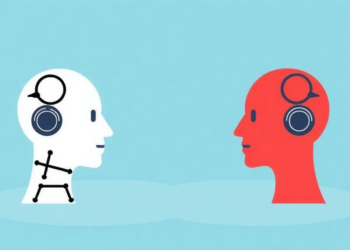
AI Agents Match Human Averages but Diverge in How They Respond to Rewards and Penalties
A controlled experiment comparing humans with two large language models under a sequential carbon credit incentive finds that identical aggregate ...
A controlled experiment comparing humans with two large language models under a sequential carbon credit incentive finds that identical aggregate ...

Researchers have developed ValuePEFT, a parameter-efficient fine-tuning method that steers large language models toward explicitly specified human values with measurable ...
A new study finds that the locally deployable Gemma 3 27B model scores highly on a German introductory physics benchmark ...
A classroom study of Vietnamese EFL learners found that five minutes of AI-generated priming material—whether read, heard, or watched—significantly outperformed ...
Researchers have developed stMCP, a Model Context Protocol server that lets scientists analyze spatial transcriptomics data through natural language while ...
A new review argues that transmitting meaning instead of raw bits could keep future wireless networks reliable even in extreme ...
Researchers at Tsinghua University have developed a Series Saliency module guided by large language models that improves the accuracy and ...
A new special issue of AI & Society, framed by N. Katherine Hayles, maps the mutual entanglement of humans and ...
A University of Waterloo study of 11 large language models found that chatbots systematically favour existing options over change in ...
A new perspective in Discover Artificial Intelligence argues that prompt engineering is merely a subproblem within context engineering, a system-level ...

Embark on a thrilling journey of discovery with Scienmag.com—your ultimate source for cutting-edge breakthroughs. Immerse yourself in a world where curiosity knows no limits and tomorrow’s possibilities become today’s reality!