


AI Learns to Design Materials by Predicting Their Electrons, Not Just Their Atoms
Researchers at the University of Tokyo have extended a generative AI model to jointly design crystal structures and local electronic ...
Researchers at the University of Tokyo have extended a generative AI model to jointly design crystal structures and local electronic ...

Researchers at Purdue and Harvard used topology-optimized silicon-on-sapphire nanocavities to achieve roughly tenfold enhancement of excitonic light emission from monolayer ...
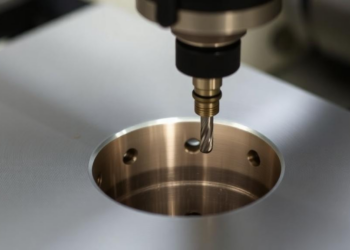
Researchers in India combined µEDM drilling experiments on titanium with benchmarked machine learning models, explainable AI, and a surrogate-based inverse ...

Researchers have developed an inverse-design framework that turns desired electromagnetic functions into additively manufactured gradient-index metamaterial lenses in minutes, demonstrating ...

An AI-driven inverse-design framework has identified multiple distinct chemical vapour deposition recipes that grow carbon nanotube arrays with nearly identical ...

Researchers in China have developed an interpretable multimodal AI framework that predicts the research octane number of pure compounds and ...

Researchers have demonstrated a photonic chip that trains itself on the hardware using on-chip holography to compute physical gradients, achieving ...

A new review in the Journal of Materials Science maps how machine learning, from graph neural networks to large language ...

An AI-driven inverse design protocol combining a Hammett-encoded neural network with genetic and swarm optimization has uncovered singlet fission candidates ...

A sweeping review details how graph neural networks, generative AI and autonomous laboratories are accelerating the discovery of cathode, anode ...


Embark on a thrilling journey of discovery with Scienmag.com—your ultimate source for cutting-edge breakthroughs. Immerse yourself in a world where curiosity knows no limits and tomorrow’s possibilities become today’s reality!