


Urban Building Layouts Directly Dictate Wind Speeds Around High-Rise Structures
Simulations reveal that surrounding building density and height non-linearly alter airflow around central high-rise towers.
Simulations reveal that surrounding building density and height non-linearly alter airflow around central high-rise towers.

Researchers at Graz University of Technology have developed an open-source clustering toolbox called CLARA that accelerates multiphase bioreactor simulations up ...

A computational study reveals that industrial air curtains achieve ninety-eight percent dust containment at specific jet velocities but can worsen ...

A research team at Delft University of Technology has developed a computationally efficient aerodynamic framework that accelerates leading-edge inflatable kite ...
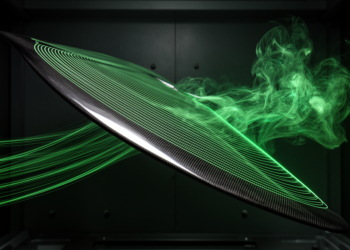
Computational fluid dynamics researchers show that modeling point sources at domain boundaries resolves artificial blockage and improves aerodynamic force predictions ...

Researchers developed a Morlet wavelet neural network surrogate model that replicates complex dissipative nanofluid flow simulations with high accuracy.

Researchers demonstrated that replacing discontinuous source terms in transitional aerodynamic models with smooth mathematical surrogates reduced the computational time required ...

A third-order characteristic-based-split finite element algorithm accurately simulates aerodynamic forces and galloping stability across single and four-bundled crescent-iced power conductors.

A new two-dimensional spectral framework reveals how wind-turbine wake turbulence changes directionally across scales, improving the accuracy of wake modeling ...

A computational fluid dynamics and thermal modeling study demonstrates that increasing afterburner fuel injector spray angles up to 90 degrees ...


Embark on a thrilling journey of discovery with Scienmag.com—your ultimate source for cutting-edge breakthroughs. Immerse yourself in a world where curiosity knows no limits and tomorrow’s possibilities become today’s reality!