


M-Function Formalism Captures Chaotic Intermittency in Discrete and Continuous Neuron Models
Researchers apply the M-function reinjection formalism to capture chaotic intermittency across discrete Rulkov and continuous Izhikevich neuron models.
Researchers apply the M-function reinjection formalism to capture chaotic intermittency across discrete Rulkov and continuous Izhikevich neuron models.

A mathematical study reveals that accounting for psyllid feeding preference substantially raises estimated citrus greening transmission while an intercropping ratio ...

A mathematical eco-epidemiological model reveals that excessive prey herd isolation and high-intensity culling can starve predators and trigger compensatory disease ...

A mathematical study demonstrates how combining periodic insecticide applications with beneficial predator releases stabilizes agricultural ecosystems and suppresses pest populations.

A mathematical study establishes exact stability conditions for periodic switched pest control, showing that predator cooperation and prey fear reduce ...

A nonsmooth mathematical modeling study reveals that mosquito and vector host preferences fundamentally alter disease thresholds, inducing backward bifurcations and ...

A theoretical study demonstrates that the homotopy perturbation method effectively identifies stable and unstable wave regimes across coupled physical fields ...
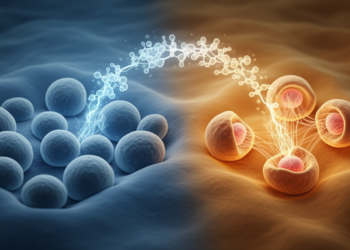
A mathematical modeling study maps how the E2F/Myc/miR-17-92 proliferation switch shifts between quiescent and proliferative regimes in breast cancer.

A new bifurcation analysis of a spruce budworm population model identifies the parameter regions governing steady states, periodic outbreaks and ...

A new mathematical analysis shows that reversing the orientation of predator-taxis is the only route to stationary spatial instability in ...


Embark on a thrilling journey of discovery with Scienmag.com—your ultimate source for cutting-edge breakthroughs. Immerse yourself in a world where curiosity knows no limits and tomorrow’s possibilities become today’s reality!