

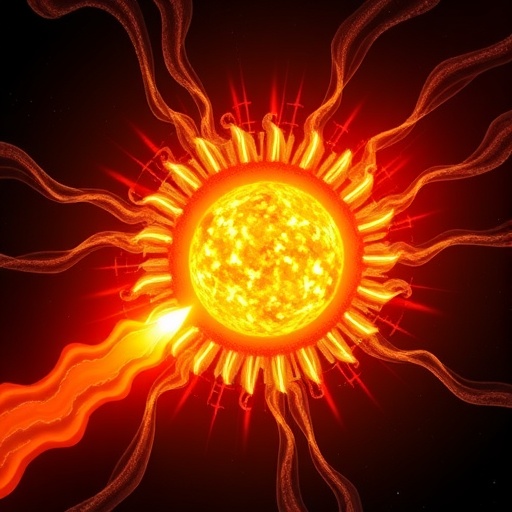
In a groundbreaking study led by scientists at the Southwest Research Institute (SwRI), fresh insights into the behavior of protons and heavy ions during solar magnetic reconnection events have emerged, fundamentally altering our grasp of the energetic processes powering the solar wind. Utilizing unprecedented data from NASA’s Parker Solar Probe, the research illuminates a complex magnetic engine within the Sun that produces significantly different acceleration mechanisms for these charged particles, challenging longstanding scientific assumptions.
Magnetic reconnection, a critical phenomenon occurring in plasma environments throughout the universe, involves the rearrangement of magnetic field lines, releasing vast amounts of energy stored in magnetic fields. This explosive energy release energizes charged particles in the Sun’s corona—the uppermost atmosphere of the star—and propels them outward at remarkably high velocities. These solar events not only sculpt the space weather environment near Earth but also influence communications, power grids, and satellite operations, making the physics underpinning them of paramount importance.
Traditionally, theoretical models have treated protons and heavy ions as reacting homogeneously to the magnetic reconnection process, assuming a uniform acceleration behavior for all particle species. However, Parker Solar Probe’s unique mission profile, involving close encounters with the Sun’s corona, has provided data that debunk this assumption. SwRI’s lead author, Dr. Mihir Desai, reveals that protons and heavy ions respond distinctly during reconnection events, a revelation that forces a re-examination of particle acceleration theories.
According to these new observations, heavy ions experience acceleration in a highly collimated, beam-like fashion, akin to the precision of a laser beam. This directional acceleration preserves their speed and energy distribution, enabling the ions to maintain a coherent trajectory as they escape the Sun’s magnetic environment. In stark contrast, protons generate wave-mediated turbulence that induces scattering, resulting in a dispersed pattern reminiscent of illumination from a flashlight, rather than a laser. This scattering significantly alters subsequent proton acceleration and transport dynamics.
The divergence in particle response stems from the nuanced interplay between magnetic fields and charged particle masses. Heavy ions, being more massive, interact with the magnetic topology in ways that favor direct, streamlined acceleration. Conversely, lighter protons excite kinetic waves that propagate back through the ambient plasma environment, facilitating efficient scattering and diffusion. This wave-particle interaction mechanism was previously underappreciated in solar wind acceleration models.
Understanding these distinct spectral signatures has profound implications for heliophysics. Magnetic reconnection events at the Sun are central to the generation of solar flares and coronal mass ejections, phenomena that unleash bursts of energetic particles and electromagnetic radiation into the heliosphere. The new data from Parker Solar Probe not only refine the mechanisms energizing these particles but also enhance predictive capabilities for space weather forecasting, ultimately aiding in the mitigation of technological hazards on Earth and in orbit.
The Parker Solar Probe’s close solar encounters allow it to collect high-resolution in-situ measurements of the heliospheric current sheet—a diffuse region near the Sun where magnetic polarities converge and reconnect. These measurements are crucial for dissecting the complex interactions between plasma particles and magnetic fields in an environment that was previously inaccessible to direct observation. Launched as part of NASA’s Living With a Star program, the spacecraft represents a technological marvel, designed to withstand the Sun’s intense heat and radiation while delivering vital science.
Remarkably, the Sun serves as a natural laboratory for plasma physics, enabling scientists to observe and decode processes that also occur in extreme cosmic environments like black hole accretion disks and supernova remnants. The insights garnered from the Parker Solar Probe mission thus extend far beyond our solar system, informing astrophysical theories about particle acceleration in varied contexts throughout the universe.
Dr. Desai emphasizes that these discoveries signify a pivotal moment in our comprehension of solar magnetic phenomena. The distinct behaviors of protons and heavy ions during reconnection events reveal an intricate “magnetic engine” that orchestrates particle energization with a complexity not accounted for in earlier models. This complexity underscores the need for sophisticated computational simulations and refined theoretical frameworks to encompass the newly unveiled physics.
Moreover, the interplay of wave generation and particle scattering offers a rich area for future research, with potential implications for controlled fusion and plasma confinement technologies on Earth. By tracing the fundamental physics in the Sun’s corona, researchers can develop analogies and strategies applicable to magnetic confinement systems, pushing forward energy science.
The research published in The Astrophysical Journal Letters illustrates the profound value of interplanetary missions like Parker Solar Probe in advancing space science. The paper, titled “Proton and Heavy Ion Acceleration by Magnetic Reconnection at the Near-Sun Heliospheric Current Sheet,” presents detailed data analysis revealing the spectral distinctions and acceleration patterns of solar wind ions. These findings are poised to reshape the narrative about how solar activity drives the energetic particle environment permeating the inner solar system.
As the Parker Solar Probe continues multiple close passes through the solar corona annually, it will provide an ever-expanding dataset to unravel the intricacies of solar magnetism and particle dynamics. This ongoing research holds the promise of not only safeguarding Earth’s technological infrastructure but also enriching our understanding of plasma physics in one of the most extreme natural laboratories accessible to humanity.
The enhanced understanding of how magnetic reconnection accelerates different particle species differently opens new frontiers for space weather prediction models and invites a reevaluation of plasma behaviors in a myriad of stellar and cosmic phenomena. In doing so, it fortifies humanity’s ability to anticipate and mitigate risks stemming from solar activity, safeguarding the interconnected civilizations increasingly reliant on space-based technologies.
Subject of Research: Not applicable
Article Title: Proton and Heavy Ion Acceleration by Magnetic Reconnection at the Near-Sun Heliospheric Current Sheet
News Publication Date: 31-Mar-2026
Web References: https://www.swri.org/markets/earth-space/space-research-technology/space-science/heliophysics
References: The Astrophysical Journal Letters, DOI: 10.3847/1538-4357/ae48f2
Image Credits: NASA
Keywords
Solar physics, Protons, Solar wind, Kinetic energy, Space weather


