

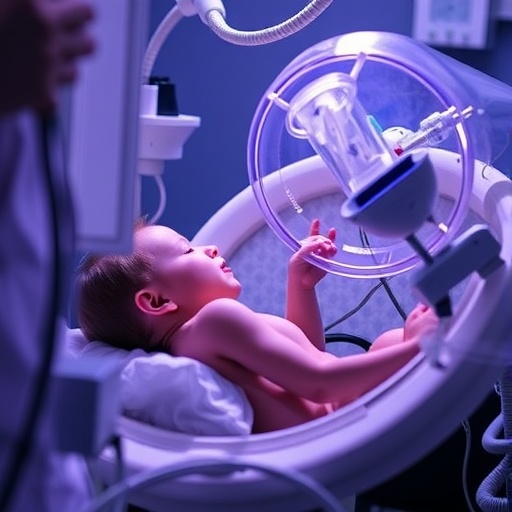
Infants born with congenital diaphragmatic hernia (CDH) continue to pose one of the most formidable challenges in neonatal medicine. Despite advances in prenatal diagnosis and postnatal care, these vulnerable newborns confront a high likelihood of requiring extracorporeal membrane oxygenation (ECMO) and facing significant mortality risks. A team of clinicians and researchers, led by Yang et al., have taken a crucial step forward by evaluating whether improvements in ECMO usage and survival rates observed initially after the adoption of new CDH care guidelines are sustainable over time. Their findings, published in the Journal of Perinatology, present encouraging data, revealing important trends in the evolution of CDH management.
CDH is a complex congenital anomaly characterized by a defect in the diaphragm, allowing abdominal organs to herniate into the thoracic cavity, thus impairing lung development. This anatomical disruption precipitates profound pulmonary hypoplasia and pulmonary hypertension, creating a precarious physiological environment. Traditional management strategies have relied heavily on ECMO as a lifesaving intervention when conventional ventilation fails, yet ECMO usage carries significant risks and resource burdens. The study spearheaded by Yang and colleagues revisited the cohort of infants treated under revised clinical guidelines, initially designed to optimize timing, patient selection, and perioperative care, to analyze if the beneficial impacts were persistent.
The clinical guidelines implemented aim for a more nuanced approach to CDH care, emphasizing early detection, optimal stabilization pre-surgery, and judicious ECMO deployment. Data spanning multiple years were retrospectively scrutinized, focusing on ECMO rates, survival outcomes, and adherence to stringent care protocols. The research employed sophisticated statistical models to adjust for confounding variables and temporal changes in patient demographics. Importantly, these metrics provided a comprehensive lens through which to gauge whether early successes represented a temporary improvement or the establishment of a new standard in CDH management.
Initial observations confirmed that the incorporation of the revised guidelines coincided with a notable reduction in ECMO utilization without compromising survival. This finding challenged prior assumptions that aggressive ECMO intervention was indispensable for improving survival odds in high-risk infants. Instead, tailored supportive care, precise timing of surgical repair, and vigilant monitoring emerged as critical determinants. The longitudinal reassessment revealed that these improvements were not a transient artifact but rather persisted throughout the extended study period, underscoring the robustness of the new clinical framework.
One of the study’s compelling outcomes was the enhanced survival rate among infants treated according to the guidelines. Survival rates improved steadily, even among those who required ECMO, signifying not only improved patient selection but also better peri-ECMO care. The researchers postulate that refined ventilatory strategies, optimized fluid management, and the multidisciplinary team approach collectively contributed to these outcomes. Such advancements reflect a deeper understanding of the pathophysiology of CDH and the evolution of neonatal intensive care practices.
Adherence to the new guideline protocols emerged as a pivotal factor influencing patient outcomes. The prospective integration of multidisciplinary teams, standardized care pathways, and regular audit cycles ensured fidelity to the care recommendations. The study emphasized that centers demonstrating high guideline adherence manifested more consistent reductions in ECMO dependency and better survival outcomes. This correlation highlights the necessity of rigorous implementation frameworks alongside clinical innovation to achieve sustained benefits.
In addition to survival and ECMO metrics, the study delved into complications and long-term morbidity associated with CDH. The extended follow-up period allowed for evaluation of pulmonary function, neurodevelopmental status, and quality of life indicators. Although the primary focus remained on acute care parameters, preliminary findings suggest that guideline-based management may have a favorable impact on long-term outcomes, a hypothesis warranting further investigation. This holistic perspective reinforces the importance of early-life interventions in shaping lifelong health trajectories.
Technological advancements have supported this clinical progress, with improvements in imaging, respiratory support devices, and ECMO machinery enhancing patient monitoring and safety. The integration of real-time data analytics into patient care pathways enabled dynamic risk stratification, facilitating timely clinical decisions. Such innovations, combined with evidence-based protocols, embody a precision medicine approach within neonatal intensive care units specializing in CDH treatment.
The implications of this study extend beyond CDH itself, illuminating broader principles in managing complex congenital conditions requiring extracorporeal support. It underscores the value of continuous quality improvement initiatives, evidence-based refinements to clinical guidelines, and the symbiosis of multidisciplinary collaboration. Future research directions include exploring biomarkers that predict ECMO necessity and response, and developing non-invasive therapeutics that could further reduce reliance on ECMO.
Equally significant is the study’s contribution to health systems planning and resource allocation. ECMO remains an expensive and labor-intensive modality, available predominantly at specialized centers. Demonstrating that ECMO utilization can be safely curtailed without compromising survival offers a pathway for economic sustainability and broadening access to care. Policymakers and healthcare administrators stand to benefit from protocols that optimize outcomes while limiting unnecessarily aggressive interventions.
This study also prompts reflection on the ethical dimensions inherent in high-risk neonatal care. Decisions surrounding ECMO initiation involve balancing technical feasibility, prognostic uncertainty, and quality of life considerations. The establishment of clear, evidence-based guidelines helps standardize care and supports transparent communication with families, fostering shared decision-making grounded in empirical data.
In summary, the diligence of Yang and colleagues affirms that the improved care standards instituted for CDH patients are not ephemeral but provide a durable foundation for enhanced survival and judicious ECMO use. Their meticulous work offers hope that even the most daunting neonatal challenges can be mitigated through systemic innovation, interdisciplinary cooperation, and relentless pursuit of evidence-based practice. As this field evolves, it exemplifies the transformational potential of modern neonatology when bolstered by rigorous clinical science.
The ongoing refinement of CDH management stands as a testament to the synergy between clinical expertise, research acumen, and technological progress. It holds promise for future generations of infants born with this congenital defect, enabling more lives to be saved and more families to experience the joy of survival against formidable odds. Continuous vigilance, adaptive learning, and global collaboration will be paramount to ensuring that these early successes translate into universal standards of care.
Looking ahead, this research paves the way for incorporating genomics, advanced neonatal imaging, and machine learning algorithms into personalized treatment planning. Such integrative approaches could further revolutionize outcomes, reducing dependence on ECMO and minimizing complications. The story of sustainable improvements in CDH is thus not only a milestone but also a beacon guiding future innovation in neonatal critical care.
Finally, the study calls for widespread dissemination and adoption of the validated guidelines among neonatal centers worldwide. Tailoring the guidelines to diverse healthcare settings and cultural contexts will be critical in bridging global disparities in neonatal survival. With sustained commitment, the improved survival and lower ECMO rates chronicled by Yang and colleagues may one day become the universal norm for managing congenital diaphragmatic hernia.
Subject of Research: Congenital diaphragmatic hernia (CDH) management, ECMO utilization, and neonatal survival rates.
Article Title: Congenital diaphragmatic hernia: are improvements in ECMO & survival sustainable over time?
Article References:
Yang, M.J., Carpenter, R.J., Yost, C.C. et al. Congenital diaphragmatic hernia: are improvements in ECMO & survival sustainable over time?. J Perinatol (2026). https://doi.org/10.1038/s41372-026-02605-0
Image Credits: AI Generated
DOI: 13 March 2026


