

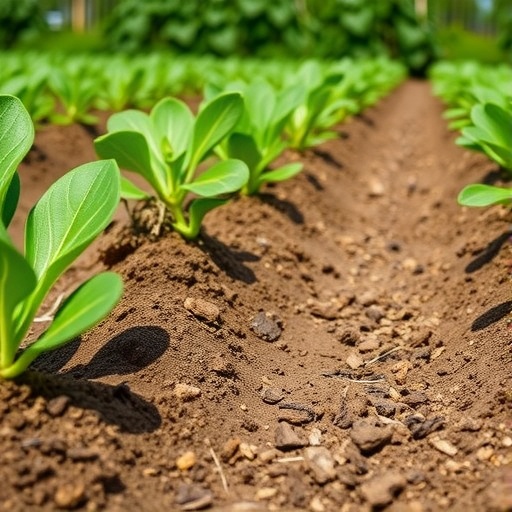
Recent groundbreaking research has illuminated a vital link between sustainable soil management practices and enhanced crop defenses, a discovery that could signal a transformative shift in agricultural paradigms worldwide. At the heart of this revelation is the intricate relationship between the soil microbiome and plant immunity. By carefully managing soil health, farmers can inadvertently bolster their crops’ natural defenses, reducing reliance on chemical pesticides and promoting more resilient agricultural systems. This research, led by Bloom, Atallah, and Casteel, underscores the profound influence of microbial communities in the soil, which act as unseen allies in the battle against pests and pathogens.
The study delves deeply into the microbial ecosystems that inhabit soil, emphasizing how sustainable practices like reduced tillage, organic amendments, and crop diversity cultivate a fertile ground for beneficial microorganisms. These microbes form symbiotic relationships with crops, triggering systemic defense responses that enhance the plant’s ability to resist damage. Unlike conventional approaches that often view soil as merely a growth medium, this research reconceptualizes soil as a dynamic living community, where microbial interactions play a pivotal role in crop health and productivity.
One of the critical insights from the research is that sustainable soil management leads to quantifiable shifts in microbiome composition, favoring microbial taxa known for their antagonistic properties against common crop pests. These beneficial microbes include several species of bacteria and fungi capable of producing bioactive compounds that deter harmful insects or inhibit pathogenic growth. Through metagenomic sequencing and functional analyses, the researchers decoded the complex microbial dynamics that respond to sustainable interventions, revealing that such practices cultivate a microbiome with enhanced defensive capabilities.
Furthermore, the research highlighted that the benefits of microbiome-mediated crop defenses are not superficial or transient. Instead, these changes in microbial communities contribute to long-term resilience, as crops grown in sustainably managed soils consistently showed reduced pest damage in field trials spanning multiple growing seasons. This persistence signals that fostering a healthy soil microbiome could be a cornerstone strategy for sustainable agriculture, potentially alleviating the environmental and economic burdens of pesticide overuse.
Expanding on the mechanistic aspects, the team explored how microbial signals prime plant immune systems. Certain soil microbes can elicit systemic acquired resistance (SAR) in plants – a broad-spectrum defensive state enabling crops to respond swiftly and robustly to insect herbivory or pathogen attack. These microbe-induced immune responses involve complex hormonal pathways, including salicylic acid and jasmonic acid signaling, which are essential for orchestrating effective defense gene activation. By enhancing these pathways, sustainable soil management indirectly amplifies the plants’ natural ability to withstand biotic stressors.
The implications of these findings extend far beyond academic interest. For farmers and agricultural policymakers, this research provides compelling evidence that investing in sustainable soil practices can yield multi-dimensional benefits: improved crop health, reduced chemical input, environmental conservation, and enhanced food security. It presents a holistic framework suggesting that the health of the soil microbiome directly parallels the robustness of crop defense strategies, merging ecological stewardship with agricultural productivity.
Moreover, the study’s methodological rigor deserves emphasis. By integrating high-throughput sequencing, metabolomics, and field-based phenotyping, the researchers captured the complexity of plant-microbe-environment interactions in unprecedented detail. This comprehensive approach allowed for the identification of specific microbial consortia associated with heightened crop defense, providing a roadmap for targeted interventions in soil management and microbial inoculation strategies.
Intriguingly, the data also suggest differential responses among crop species and soil types, highlighting the nuanced nature of soil microbiome dynamics. While sustainable practices universally shifted microbiome composition towards defensive phenotypes, the magnitude and nature of these changes varied, implying that tailored management approaches may optimize outcomes in different agroecosystems. This dimension opens exciting possibilities for precision agriculture guided by microbial ecology insights.
The broader context of this research aligns with global sustainability goals aiming to mitigate climate change impacts and biodiversity loss in agriculture. By leveraging natural biological interactions rather than synthetic chemistry, the findings advocate for regenerative agriculture systems that restore ecosystem functions. These systems not only provide resilience against pests but also enhance soil carbon sequestration, nutrient cycling, and water retention, encompassing multiple facets of sustainability.
Likewise, the researchers caution that while the benefits of sustainable soil management are compelling, challenges persist in scaling these practices universally. Factors such as socioeconomic barriers, knowledge transfer, regional differences, and initial transition costs require strategic solutions. Nonetheless, the study’s robust evidence base makes a persuasive case for integrating microbiome-friendly practices into mainstream agricultural frameworks.
Looking forward, this pioneering work sets the stage for innovative agricultural biotechnology and microbiome engineering. Future research could explore custom microbial consortia designed to confer specific defensive traits, or breeding programs that select for crop varieties most responsive to beneficial soil microbes. Integrating these advances could revolutionize pest management and soil health simultaneously, fostering resilient food systems in an era of ecological uncertainty.
Crucially, this research dresses an ecological narrative in a technological garb, where soil is no longer inert dirt but a vibrant living entity shaping crop fate. The delineation of microbiome-mediated crop defense embodies a paradigm shift towards what some might call “agroecological intelligence,” an approach recognizing and harnessing nature’s intricacy for sustainable wealth and wellbeing.
In the final analysis, Bloom, Atallah, and Casteel have illuminated a promising pathway towards more sustainable, efficient, and environmentally sound agriculture. Their work invites us to reconsider how we interact with the soil beneath our feet, urging a balance that respects microbial life as a central component of plant health. As the global demand for food escalates amidst climatic challenges, such insights could underpin the development of food systems characterized by resilience, sustainability, and harmony with nature.
This research article, published in npj Sustainable Agriculture, marks a significant milestone by translating fundamental microbial ecology into practical agricultural benefits. Through careful experimentation and interdisciplinary collaboration, it bridges the often-siloed fields of soil science, plant pathology, and sustainable farming, producing insights valuable to scientists, farmers, and policymakers alike.
As agricultural landscapes worldwide face mounting pressures, the ability to harness soil microbiomes to enhance crop defense offers a tantalizing agronomic tool. It represents a symbiotic alliance where microbes and plants coalesce to reduce pest pressures naturally, potentially reducing the environmental footprint of farming and aligning with global efforts to create regenerative food systems.
Ultimately, this revelation charts a hopeful future where soil stewardship is not just an environmental virtue but a strategic imperative for global food security and ecosystem health. The comprehensive understanding of how sustainable soil management transforms the microbial ancestors of crop defense might well herald a new green revolution — one rooted in microbial symbiosis rather than chemical intervention.
Subject of Research: Sustainable soil management and its impact on crop defense via soil microbiome changes.
Article Title: Sustainable soil management practices are associated with increases in crop defense through soil microbiome changes.
Article References:
Bloom, E.H., Atallah, S.S. & Casteel, C.L. Sustainable soil management practices are associated with increases in crop defense through soil microbiome changes. npj Sustain. Agric. 3, 67 (2025). https://doi.org/10.1038/s44264-025-00109-6
Image Credits: AI Generated


