

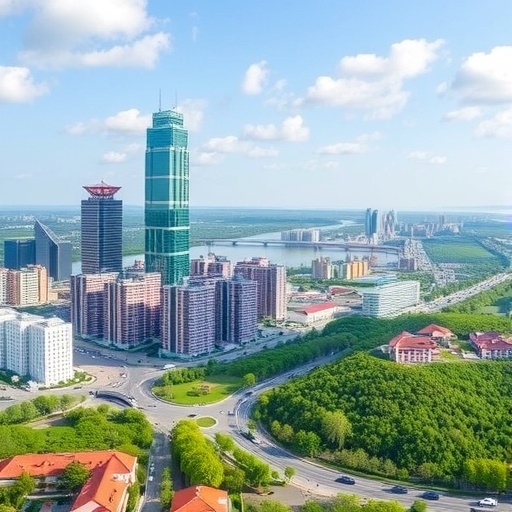
In the face of escalating environmental concerns and the imperative for sustainable growth, researchers have turned their attention to multidimensional assessments of sustainable development (SD). A prominent study by Xuedong, Yiheng, and Qinwei examines the intricate dynamics involved in sustainable development in the economically vibrant and populous Beijing-Tianjin-Hebei (BTH) region of China. This area, marked by rapid urbanization and industrialization, serves as a critical backdrop for understanding the mechanisms that drive sustainable development across key sectors.
The research conducted in BTH is a testament to the urgent need for evaluating sustainable development from a multifaceted perspective. With the region grappling with a combination of environmental degradation, socioeconomic disparities, and governance challenges, the authors propose a multidimensional Sustainable Development Index (SDI) that incorporates various indicators across environmental, economic, social, and governance dimensions. This innovative approach aims to provide a comprehensive assessment of the region’s sustainable development trajectory and uncover the vital mechanisms that influence it.
One of the most compelling aspects of the study is the identification of driving factors behind successful sustainable development outcomes. The authors leveraged extensive data collection methods, employing both qualitative and quantitative analyses. By merging statistical data with case studies, the research team managed to unveil a nexus of factors that significantly influence sustainable practices in urban and rural settings alike. These factors encompass economic policies, social equity, technological advancements, and public awareness, which together orchestrate the viability of sustainable initiatives.
At the core of their analysis, the researchers analyzed quantitative metrics pertaining to air quality, water resources, waste management, and green space. By evaluating these environmental indicators, they generated a broader understanding of the ecological challenges facing the region. The temporal aspect of the evaluation was also essential; the study not only benchmarks current performance but also projects future trajectories based on varying socio-political scenarios. This predictive modelling offers valuable insights for policy-makers striving to enhance the region’s sustainable framework.
Through the application of advanced econometric techniques, the researchers were able to ascertain the relative impacts of different driving mechanisms on sustainable development indicators. This level of granularity is crucial, as it allows stakeholders to identify which areas warrant more significant intervention. Policymakers can then design targeted strategies that are evidence-based, ensuring that investments effectively channel resources towards the most impactful initiatives.
The implications of this research extend far beyond the confines of the BTH region. As one of China’s key economic zones, the lessons learned here have the potential to inform sustainable development practices across similar urban agglomerations worldwide. With urban populations continuing to swell, understanding how to navigate the complexities of sustainable development becomes increasingly vital. This study serves as a beacon of knowledge, shedding light on how informed decision-making can propel urban areas towards sustainable futures.
Moreover, the socio-political context of the BTH region enhances the importance of this research. China’s unique governance model, characterized by centralized control but increasing public engagement, presents both challenges and opportunities for sustainable development. The study navigates this terrain adeptly, outlining how local governments can harness citizen participation to champion sustainable policies. Engaging public sentiment and fostering community involvement is posited by the authors as a crucial mechanism for driving sustainable practices.
The authors also emphasize the role of technological innovation in reshaping the landscape of sustainable development. In a region characterized by immense industrial activity, transitioning towards cleaner technologies is paramount for reducing carbon footprints. The study spotlights successful collaborations between universities, industries, and governmental bodies in spearheading research and deploying sustainable technologies. Such collaboration exemplifies how integrative approaches can escalate progress toward sustainable targets.
As with any ambitious research endeavor, the limitations and boundaries of the study warrant acknowledgment. The authors critically reflect on external factors that could influence the SDIs, including global market trends and climate change scenarios. Recognizing that sustainability is an evolving challenge, they advocate for ongoing research to refine assessments and incorporate emerging variables that could impact sustainable development trajectories.
The authors’ resolve culminates in a call for an integrated policy framework that reconciles economic growth with environmental stewardship. By highlighting successful case studies within the BTH region, they underscore how localized strategies can yield broader societal benefits. This aligns with global aspirations outlined in the United Nations Sustainable Development Goals (SDGs), where synergy among different initiatives is paramount for achieving comprehensive sustainability.
In conclusion, the study by Xuedong, Yiheng, and Qinwei represents a significant leap forward in our understanding of multidimensional sustainable development assessments. By dissecting the complex interplay of various factors at work in the BTH region, the authors offer a blueprint for other regions grappling with similar challenges. Their findings advocate for a holistic view of sustainability, urging stakeholders to consider interdisciplinary approaches in crafting policies. The resonant message is clear: the pathway to sustainability is multifaceted, requiring collaborative efforts between governments, industry leaders, academia, and civil society.
As environmental challenges burgeon globally, the insights gleaned from the BTH region’s journey towards sustainable development can inspire and inform efforts in other urban contexts. By advancing the conversation on sustainable practices through concrete research, we are not only addressing the present needs but also safeguarding the future. The proactive measures and comprehensive analyses presented in this study lay the groundwork for robust, actionable frameworks that aspire to mitigate tomorrow’s challenges through today’s informed decisions.
This seminal research is poised to leave a lasting impact in academia and beyond, shaping the discourse around sustainable development and offering a much-needed roadmap towards feasible solutions. As the world looks to address the multifarious challenges of climate change, resource scarcity, and social inequities, the lessons learned from the Beijing-Tianjin-Hebei region herald a promising approach to sustainable progress.
Subject of Research: Sustainable Development Assessment in the Beijing-Tianjin-Hebei Region
Article Title: Multidimensional SDI-based Assessment of Sustainable Development and Its Driving Mechanisms in the Beijing-Tianjin-Hebei Region, China
Article References:
Xuedong, Z., Yiheng, L., Qinwei, Q. et al. Multidimensional SDI-based assessment of sustainable development and its driving mechanisms in the Beijing-Tianjin-Hebei region, China.
Discov Sustain (2026). https://doi.org/10.1007/s43621-026-02630-1
Image Credits: AI Generated
DOI: 10.1007/s43621-026-02630-1
Keywords: Sustainable Development, Multidimensional Assessment, Beijing-Tianjin-Hebei, Environmental Policy, Socioeconomic Disparities, Governance Challenges, Ecological Indicators, Technological Innovation, Urban Sustainability, Global Market Trends.


