

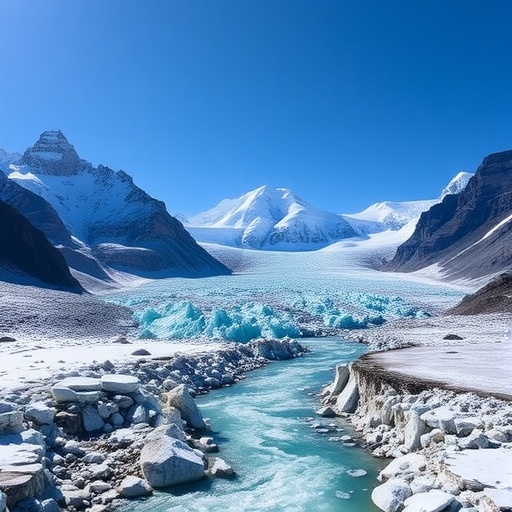
Recently, a groundbreaking study by Wang et al. has emerged, shedding light on the often-overlooked relationship between glacial processes and the sustainability of water resources in Asia. The research, directed towards understanding how positive glacial regulatory mechanisms can enhance the resilience of glacier-fed water sources, presents crucial insights that could reshape our understanding of water resource management in this critical region.
Asian glaciers, found across the Himalayan, Pamir, and Tien Shan mountain ranges, are vital reservoirs of freshwater, impacting millions of lives downstream. As climate change accelerates, patterns of glacier retreat and accumulation have become increasingly erratic, posing direct threats to the availability of water throughout Asia. Wang and colleagues delve into the processes that underpin these glaciers, aiming to highlight how certain natural mechanisms can mitigate the adverse effects of climate change on water resources.
The study begins with a comprehensive overview of glacier dynamics, illustrating their role in the hydrological cycle. Glaciers act as natural water storage systems, gradually releasing meltwater in warmer months, which feeds into rivers and supports agriculture and daily living for communities. However, the expected accelerated melting due to climate rise poses a double-edged sword, threatening to overwhelm rivers initially while diminishing long-term water availability. The authors emphasize the significance of understanding these patterns if we are to predict future water scenarios accurately.
One of the study’s pivotal findings revolves around the concept of “positive glacial regulatory processes.” Wang and his team argue that certain natural processes associated with glaciers—such as the generation of glacial meltwater and the interaction between glaciers and their environment—can positively influence local climates and ecosystems. For instance, the release of nutrients from glacial melt can stimulate productivity in downstream river systems, enhancing biodiversity and ecosystem resilience.
The article meticulously outlines the ecological ramifications of sustainable glacier management, advocating for a shift in focus from glacier mass loss alone to recognizing their protective roles in regulating water supplies and quality. By promoting policies and practices that enhance the positive aspects of glacial dynamics, stakeholders could potentially bolster water security across entire regions. This approach not only serves immediate human needs but also supports ecological integrity.
While discussing the socio-economic dimensions of glacier resources, Wang et al. underscore the critical dependencies of local populations on glacier-fed water. They point out that many communities have tailored their agricultural practices and water usage strategies around predictable glacial melt patterns. Thus, disruption caused by climate change could lead to severe food and water shortages, amplifying existing socio-economic challenges in the region. Highlighting the intersection of climate and human rights, the authors advocate for a more integrated approach to water resource management, one that acknowledges the rights of local communities.
Moreover, the research delves into the technology and innovation necessary for effective glacial monitoring and resource management. Employing satellite imagery, climatic modeling, and community-led data collection are among the recommended strategies for fostering a comprehensive understanding of glacier dynamics. Such technological advancements can make it easier not only to monitor changes more accurately but also to forecast upcoming shifts in water availability.
In a riveting turn, the study generates a call to action for policymakers to rethink water governance in light of these findings. The authors argue that traditional water management frameworks are ill-equipped to handle the complexities introduced by climate-influenced glacier dynamics. Instead, they push for adaptive management strategies that prioritize resilience and sustainability, aimed at both mitigating risks and enhancing the benefits offered by glacial systems.
The potential for international collaboration emerges as another key theme in Wang et al.’s research. As glaciers transcend national borders, the authors advocate for cooperative water management policies that facilitate shared knowledge, resources, and technology among countries. Enhanced collaboration could cultivate a synergistic approach to glacier conservation, benefiting regional water security.
Furthermore, the study offers hope, illustrating cases where positive regulatory mechanisms have been successfully harnessed. Communities that have invested in sustainable environmental practices show promising results, yielding improved water quality and availability. Such examples serve as models for others to emulate in adapting to the dual pressures of climate change and rising populations.
The implications of these findings extend beyond the immediate region, beckoning global awareness about the role that alpine glaciers play in the interconnected web of our planet’s climate system. As climate change continues to disrupt traditional weather patterns and ecosystems, the lessons gleaned from the study become increasingly relevant to world sustainability efforts.
In conclusion, the research conducted by Wang et al. paves the way for a redefined understanding of Asian glacier dynamics. It lays bare the vulnerabilities and resilience embedded within these natural systems, prompting a critical discourse on the nexus between glacial processes and water resources. This work is not only a testament to the intricate relationships within our environment but also serves as a clarion call for action—encouraging humans to learn from nature’s regulatory processes to forge a sustainable future.
As more studies evolve from these initial findings, the significance of our glaciers continues to grow, making this research indispensable for policymakers, scientists, and residents alike who depend on these precious water resources. The future of water security in Asia could very well hinge on our ability to adaptively manage and protect these glacier systems.
Subject of Research: The role of positive glacial regulatory processes in the sustainability of water resources in Asia.
Article Title: Positive glacial regulatory processes promote sustainability of Asian glacier water resources.
Article References: Wang, Q., Wang, X., Duan, K. et al. Positive glacial regulatory processes promote sustainability of Asian glacier water resources. Commun Earth Environ (2026). https://doi.org/10.1038/s43247-026-03225-4
Image Credits: AI Generated
DOI: 10.1038/s43247-026-03225-4
Keywords: glaciers, water resources, climate change, sustainability, ecological integrity, societal impact, hydrological cycle, glacier dynamics, nutrient release, adaptive management, international collaboration.


