

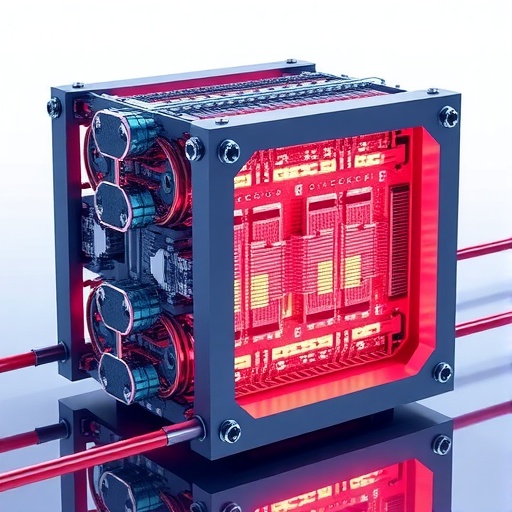
The pursuit of scalable quantum computing platforms has been fiercely challenged by the sheer complexity of the necessary control infrastructure. Traditional superconducting qubit architectures require an individually dedicated control line for each qubit—a reality that severely limits the scalability of quantum processors. This linear scaling of wiring not only increases the physical footprint but also introduces significant heat loads and signal distortions, threatening qubit fidelity and coherence. In a groundbreaking advancement, researchers have now unveiled a fully integrated cryogenic quantum processor module that marries qubits with superconducting digital control electronics at millikelvin temperatures, shattering previous barriers and pointing toward a truly scalable quantum future.
At the heart of this innovation is the seamless integration of superconducting Single-Flux Quantum (SFQ) control circuits directly alongside superconducting qubits within a single multi-chip module. Traditionally, qubit control signals are generated by classical digital electronics housed at room temperature, then transmitted through coaxial cables to the cryogenic quantum chips operating at millikelvin temperatures. This approach demands extensive wiring infrastructure and suffers from bandwidth limitations and thermal losses. By contrast, the newly demonstrated system brings the control electronics into the cryogenic realm, co-located with qubits, drastically reducing the signal path length and the resulting latency and noise.
This integrated multi-chip module is constructed using flip-chip bonding technology, an advanced packaging technique that enables dense and low-inductance interconnects between the qubit array and the SFQ controllers. The SFQ circuits are based on superconducting Josephson junctions that process information as quantized magnetic flux pulses—essentially representing digital bits with ultra-low energy consumption and picosecond timing precision. This quantum processor unit harnesses SFQ-based digital demultiplexing circuits, which distribute control pulses efficiently across multiple qubits, thereby circumventing the scaling problem of one-to-one wiring.
Implementing digital demultiplexing allows the shared use of a limited number of control lines to operate many qubits in time-multiplexed fashion. This represents a paradigm shift in qubit control architecture, breaking free from linear wiring proliferation and enabling exponential scaling potential. The functionality of the SFQ control circuits has been rigorously tested and calibrated to deliver precisely timed microwave pulses essential for qubit manipulation, including initialization, gate operations, and readout.
A major highlight of this work is the demonstration of single-qubit gate fidelities exceeding 99%, with some gates reaching as high as 99.9% fidelity—a threshold considered crucial for fault-tolerant quantum computing. These fidelity metrics indicate that the SFQ-based cryogenic control electronics introduce negligible additional error to qubit operations, a monumental achievement given the complexity of integrating classical digital logic at millikelvin temperatures.
Achieving such high-fidelity operations required overcoming several formidable engineering challenges. The SFQ control signals had to be carefully engineered to avoid electromagnetic interference and spurious quasiparticle generation that might decohere the qubits. Sophisticated filtering and shielding techniques were employed alongside careful electrical design to ensure stable and noise-free coexistence of SFQ and qubit circuits on the same module.
Moreover, this design inherently improves the overall system compactness and thermal management. By minimizing the length and number of wiring lines that traverse temperature gradients—from room temperature down to millikelvin—it drastically reduces parasitic heat loads. This efficiency is critical because excessive heat can degrade the performance of dilution refrigerators, which maintain qubits at ultralow temperatures necessary for superconductivity and coherent quantum behavior.
This integrated cryogenic digital control approach stands in stark contrast to conventional microwave control schemes, which rely heavily on room-temperature equipment generating continuous waveforms sent through attenuated coaxial cables. SFQ-based pulse control, inherently digital and clocked, offers superior timing resolution and energy efficiency, paving the way for more complex multi-qubit gate sequences and error correction routines all implemented on-chip.
Looking ahead, this integrated platform opens exciting paths for scaling up quantum processors by orders of magnitude. As more qubits are integrated with their local SFQ controllers, the architecture supports modular expansion and potentially even distributed quantum computing within a single refrigerator. This holistic integration could facilitate advanced quantum algorithms requiring deep and synchronous control over large qubit arrays without incurring prohibitive wiring or thermal penalties.
The researchers underscored the versatility of the flip-chip bonding method, which allows independent optimization of the qubit array and the SFQ control circuits before integration, streamlining fabrication and improving yield. Furthermore, the modular approach could be adapted to other quantum hardware platforms such as spin qubits or topological qubits, broadening its impact across different quantum computing modalities.
Challenges remain, particularly in scaling the SFQ control blocks to handle thousands or millions of qubits and developing sophisticated software to manage real-time pulse scheduling and error tracking. However, this pioneering demonstration offers a viable roadmap to push quantum computing from laboratory curiosities toward practical, commercially viable machines.
In summary, this work represents a monumental leap forward in cryogenic quantum-classical integration. It elegantly resolves one of the most entrenched bottlenecks in superconducting quantum computer design: the exponential wiring overhead for qubit control. By embedding superconducting digital control electronics at ultralow temperatures within a single multi-chip module, it unlocks pathways to truly scalable quantum processors capable of supporting complex quantum algorithms with high fidelity and efficiency.
The implications for the broader quantum technology ecosystem are profound. As quantum computing races toward practical utility, innovations like this integrated cryogenic digital control architecture will be pivotal. They present a blueprint for next-generation quantum machines that combine the best of classical digital logic and fragile quantum coherence—ushering in a new era of quantum computational power and reliability.
As we stand on the cusp of the second quantum revolution, this pioneering quantum processor unit, controlled by superconducting digital electronics operating in the realm of millikelvin temperatures, marks a seminal milestone. It blurs the traditional distinction between quantum and classical realms, enabling unprecedented levels of integration, control precision, and scalability, and pushing the boundaries of what quantum computers can achieve.
The research team, led by Jordan, Bernhardt, Rahamim, and colleagues, published their findings in Nature Electronics in 2026, highlighting the extraordinary potential of combining Josephson junction-based SFQ electronics with superconducting qubits. This technology promises to accelerate progress not only in quantum computation but also in quantum sensing and communication fields that require precise nanoscale control at cryogenic temperatures.
Ultimately, this fusion of superconducting digital electronics and quantum processors could become the cornerstone technology for the upcoming generation of quantum information science, fostering innovations beyond the confines of present-day quantum device architectures and heralding a new standard for quantum hardware integration.
Subject of Research: Superconducting quantum computing integration with cryogenic superconducting digital control electronics
Article Title: A quantum computer controlled by superconducting digital electronics at millikelvin temperature
Article References:
Jordan, C., Bernhardt, J., Rahamim, J. et al. A quantum computer controlled by superconducting digital electronics at millikelvin temperature. Nat Electron (2026). https://doi.org/10.1038/s41928-026-01576-6
Image Credits: AI Generated


