

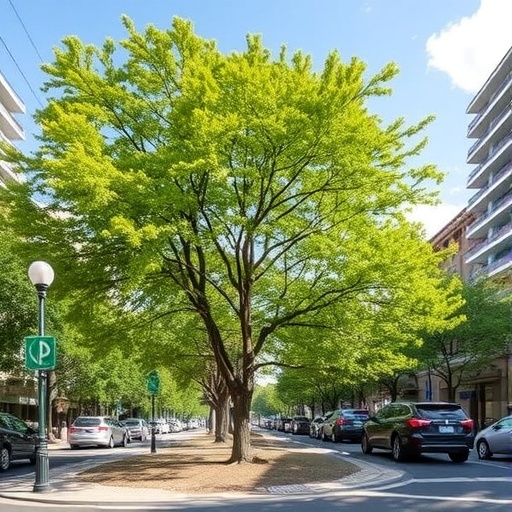
In the evolving landscape of urban climate science, a groundbreaking study has unveiled the remarkable capability of urban trees to offset carbon dioxide emissions, with precise spatial detailing that reshapes our understanding of urban vegetation’s role in climate regulation. This pioneering research conducted by the Technical University of Munich (TUM) introduces a high-resolution model that captures biogenic CO₂ flows across cities with unparalleled accuracy, demonstrating that urban trees significantly counterbalance the emissions generated by urban traffic in metropolitan areas such as Munich.
The challenge of accurately quantifying urban carbon fluxes has long been hampered by limitations in remote sensing technology. Prevailing models rely primarily on satellite data with a spatial resolution of approximately 500 meters, significantly underestimating smaller green spaces and individual trees scattered throughout urban environments. This limitation has obscured the full impact of urban vegetation on city carbon dynamics. Addressing this gap, researchers at TUM have developed an innovative model operating at a refined 10-meter resolution. This enhanced granularity allows urban planners and scientists to assess vegetation’s climate impact at the scale of individual parks and street trees, a scale of analysis previously unattainable.
This sophisticated modeling framework integrates multiple versions of vegetation photosynthesis and respiration models, supported by rigorous in situ biospheric measurements conducted over an extended period from April 2024 to February 2025. These empirical data, collected by Jia Chen, a professor specializing in environmental sensing and modeling, and her doctoral student Junwei Li, were crucial in validating the model’s accuracy. Field measurements performed in Munich’s urban parks provided new insights into the contributions of different vegetation types to carbon fluxes, lending a robust empirical foundation to the theoretical construct.
One of the most striking findings from this research is the dominant role of urban trees as net carbon sinks. On select summer days, the photosynthetic absorption of CO₂ by these trees not only equals but sometimes surpasses the carbon emissions originating from urban traffic. This temporal exceedance is significant because it highlights the potential of urban trees to act as a mitigating agent against greenhouse gas emissions on days when anthropogenic activity peaks.
Conversely, the study observed that grassy areas do not follow the same carbon offset pattern. Instead of acting as sinks, grasslands in urban settings frequently emerge as net sources of CO₂ on an annual basis. This unexpected result is attributed to soil respiration processes exceeding photosynthesis rates in these areas. Soil respiration is a key biological mechanism wherein soil organisms and roots release CO₂ into the atmosphere, and in grassy urban spaces, this output surpasses the carbon absorbed through plant photosynthesis, indicating a nuanced complexity in urban biogenic carbon fluxes.
The heterogeneity of urban vegetation is another crucial point underscored by this investigation. Unlike previous models that generalized vegetation cover through low-resolution data, this study reveals the stark variability among different types of green infrastructure within cities. The fine-scale model identifies which specific vegetated zones exert a measurable influence on the urban climate, suggesting targeted opportunities for urban greening initiatives that optimize carbon sequestration.
Professor Jia Chen emphasizes the multifaceted benefits of urban green spaces, cautioning against evaluating them based solely on carbon fluxes. Beyond their role in carbon dynamics, green spaces provide vital ecosystem services such as urban heat mitigation during summer months, enhanced water infiltration reducing flood risks, and overall improvements in urban livability and biodiversity. These co-benefits reinforce the integrative value of incorporating green infrastructure into sustainable urban planning frameworks.
The technological sophistication of the model stems from its integration of distinct physiological components representing vegetation photosynthesis and respiration processes, allowing it to simulate diurnal and seasonal carbon flux variations with remarkable precision. This dual integration facilitates an enhanced understanding of the temporal dynamics governing CO₂ exchange in urban ecosystems, offering a powerful tool for environmental scientists dedicated to quantifying urban carbon budgets.
Also noteworthy is the international collaboration underpinning this research effort. Along with TUM, the University of Basel, the Swiss Federal Laboratories for Materials Science and Technology (EMPA), and the German Aerospace Center (DLR) contributed significant expertise and data instrumental to the study’s success. This multinational partnership, supported by the EU project “ICOS Cities,” exemplifies the cross-border scientific cooperation essential for addressing the multifaceted challenge of urban climate resilience.
The practical implications of this research extend beyond Munich and Zurich, where the model was initially deployed. The framework is adaptable for implementation in other urban areas globally, allowing city administrators and policymakers to tailor carbon sequestration strategies specific to their unique vegetative landscapes. Such scalability brings renewed optimism for urban climate mitigation efforts, enabling cities worldwide to harness their green infrastructure’s potential more effectively.
Moreover, the research highlights a critical disparity in how different vegetation types contribute to carbon dynamics, underscoring the imperative for differentiated urban greening strategies. Investment in planting and maintaining urban trees could yield greater returns in terms of CO₂ sequestration when compared to grassland expansion, which may inadvertently increase net emissions if soil respiration factors are not properly managed.
Methodologically, the research leverages in situ biospheric flux measurements collected using advanced environmental sensing technologies capturing real-time exchange of gases between urban vegetation and the atmosphere. These high-fidelity datasets provide empirical benchmarks, enabling the calibration of photosynthesis and respiration sub-models embedded within the overall framework. The approach represents a new paradigm in urban ecology, uniting remote sensing, field observation, and process-based modeling at unprecedented resolutions.
This study also paves the way for integrating such high-resolution ecological data into urban climate adaptation and mitigation planning tools. By precisely identifying carbon sink hotspots and emission hotspots within urban fabric, planners can prioritize actions to boost carbon uptake or mitigate emissions, including expanding tree canopies in under-vegetated neighborhoods or enhancing soil health in grassy areas to reduce respiration rates.
Finally, the research situates the urban vegetation carbon flux narrative within a broader ecological context, promoting interdisciplinary dialogue among climatologists, ecologists, urban planners, and policymakers. Understanding the fine-scale dynamics of urban vegetation’s interaction with atmospheric CO₂ enriches the scientific discourse on sustainable cities, informing evidence-based interventions to curb urban contribution to global climate change.
Overall, this pioneering study conducted by TUM and partners represents a seminal advancement in urban carbon flux estimation, revealing urban trees as powerful agents in climate mitigation while challenging assumptions about grassland roles in carbon cycling. Its high-resolution modeling approach and empirical validation set new standards in urban ecological research, promising vital contributions to global efforts in achieving carbon neutrality and resilient urban futures.
Subject of Research: High-resolution modeling and empirical validation of urban biogenic carbon dioxide (CO₂) fluxes, focusing on vegetation contributions to carbon sequestration and emission dynamics in metropolitan environments.
Article Title: Fine‐Scale Estimation of Urban Biogenic CO2 Fluxes: A Novel Framework Integrating Multiple Versions of Vegetation Photosynthesis and Respiration Models and In Situ Measurements
News Publication Date: 25-Feb-2026
Web References: 10.1029/2025EF007458
Keywords
Urban carbon flux; urban trees; photosynthesis; soil respiration; carbon sequestration; high-resolution modeling; in situ biospheric measurements; urban ecology; climate mitigation; green infrastructure; environmental sensing; urban greening strategies


