

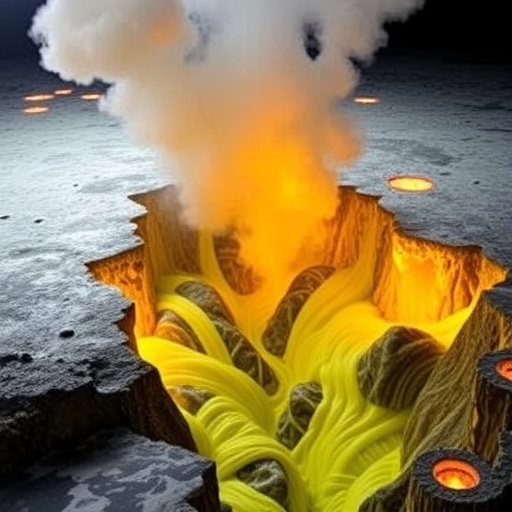
In a groundbreaking study published recently, researchers have unveiled the pivotal role of sulfur-enriched sub-arc fluids in driving the deep sulfur cycling occurring within Earth’s subduction zones. This discovery sheds new light on the complex geochemical interactions occurring beneath convergent plate boundaries, offering profound implications for our understanding of global sulfur budgets, volcanic activity, and mantle geochemistry. The research dives deep into the enigmatic processes that govern sulfur behavior in the Earth’s interior, proposing mechanisms that could explain long-standing questions about elemental cycling and volcanic emissions.
Subduction zones, where one tectonic plate descends beneath another, are among the most dynamic regions on Earth. These zones facilitate the recycling of surface materials into the mantle, influencing volcanic activity and geochemical fluxes at the surface. Among the many elements involved in these processes, sulfur stands out due to its essential role in atmospheric chemistry and its impact on climate through sulfur dioxide emissions from volcanoes. However, the detailed pathways of sulfur transport and transformation at depths have remained elusive until now.
The study focuses on sub-arc fluids—hydrous fluids generated deep beneath the arc volcanoes. These fluids originate from the dehydration and metamorphic reactions occurring in the subducted slab and overlying mantle wedge. Prior research suggested that such fluids are carriers of various volatile components, including sulfur species. Yet, the composition, concentrations, and influence of these fluids on deep Earth sulfur cycling were not well characterized.
Utilizing advanced analytical techniques and high-pressure experimental simulations, the research team demonstrated that these sub-arc fluids are significantly enriched in sulfur, particularly in reduced sulfur species like hydrogen sulfide (H₂S). This reduced sulfur enrichment contrasts with the predominantly oxidized sulfur forms found in other geological fluids, representing a notable geochemical signature of subduction-related processes. This insight was made possible through meticulous sample collection from natural volcanic gases and inclusions within mantle-derived minerals coupled with state-of-the-art mass spectrometry.
The sulfur-enrichment in sub-arc fluids suggests that as oceanic crust and sediments subduct, they release sulfur into the overlying mantle wedge in a form highly reactive and capable of influencing mantle melting and magma genesis. These fluids likely play a crucial role in metasomatism, the process by which the mantle’s chemical composition is altered by fluid infiltration, enriching it in sulfur and other volatiles. This enrichment impacts the melting temperatures and physicochemical properties of the mantle, which in turn regulates volcanic output and the types of magma produced beneath arcs.
Importantly, the research clarifies the deep cycling of sulfur, highlighting feedback loops between subduction processes and surface sulfur emissions. Sulfur cycling influences not only local volcanic environments but also has broad-reaching effects on atmospheric chemistry. Sulfur dioxide released during volcanic eruptions can form sulfate aerosols, which reflect solar radiation and can cause temporary cooling of the Earth’s surface. Therefore, understanding the sources and transformations of sulfur at depth has direct implications for climate modeling and hazard prediction.
The experimental component of the research involved recreating the pressure and temperature conditions of the sub-arc mantle wedge in laboratory settings. These simulations confirmed that sulfur-bearing fluids can persist at depth and are capable of transporting significant sulfur quantities into melting zones. Such insights overturn previous assumptions that sulfur would precipitate out or be immobilized before reaching magma generation regions, revising the conceptual framework of volatile transport within the Earth.
On a broader scale, this study contributes to refining global biogeochemical cycles. Sulfur is a key nutrient for microbial life and participates in numerous oxidation-reduction reactions that sustain ecosystems. By characterizing the pathways through which sulfur is cycled deep within Earth’s interior, the research offers new perspectives for understanding how Earth’s surface environments are influenced by subsurface processes over geological time scales.
Moreover, this research holds important implications for mineral deposits’ formation, as sulfur-rich fluids are often associated with ore-genesis. The transport of sulfur into the mantle and back to the crust during subduction and volcanic activity can facilitate the concentration of metals, contributing to the formation of economically valuable sulfide deposits. Hence, these findings may impact strategies for mineral exploration and resource management.
The interdisciplinary approach combining petrology, geochemistry, high-pressure experiments, and field analyses exemplifies the cutting-edge methodology required to tackle such complex Earth science questions. Collaborations across various institutes and the incorporation of novel technologies have allowed for unprecedented precision and detail in tracking sulfur species through subduction environments.
Looking forward, the study opens multiple avenues for further research. Understanding the isotopic signatures of sulfur in sub-arc fluids, their variations between different subduction zones, and their interaction with carbon and other volatile cycles could offer even more comprehensive models of mantle dynamics. Additionally, investigating how variations in slab composition and subduction parameters influence sulfur transport will enrich models of arc volcanism and geological hazards.
In conclusion, the identification of sulfur-enriched sub-arc fluids as active agents of deep sulfur cycling represents a paradigm shift in geosciences. It underscores the intricate interactions between geological processes occurring deep within our planet and their widespread implications on Earth’s surface and atmosphere. As the scientific community integrates these findings, they will undoubtedly refine our comprehension of Earth’s complex system, informing both academic inquiry and practical applications in environmental sciences and natural resource management.
The breakthrough achieved in this research not only advances fundamental Earth science but also underscores the dynamic nature of the planet’s interior, which continues to influence surface environments in profound and sometimes unexpected ways. By unveiling the hidden pathways of sulfur beneath subduction zones, the study bridges the gap between deep Earth processes and global chemical cycles, paving the way for future discoveries at the interface of geology, chemistry, and atmospheric science.
Subject of Research: Deep sulfur cycling in Earth’s subduction zones mediated by sulfur-enriched sub-arc fluids.
Article Title: Sulfur-enriched sub-arc fluids drive deep sulfur cycling in subduction zones.
Article References:
Tan, DB., Xiao, Y., Li, Y. et al. Sulfur-enriched sub-arc fluids drive deep sulfur cycling in subduction zones. Nat Commun (2026). https://doi.org/10.1038/s41467-026-71439-3
Image Credits: AI Generated


