

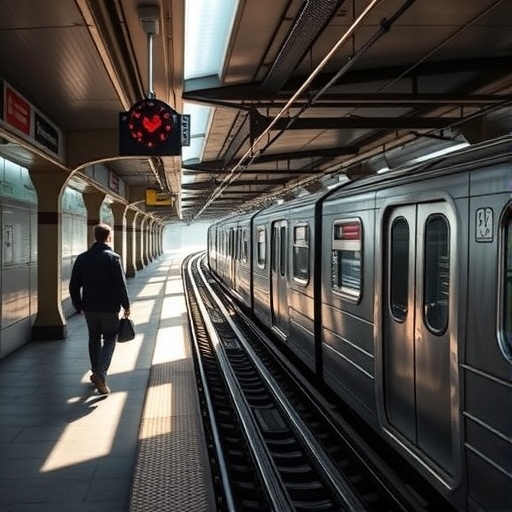
For millions of commuters around the globe, the start of the daily grind is more than just stepping onto a train; it is an immersion into an underground environment that is increasingly challenging due to rising subterranean temperatures. A groundbreaking study spearheaded by Northwestern University researchers reveals that subway riders in major metropolitan cities such as Boston, London, and New York routinely endure uncomfortable, and at times hazardous, heat beneath the surface. This research pioneers the use of vast crowdsourced data, moving beyond traditional surveys, to quantify and analyze thermal discomfort within underground metro systems over a sixteen-year period.
Unlike typical thermal comfort studies that depend on costly and fleeting survey snapshots, the Northwestern team leveraged the digital age’s treasure trove of real-world feedback. By systematically scraping and analyzing over 85,000 social media posts and online review comments published between 2008 and 2024, they extracted a meaningful narrative of how underground temperatures affect commuter well-being. These comments were filtered using sophisticated natural language processing techniques to precisely identify expressions of thermal discomfort, excluding irrelevant mentions of words associated with heat. The result was a robust dataset of over 22,000 validated complaints that paint a temporal and spatial map of heat-related distress in subway environments.
The overarching pattern derived from this extensive data reveals a clear correlation: as above-ground temperatures climb, thermal complaints underground rise sharply. Specifically, for each degree Celsius increase above 10°C, the rate of complaints surged by 10% in Boston, 12% in New York, and a striking 27% in London. These figures underscore the intensification of heat stress commuters face during summer months, with peaks in complaints aligning closely with known heatwave events in 2018 and 2019. Interestingly, even in colder seasons, many commuters voiced discomfort, likely due to heavy clothing becoming an encumbrance once they descend into warmer subterranean spaces.
The persistence of heat underground is intrinsically tied to the physical properties of the urban environment. Urban heat islands, a well-documented phenomenon characterized by metropolitan areas being significantly hotter than their rural surroundings, extend their influence below ground. Contrary to what some might assume, heat does not simply dissipate beneath the city surface; it is trapped. The insulating effects of soil and rock effectively retain warmth, which can lead to temperatures underground exceeding those recorded above, as evidenced by the London Underground reaching alarming highs of 47°C (116°F)—temperatures surpassing the city’s highest surface air measurements.
This subterranean heat accumulation is exacerbated by anthropogenic activities. Every braking train releases substantial frictional heat, lighting systems emit additional warmth, and the human bodies themselves contribute to the thermal load. Moreover, solar heat penetrates the ground and tunnels, compounding the problem. The study’s authors stress that while these factors are human-induced, they also possess the agency—and responsibility—to address and ameliorate these conditions to safeguard public health and infrastructure longevity.
Temporal dynamics also influence the perception and reporting of thermal discomfort. The analysis uncovered consistent peaks in complaints during particular times of the day—late afternoon in London and both midday and late evening in Boston and New York. Additionally, weekends saw a drop in thermal distress reports, suggesting that the social context, including crowd density and commuter mindset, plays a significant role in shaping thermal perception. These findings imply that heat mitigation strategies in metro systems cannot be monolithic but must consider these temporal and social variables to be both effective and energy-efficient.
The health implications stemming from prolonged exposure to extreme subterranean heat are profound. Beyond mere discomfort, elevated temperatures underground present public health risks, as extreme heat events are now known to cause more deaths annually than any other natural hazard combined. Moreover, infrastructure itself is jeopardized by heat-induced stresses. Elevated temperatures can lead to deformation of rail tracks, accelerated wear and tear of mechanical components, and disturbances in groundwater systems, all of which threaten the safe and reliable operation of metro transit networks.
In light of these challenges, the Northwestern research team advocates for enhanced monitoring and transparency of underground environmental conditions. There is a critical need to expand public datasets capturing temperature, humidity, and air quality in subterranean transportation systems globally. These datasets would empower urban planners, engineers, and transit agencies to design informed, adaptive strategies that anticipate and respond to thermal stresses brought about by climate change, urbanization, and increasing ridership.
One of the most compelling aspects of this study is its demonstration of how crowdsourced data can revolutionize urban environmental monitoring. By tapping into commuters’ digital expressions of discomfort, researchers gain access to continuous, large-scale, and detailed thermal experience data without the prohibitive costs of traditional methods. This approach could be adapted to other cities worldwide, providing a scalable model for integrating social data streams into urban climate resilience planning.
The research also provides actionable insights into crafting more targeted, energy-conscious interventions. For instance, increasing the operation of ventilation fans or cooling systems only during peak discomfort times—identified through complaint analysis—can enhance commuter comfort without unnecessary energy expenditure. This precision in cooling strategy not only conserves resources but also aligns with broader sustainability goals critical for cities grappling with climate change impacts.
Ultimately, the study underscores a sobering reality: the underground is heating up due to human activity and environmental pressures, and this trend carries significant ramifications for urban mobility and public health. By harnessing the voices of commuters and embracing innovative data analysis methods, the researchers illuminate pathways toward resilient and comfortable metro systems. Their work, soon to be published in the journal Nature Cities, adds a vital dimension to our understanding of urban heat dynamics and highlights the urgency of addressing subterranean thermal conditions as a component of holistic climate adaptation strategies.
In summary, as cities grow hotter above ground, the subterranean transit world is becoming an increasingly challenging environment. This comprehensive study not only quantifies the scale of underground thermal discomfort but also opens doors to leveraging modern data techniques for real-world solutions. It is a call to action to rethink how we design, operate, and adapt our metro systems in the face of escalating urban temperatures, forging a future where underground travel is both safe and comfortable.
Subject of Research: Thermal discomfort and heat stress in urban underground metro systems
Article Title: Thermal discomfort in urban underground metro systems
News Publication Date: 10-Mar-2026
Web References: DOI: 10.1038/s44284-026-00404-4
Keywords: Mass transit, Transportation engineering, Underground construction, Sociological data, Architecture, Climate change, Global temperature, Heat waves


